Developing talent who will pioneer the future
Toward a better, brighter future
Executive Vice President for Education Noriyuki Wakabayashi x Executive Vice President for Education Hidetoshi Sekiguchi
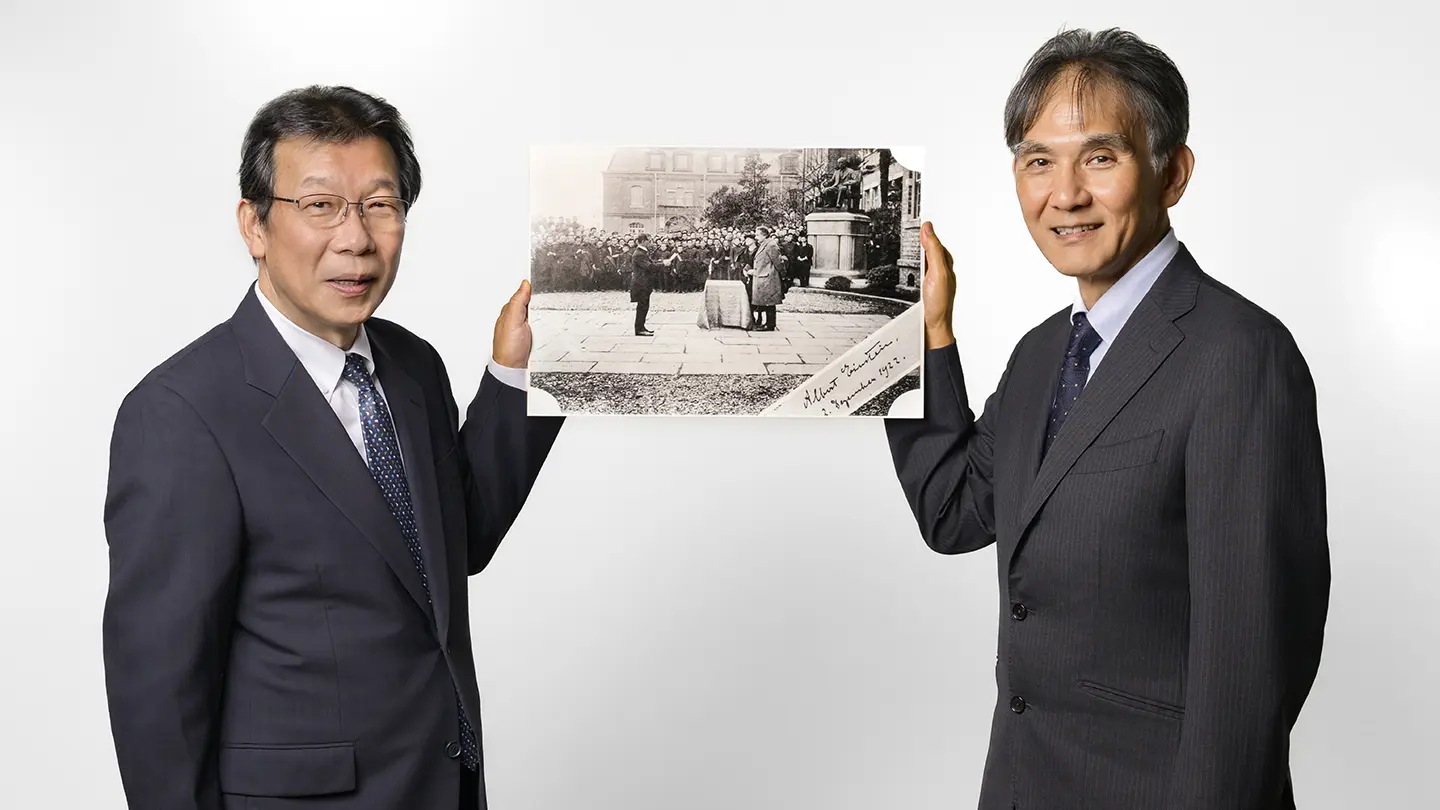
One year has passed since the establishment of Institute of Science Tokyo (Science Tokyo). Executive Vice Presidents Wakabayashi and Sekiguchi, both at the forefront of educational reform, discussed the direction and future of university education, including the Visionary Project, the quota system for female students, and global collaboration.
Experiencing campus integration: The success of Ookayama Day and the Visionary Project
Sekiguchi One year has passed since the establishment of Science Tokyo, and several educational initiatives have left a strong impression.
Wakabayashi One major topic is the Visionary Project. This is a humanities and social science course taken by first-year students on Ookayama Day. Every Monday in April and May, all medical and dental students from the Yushima Campus came to Ookayama Campus to study on Ookayama Day. For the Visionary Project held on that day, approximately 1,400 students, including those from science and engineering, were divided into 14 groups to discuss the same topics. Science Tokyo believes that having students work together on a common project early in their undergraduate studies helps them develop broader perspectives through exposure to diversity, enriching their future work and lives. I heard from faculty members involved in the Visionary Project that the results exceeded expectations. Preparing for the Visionary Project must have been a significant challenge for the faculty members involved. We are now exploring how best to share various subjects and classes across the Institute, beyond the boundaries of individual disciplines. The challenges identified through the Visionary Project will provide valuable insights for future courses.
Sekiguchi It is impressive that faculty were able to overcome challenges with timetables and inter-campus travel to implement the Visionary Project this year. Further coordination and discussion will be needed to expand the project by 2028, when the current first-year students become fourth-year students. I believe the Visionary Project will serve as a catalyst for paving the way toward uniting the two former universities. Executive Vice President Wakabayashi, you have many opportunities to interact with students from both of the former universities. What do you see as the main differences in their characteristics?
Wakabayashi Both science and engineering students and medical and dental students are undoubtedly excellent, though the nature of their excellence differs slightly. Last year, I joined a group discussion with science and engineering students in one program, and the following week, I happened to have a similar discussion with medical and dental students. The science and engineering students were very happy to talk about their research. They also asked me questions about my own specialty of dental research. By contrast, the medical and dental students eagerly asked about my career path, perhaps because I myself come from a medical and dental background. Both groups are excellent students; however, perhaps they differ between those who are immersed in their current research and want to pursue that interest going forward, and those who want to further solidify the future direction they have already decided.
Sekiguchi Medical and dental students tend to reflect on themselves objectively, which may explain why they asked about your career path.
Wakabayashi What I am about to say is a generalization that does not apply to all students. However, students in the School of Medicine tend to think about what they want to accomplish in the next few years; for example, obtaining a medical license after graduation, doing two years of clinical and basic training, and then branching out to specialize and obtain a specialist license. On the other hand, science and engineering students simply want to discuss how much they enjoy their current research theme.
Sekiguchi In terms of the overall structure of the education program, we are thinking about how we can bring first-year and undergraduate education together across both departments. However, we are encountering limits. Even with a new educational philosophy, each department and faculty has its own policies, and the medical and dental curriculum is very strict. Currently, we are trying to find a way to realize a more horizontal education program.
Wakabayashi For some time now, there has been talk of actively encouraging mutual enrollment, including in specialized subjects, so that students can become familiar with each other's studies in a complementary manner. However, a specialized curriculum will not be implemented until the 2028 academic year at the earliest. We have only just begun implementing the Visionary Project. In the future, our goal is not only to have students take each other's courses, but also to start new courses related to medical and engineering collaboration, as well as classes and courses that are not available at other universities. Ultimately, we hope that these initiatives will spread to other universities as well.
Sekiguchi In 2024, we released a student survey that examined student feedback and satisfaction. Although the survey only covered the science and engineering departments, it reflected a variety of opinions. President Tanaka found the survey extremely meaningful. The former Tokyo Tech had administered this survey for some time, and President Tanaka indicated his intention to expand it to the medical and dental departments as well.
Wakabayashi It is great to receive specific feedback on student satisfaction.
Sekiguchi We have been putting a lot of effort into supporting students. For example, our Peer Supporter consultation services are run by students for students. They offer intensive sessions for new students to discuss various aspects of university life, including course selection. We also hold departmental consultation sessions when first-year students are considering which department to join.
Wakabayashi Compared to the Yushima Campus, the Ookayama Campus has more open space and greenery. This makes it closer to the image of a "university campus" as envisioned by most people. Medical and dental students who usually study on the Yushima Campus in downtown Tokyo seem to enjoy coming to the Ookayama Campus. I heard some of those students remark that they were sad that the Visionary Project ended in May.
Sekiguchi I heard the same thing. I think it was students from the School of Medicine. They said there was a lot of greenery at Ookayama and that it was the archetype of a university campus. They said that compared to Yushima or Konodai Campus, coming to Ookayama made them feel like university students.
Taking the initiative to learn and change society — Future human resources cultivated by VIs
Wakabayashi
Based on the concept of Visionary Initiatives (VIs), research outcomes must connect with the resolution of social issues and contribute to the advancement of humanity. To achieve this, it is essential that the leading role be taken not by the current faculty, but by the students who are embarking on their studies and the faculty members and researchers of the future. Therefore, from the outset, we envisioned that VIs would be incorporated into education and that education itself would be carried forward on that basis.
At traditional universities and graduate schools, the basic approach is to have students advance their research while studying with a particular professor and the corresponding laboratory. While this type of education under a research supervisor has its merits, some students may become interested in an entirely different research field and want to pursue their own research theme while studying multiple fields of expertise. In my opinion, the ideal would be a framework in which students themselves can take the lead in shaping their own studies or even in creating the curriculum.
Students who advance to the specialized program have already studied a wide range of subjects in the undergraduate program. Of course, it is valuable for such students to pursue their research in greater depth. At the same time, it is worthwhile for them to deviate from the prescribed route and explore different fields of study. I hope that such researchers will create new academic fields and subjects.
Sekiguchi VIs originated from the concept of further expanding integrated education in science and engineering and developing more interdisciplinary courses. Originally, the medical and dental sciences lacked such an approach. However, we decided to establish a guidance framework that would encompass medical and dental sciences together with science and engineering in an integrated manner. The idea behind this initiative was to create a system where students can receive guidance from a variety of people, rather than being divided into vertical sections. Such a structure makes it possible to tackle major issues like societal challenges. The challenge going forward will be how to institutionalize this style of learning. We must also properly expand our interdisciplinary graduate majors, provide guidance to students while conducting research, and achieve tangible results as part of VIs. For this reason, I feel both excitement and concern about how the system should be designed.
Wakabayashi Regardless of the initial concept, I would like to create a system that will benefit those who will study and conduct research in the future, in other words, a system designed for students.
Sekiguchi For example, when the Massachusetts Institute of Technology (MIT) communicates its results to society, its international approach is completely different from that of Japanese universities. In this way, the method used to communicate the results of VIs to the world is also very important.
Wakabayashi The method of communicating results is slightly different from the method of promoting VIs itself. After all, VIs is an initiative that works in the background. Ideally, innovation would emerge first, and then interested parties looking into it would discover that Science Tokyo has an initiative called VIs in place. The outcomes of VIs do not necessarily have to be products or inventions; for example, they can also include ways of thinking. The two merged universities were originally based on practical learning. Therefore, I would be pleased if people came away with the impression that Science Tokyo is an educational institution that nurtures individuals who work hard and think for the benefit of society, reaching every corner of the world. Rather than promoting our university as a prestigious institution, I would like people to praise the quality of human resources it produces.
From consideration to value — The future of education paved by a quota system for female students
Wakabayashi As part of education reform, we introduced a quota system for female students in the undergraduate admissions for the science and engineering program from this academic year. The system has attracted attention throughout Japan, and we have also been interviewed by major newspapers and other media outlets.
Sekiguchi It certainly has attracted a lot of attention. We carefully designed the quota system as a recommendation-based selection system that is open to female students who wish to apply. Specifically, its main focus is promoting diversity and unearthing potential.
Wakabayashi One distinguishing feature of this voluntary entry system is that it respects the initiative of applicants. We also believe it is important to clearly disclose the selection criteria and process. We are confident in our high level of transparency.
Sekiguchi We have also enhanced our support system after enrollment. We place great importance on making it easier for students to learn after enrollment. For example, we have established mechanisms such as safe spaces where female students can consult with one another, Peer Support consultation services, and flexible guidance in selecting laboratories. The system is designed not merely to increase the number of admission slots for female students, but also to consider how they will continue to learn and thrive after enrollment.
Wakabayashi We hope that this system will make our campus an environment where diversity generates new ideas and value. With that goal in mind, the system does not provide special treatment to female students; rather, it offers them an opportunity to demonstrate their abilities. We hope that this will serve as the first step toward creating a valuable cycle in which projects advance through the participation of diverse individuals. We also hope that this system will become a catalyst for sustained social impact.
From bilingual to multi-scale — New developments in the internationalization of education
Wakabayashi In terms of conducting undergraduate programs in English, the former Tokyo Tech had already set a precedent with GSEP. Rather than being bound by language itself, the ideal approach is to use whichever language best suits the content. I believe that students in the near future will naturally acquire this ability to switch languages according to context.
Sekiguchi Our faculty needs to attract more international students. With that in mind, we hope to expand GSEP and establish a system that can be implemented across all departments. On the other hand, as Professor Wakabayashi mentioned, although students today generally have a basic command of English, qualifications such as medical and dental licenses in Japan are still based on Japanese. Furthermore, if we want international students to settle in Japan, we must ensure they acquire a high level of Japanese. We want to cultivate both international students who can speak Japanese and Japanese students who can speak English. Ideally, we would have a class structure where either language is acceptable, and such a structure would connect seamlessly to graduate school. The key question is how to achieve this goal.
Wakabayashi Japan's birthrate is declining. Therefore, it is important for talented international students, such as those who earn degrees at Science Tokyo, to remain in Japan and contribute to Japanese society.
Sekiguchi For example, it might work well to enroll international students in September, have them study Japanese for six months, and then start together with Japanese students in April. Such a program could also help retain international students who might otherwise go to universities outside Japan. For example, graduates can fulfill a specific need for bilingual doctors in Japan's future society.
Wakabayashi
Traditionally, it has been considered difficult — even impossible — for medical and dental schools to admit international students into undergraduate programs. However, going forward, even if international students are not fluent in Japanese upon enrollment, one viable approach would be to provide solid support after enrollment so that they can take Japan's national examinations. Even if there are only a small number of international students, they still help to internationalize the entire class. Of course, whether international students wish to remain in Japan after graduation is up to the individual, but it is very important to establish a system that provides effective Japanese-language education.
Another initiative we are preparing is to cultivate students with backgrounds in both science and engineering and medicine and dentistry from the undergraduate level. For example, students who initially enroll in the medical or dental department will undertake research training in science and engineering during their fourth year. They will step away from the standard curriculum for about six months to study the basics of research in a science and engineering laboratory, ideally up to a master's level, and then return to their medical or dental program. After becoming medical or dental doctors, they will return to a science and engineering laboratory to pursue a doctorate. We are now working to put this framework in place. Similarly, we need a system where students who enroll as science and engineering majors can go on to study medicine or dentistry.
Sekiguchi We are developing a system that will enable students to earn both a medical or dental degree and a science and engineering degree.
The value of a university lies in its people — A future created by education that fosters growth
Wakabayashi Discussions about support for doctoral students often center on the Universities for International Research Excellence. However, our goal is to establish a system that enables doctoral students to be recognized as individual researchers — essentially, as working professionals — regardless of whether they are affiliated with the program.
Sekiguchi In the science and engineering departments, we provide a range of support programs such as the Tsubame Scholarship for Doctoral Students, tuition waivers, and national scholarships. However, it is difficult for students to sustain themselves on tuition waivers alone. We are designing a system that allows students to focus on their research while receiving financial support comparable to that of those who begin working after completing their master's degree.
Wakabayashi There are already various grants available in addition to scholarships. In addition to national funding, Science Tokyo is also considering establishing its own independent support system. We hope students will look forward to these new developments.
Sekiguchi We have launched a program for master's students who aim to advance to a doctoral program in science and engineering. The program offers paid research internship opportunities along with a job offer to join the research and development division of NEC. This is just one example, but we believe it is important to expand programs that support students pursuing doctoral studies and to create more initiatives that allow them to focus on their research for three years without the need to engage in job hunting.
Wakabayashi I also think it is important to support young employees who have joined a company and want to pursue a doctoral degree in research themes that relate to their actual work.
Sekiguchi In science and engineering, there are initiatives such as collaborative research centers between large companies and universities. Under this system, young researchers employed by companies can earn doctoral degrees while continuing their professional careers.
Wakabayashi In medicine and dentistry, we are also aiming to increase the number of working professionals who earn doctorates, for example, by creating an environment that makes it easier for hospital staff to pursue degrees. It is students and young people who will shape the future. To help them make the most of Science Tokyo, many factors must come together. It would be wonderful if we could gradually move away from pre-established programs and courses that require students to take specific classes.
Sekiguchi We recently signed a strategic partnership with RWTH Aachen University in Germany. We also maintain close strategic partnerships with MIT and Harvard in the United States and Imperial College London in the United Kingdom. We will continue to deepen these collaborations to drive research and innovation and to create greater international and societal impact.
Wakabayashi I would like to further enhance systems for sending young researchers to overseas universities and research institutes. I envision a system that allows students to study abroad during their undergraduate program, go through the same process as doctoral students, and continue to be dispatched even after becoming independent researchers — in other words, providing sustained, individual opportunities for overseas research rather than one-time experiences. Such a system would serve as the basis for major projects.
Sekiguchi Imperial College London is expected to expand mutual student exchange and study abroad opportunities, particularly in the medical and dental fields. At RWTH Aachen University, there are already many students who wish to study in Japan, as well as many Science Tokyo students who hope to study in Germany. MIT is also building an environment that should lead to impactful student exchanges and overseas research in the future.
Wakabayashi Every year, Science Tokyo sends three students from the School of Medicine to Imperial College London for a one-year study abroad program. Science Tokyo covers all expenses, including living expenses. Participants earn an Intercalated BSc (IBSc) , which is an international degree equivalent to a master's degree. This is an extremely high-level course, and students come from other medical schools in the UK as well. Science Tokyo selects the three students each year through a highly rigorous selection process, focusing primarily on English proficiency. It is an attractive program for prospective students.
Sekiguchi In July, Ochanomizu University joined the three-university consortium consisting of Science Tokyo, Tokyo University of Foreign Studies, and Hitotsubashi University. Together, the four universities concluded a new charter called the Future Leading Innovation Partnership (FLIP) . Going forward, we are considering adopting a "university alliance promotion corporation" framework to achieve more effective and stable collaboration.
Wakabayashi It is particularly significant that Ochanomizu University is adding a field of study related to living spaces. We are also promoting DEI (Diversity, Equity, and Inclusion) .
Sekiguchi
It would be wonderful to bring together each university's strengths — multicultural and multilingual studies at Tokyo University of Foreign Studies, management and law at Hitotsubashi University, and medical, dental, and science and engineering fields at Science Tokyo — to create new academic fields.
As emphasized by our President and CEO Naoto Ohtake, "1 + 1 does not necessarily equal 2." By bringing together the distinctive strengths of each university, we can create a new kind of institution — one that nurtures graduates unlike any before and enables them to make meaningful contributions to society. A new chapter in the history of Science Tokyo has only just begun. Although it will still take time, we will continue moving toward our goal by creating new programs one at a time.
Wakabayashi I previously served as director of the Dental Hospital when it was still an independent institution. The most enjoyable part of my work at that time was working as a team with hospital staff, administrative personnel, and others who contributed in many ways. It was far more rewarding than working alone. Now, I am grateful to have the opportunity to work with many staff members, including those in the Student Division.
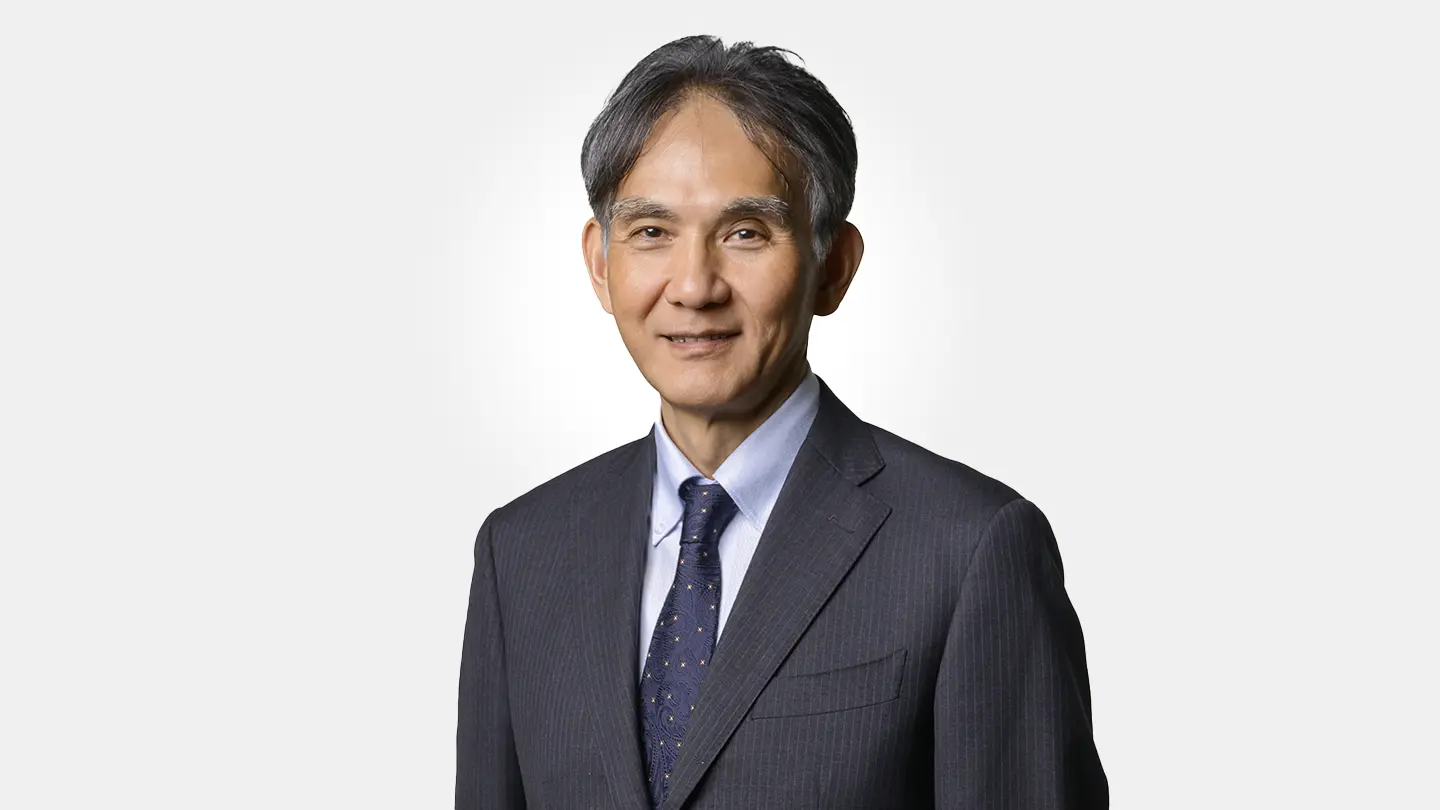
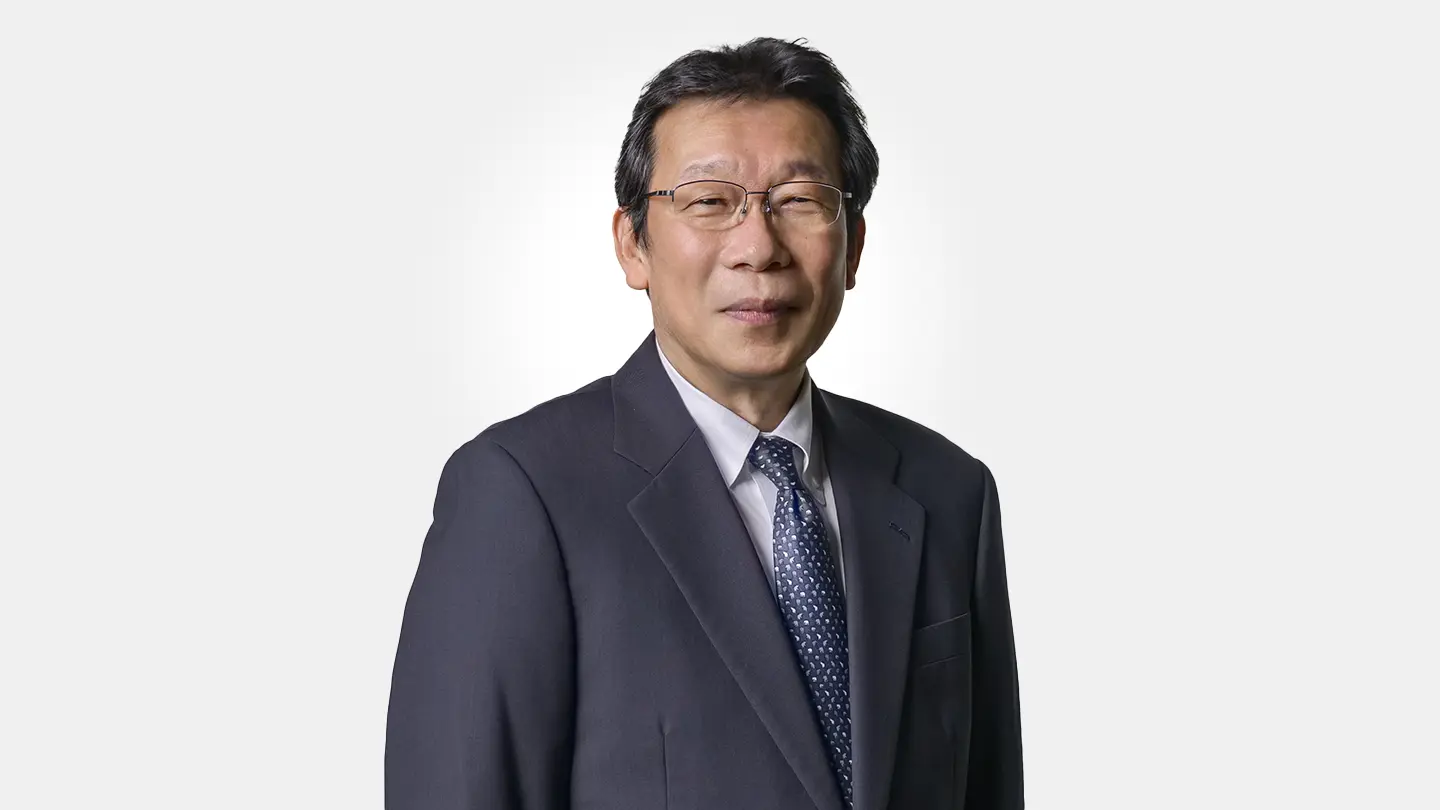
Profile
Rerated articles
Integrated Report 2025
In addition to financial data, the Integrated Report provides a comprehensive overview of Science Tokyo’s contributions to society, governance, and non-financial information for its stakeholders. The report describes the Institute’s education, research, social initiatives, and management strategies, while charting a course towards further progress.
Interview held on June 25, 2025