Smaller but stronger: a 25-nanometer memory that challenges traditional limits
A breakthrough that challenges the idea that “smaller means lower performance”
What the research is about
Have you ever noticed your smartphone getting hot after extended use, or the battery suddenly dying at a crucial moment? One reason for this is that the electronic circuits and memory inside the device draw power and produce heat.
Generally, computer memory stores information as 0s and 1s by controlling how easily electricity flows. If we could develop memory that uses very little electricity, we could greatly cut down the power consumption of smartphones and computers.
To address this problem, a new concept called a ferroelectric tunnel junction (FTJ) was introduced in 1971. This type of memory relies on ferroelectricity, a property where the direction of internal electric polarization can be reversed. Changing this polarization alters how easily current flows, enabling data storage.
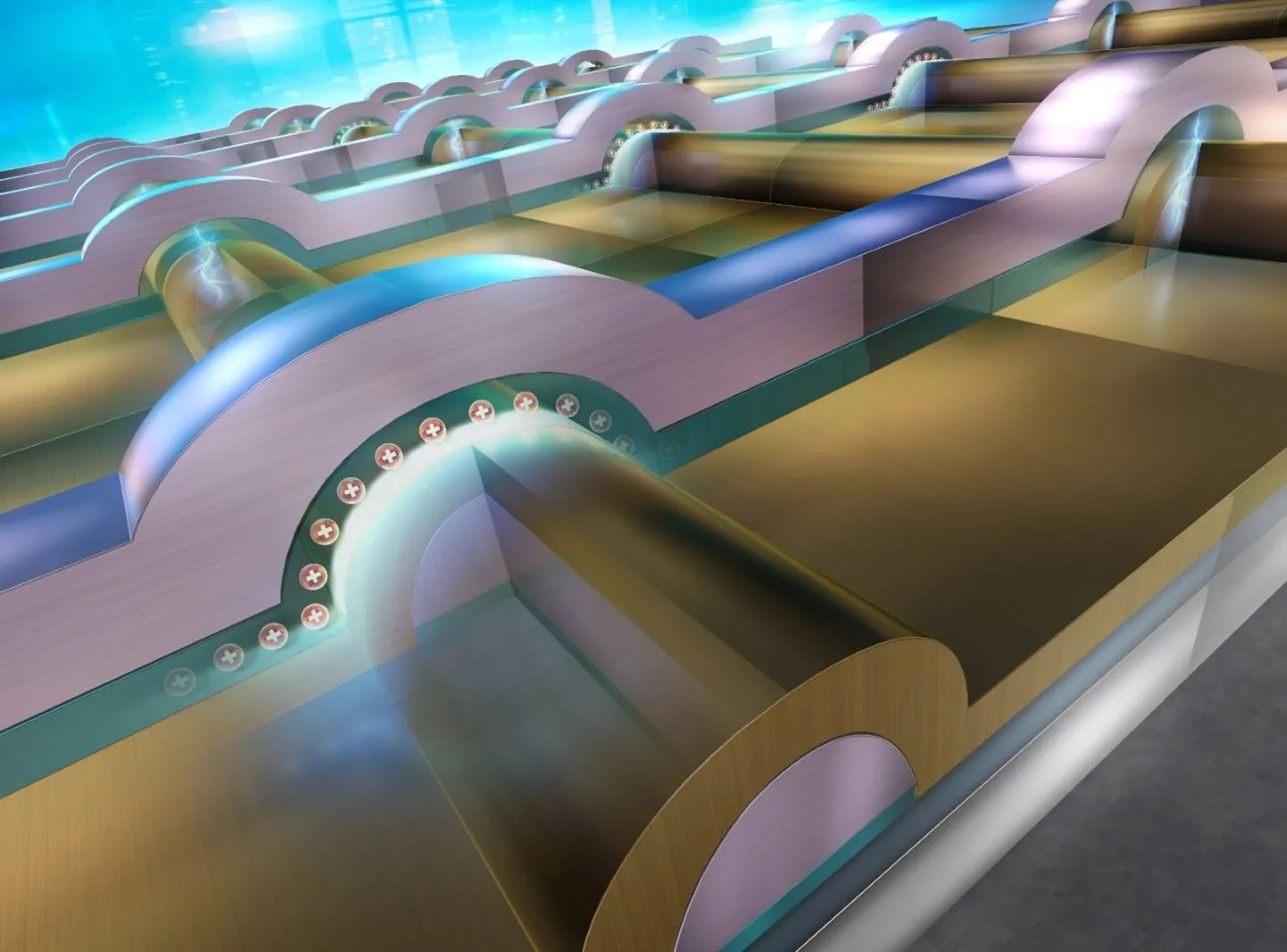
Cover artwork by Yutaka Majima. Courtesy of the Royal Society of Chemistry.
However, traditional materials had a significant limitation: as devices became smaller, their performance often declined.
A major breakthrough occurred in 2011 when researchers found that a common material called hafnium oxide could keep its electric polarization even when made very thin. Using this material, Professor Yutaka Majima and his research team at the Institute of Science Tokyo (Science Tokyo) aimed to create an ultra-small memory device just 25 nanometers wide—about one three-thousandth the thickness of a human hair.
Why this matters
When attempting to miniaturize memory devices to such an extreme scale, a significant problem emerges: current can leak through the boundaries between tiny crystals within the material. This leakage has long prevented further miniaturization. The team made a bold decision: instead of avoiding this issue, they chose to make the device even smaller, reducing the influence of these boundaries.
They also introduced a novel technique—heating the electrodes so they form a natural semicircular shape. This enabled the creation of a structure more like a single crystal, with fewer boundaries where leakage might occur.
This combination of structural design and intentional extreme miniaturization allowed the device to attain top performance. Consequently, the researchers unlocked a new possibility: memory devices that grow more powerful as they become smaller, defying traditional expectations.
What’s next
If this technology is implemented in practice, it could significantly impact our daily lives. For instance, we might see smartwatches that last for months on a single charge or numerous internet-connected sensors that operate without needing battery replacements.
In the field of artificial intelligence (AI), this memory could enable faster data processing while greatly reducing energy consumption. Because the material used is compatible with existing semiconductor manufacturing processes, this small yet powerful memory may soon be integrated into devices we use every day.
Comment from the researcher
Challenging what seem to be the limits of science—such as ‘we cannot make things any smaller’ or ‘they will break if we do’—is like walking in the dark. It is a continuous struggle. However, by questioning traditional assumptions and exploring new ways to overcome these barriers, we were able to discover an entirely new perspective. I would be delighted if this achievement sparks the curiosity of young people who will shape the future and helps build a better world.
(Yutaka Majima, Professor, Materials and Structures Laboratory, Institute of Integrated Research, Institute of Science Tokyo)

Dive deeper



Contact
Research Support Service Desk