A mechanically tunable molecular switch for circularly polarized light emission
Researchers develop an innovative platform to mechanically control an optical property essential in many next-generation technologies
A force-responsive molecular system that reversibly switches circularly polarized luminescence (CPL) on and off at the single-molecule level has been developed, as reported by researchers from Japan. The team designed a platform consisting of a supramolecular mechanophore embedded in a polymer network gel, whose CPL emission is switched via swelling with a solvent. This approach provides an accurate way to evaluate force-induced CPL and expands the possibilities for next-generation mechanically responsive optical materials.
Mechanical Control of Circularly Polarized Luminescence (CPL)
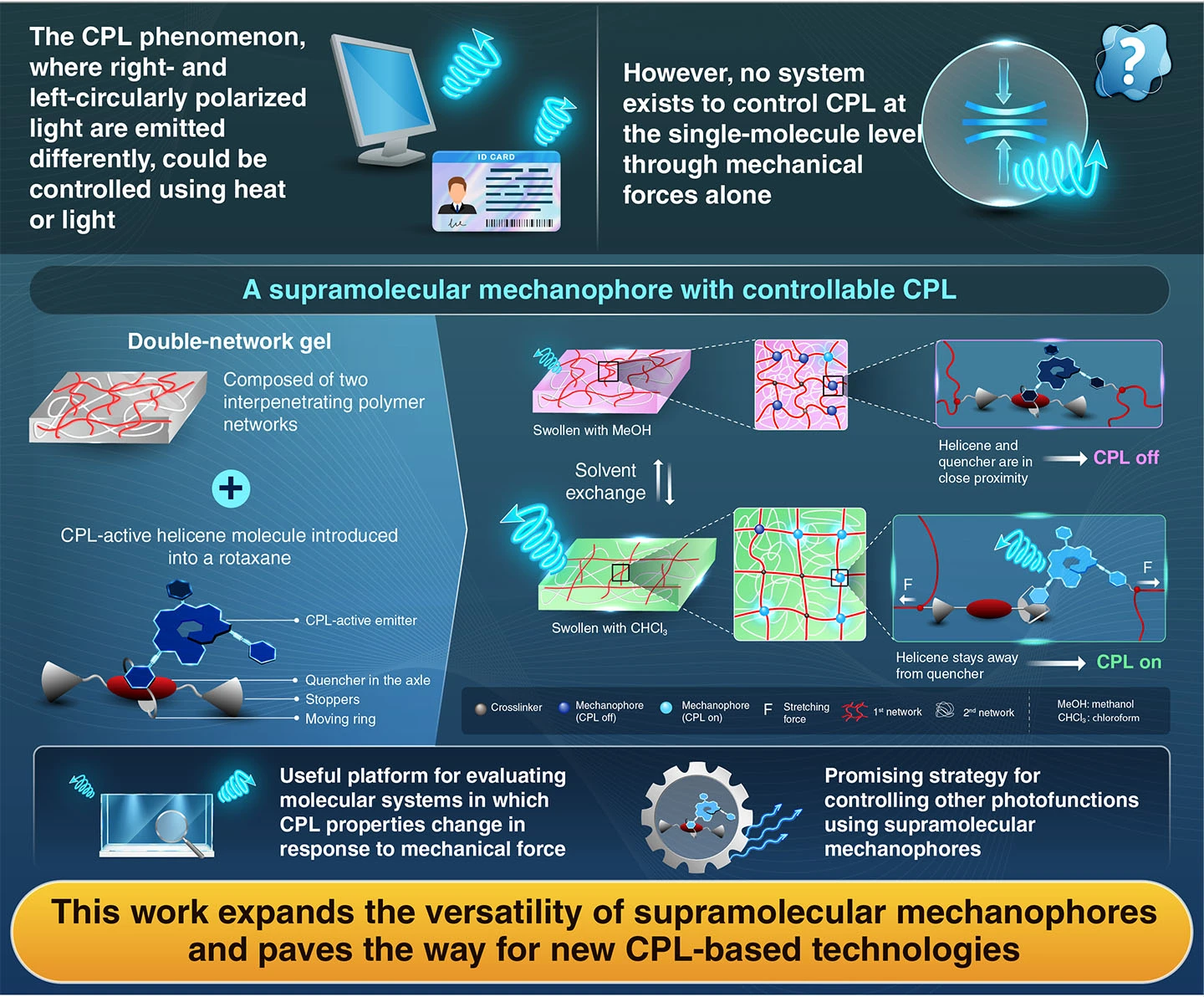
Over the past few decades, scientists have been increasingly interested in developing materials that do not simply withstand mechanical forces, but instead respond to them in useful detectable ways. For example, it is now possible to engineer materials that signal when they are under stress through changes in color or brightness. This growing domain, sometimes called mechanochromic or mechanoresponsive materials science, has found applications in structural sensors and advanced optical technology.
One optical property that researchers would especially like to control this way is circularly polarized luminescence (CPL), a type of light emission in which the emitted electric field spirals either to the left or right. This phenomenon is expected to find applications in the three-dimensional displays, anti-counterfeiting inks, biosensing, and other related technologies. While current techniques can switch CPL on and off at the molecular level using pH or chemical triggers, doing so with mechanical forces alone has remained elusive.
Now, a research team led by Associate Professor Yoshimitsu Sagara of the Department of Materials Science and Engineering, Institute of Science Tokyo (Science Tokyo), Japan, and Professor Koji Nakano of the Department of Organic and Polymer Materials Chemistry, Tokyo University of Agriculture and Technology, Japan, managed to overcome this challenge. Their latest study, published in Angewandte Chemie International Edition on July 24, 2026, reports an innovative force-responsive platform with reversible CPL.
The team designed a supramolecular mechanophore, which is a force-responsive molecule whose optical properties change when mechanical forces rearrange its structure. This mechanophore consisted of a ring threaded onto an axle without any chemical bond linking the two parts, also known as a rotaxane. The ring carried a spiral-shaped molecule that emits CPL, while the axle carried a matching quencher positioned close to its center. Left alone, the ring stayed near the quencher and the CPL stayed off. When the ring and axle were pulled in opposite directions, however, the ring slid away from the central quencher, switching the CPL on.
To apply force in a controlled manner, the team embedded these rotaxane molecules into a first network of double-network gel composed of interpenetrating polymers as the cross-linker. By swelling this network with chloroform, the polymer chains are stretched uniformly. This transmits force uniformly to the rotaxanes and, by design, pulls the ring in one direction and the axle in the other, thereby increasing the distance between them and activating CPL. In contrast, swelling the gel with methanol generates much less force, leaving the CPL switched off.
The researchers showed that this switching process could be repeated multiple times simply by alternating between the two solvents, demonstrating that the molecular system responds reversibly without breaking any chemical bonds. Moreover, this gel-swelling approach enabled accurate measurement of CPL originating from individual molecules while avoiding any interference from the orientation of the bulk material. “We expect the CPL evaluation method established in this study to become a general approach for evaluating any molecular system whose CPL properties change in response to mechanical force,” remarks Sagara.
Beyond demonstrating the first example of force-controlled CPL switching at the single-molecule level, this study also expands the versatility of supramolecular mechanophores. “Our work could facilitate the control of other photofunctions using supramolecular mechanophores and promote the future expansion of the supramolecular mechanophore library,” says Sagara.
Overall, the proposed approach provides researchers with a versatile platform for designing new mechanically responsive optical materials and for studying force-dependent luminescence-emitting systems with greater accuracy. In the near future, this could open new possibilities for next-generation sensing and photonic technologies.
Reference
- Authors:
- Keigo Nonaka1, Takumi Kuroda1, Kota Masuda1, Toshiki Nishitani1, Masaki Enokido2, Makoto Tsurui2, Yuichi Kitagawa3,4, Yasuchika Hasegawa3,4, Keiichi Noguchi5, Koji Nakano6*, and Yoshimitsu Sagara1,7,*
*Corresponding authors - Title:
- Force-induced Control of Circularly Polarized Luminescence with Rotaxane Architecture
- Journal:
- Angewandte Chemie International Edition
- DOI:
- 10.1002/anie.9590374
- Affiliations:
- 1Department of Materials Science and Engineering, Institute of Science Tokyo, Japan
2Graduate School of Chemical Sciences and Engineering, Hokkaido University, Japan
3Faculty of Engineering, Hokkaido University, Japan
4Institute for Chemical Reaction Design and Discovery (WPI-ICReDD), Hokkaido University, Japan
5Instrumentation Analysis Center, Tokyo University of Agriculture and Technology, Japan
6Department of Applied Chemistry, Tokyo University of Agriculture and Technology, Japan
7Research Center for Autonomous Systems Materialogy (ASMat), Institute of Science Tokyo, Japan
Related articles
Further information
Associate Professor Yoshimitsu Sagara
School of Materials and Chemical Technology, Institute of Science Tokyo
- sagara@mct.isct.ac.jp
Contact
Public Relations Division, Institute of Science Tokyo
- media@adm.isct.ac.jp
- Tel
- +81-3-5734-2975