Student Volunteer Group (VG) holds workshop on emergency food with Kitmee
To raise disaster prevention awareness among students, the Science Tokyo Student Volunteer Group (VG) and Kitmee* presented an “Emergency Food Workshop” on October 17 in the B2 Workshop Room at Hisao & Hiroko Taki Plaza. The event focused on the concepts of “phase-free” and long-term food storage to preserve food for emergencies, and the Safety Planning Group of the Environmental Safety Division lent support by providing emergency food supplies that were approaching their expiration dates.
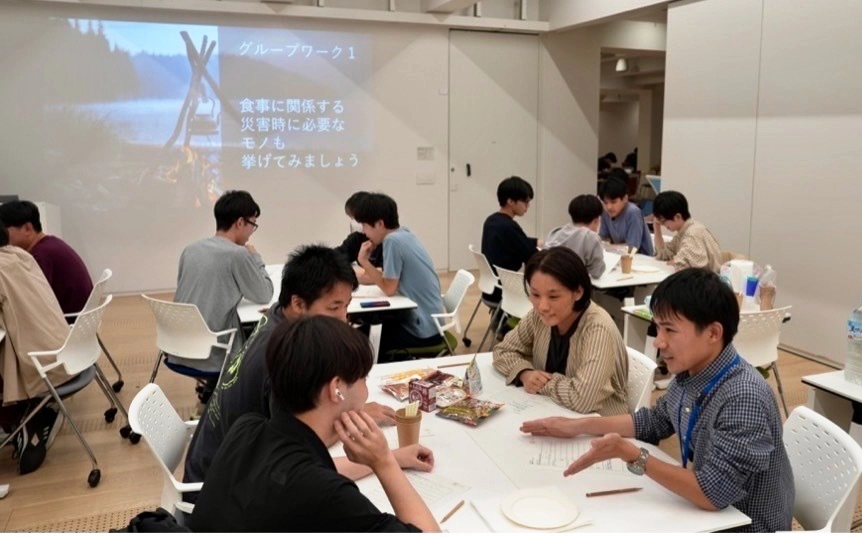
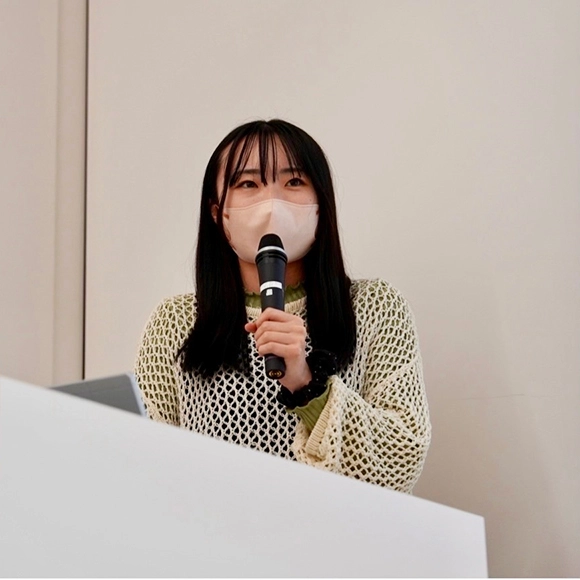
Twelve Science Tokyo students took part in the workshop, which was led by VG member Miyu Jimbo, a first-year bachelor’s student in the School of Engineering. Participants were first split into four groups, and asked to discuss what comes to mind when they think of essential emergency food, what supplies are needed in such situations, and aspects such as taste, nutrition, and preparation methods. VG members facilitating each group then explained the specific emergency food items that should be on-hand for potential disasters (e.g., three liters of water per person per day, rice, canned goods, etc.), as well as other items needed for meals (paper plates, paper cups, disposable chopsticks, portable gas stove, plastic wrap, aluminum foil, etc.).
The workshop next invited the students to actually sample some emergency food, which included both dehydrated and freeze-dried rice, as well as a range of items with a five-year shelf life: bread, nikujaga stew, hamburger steak, and sweet bean jelly. As they tasted each item, students were encouraged to adopt the perspective of someone affected by a disaster and share their thoughts about questions like, “What kinds of foods are easy to eat?”, “What kinds of preparation methods are available?”, and “Is this flavor palatable enough to keep eating it throughout an evacuation?”
After the tasting, VG members introduced key considerations for selecting emergency food supplies, such as taste, lasting appeal of the flavor, nutrition, shelf life, weight, need for utensils, and allergens. The students then reconvened their groups to discuss the most important factors when choosing emergency food, their emergency food preferences, and what foods are best suited for emergency situations before presenting their ideas to the other groups.
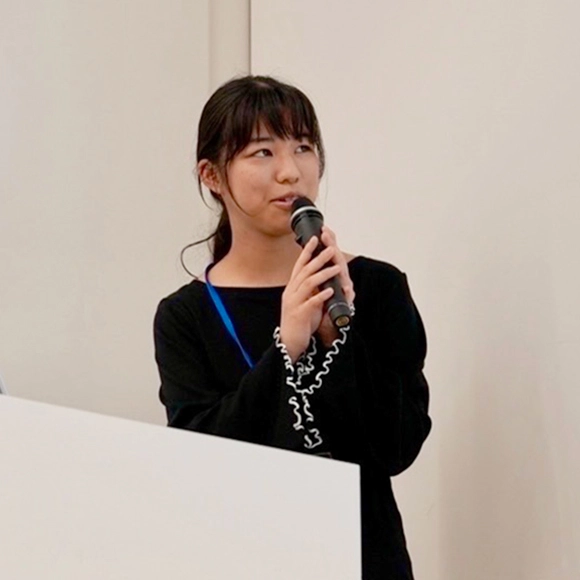
At the end of the session, Mai Watanabe, a first-year master’s student in Urban Design and Built Environment in the School of Environment and Society, addressed the participants on behalf of Kitmee . She introduced the concept of “phase-free” – an approach that does not separate daily life from disaster situations, but rather incorporates thoughtful design into everyday life so that it can be utilized during disasters – and highlighted several phase-free products and initiatives being implemented in local communities.
This event gave the participating students and VG members alike an opportunity to discuss preparing for disasters, the mindset needed to protect lives, and the value of incorporating these concepts into daily life, helping them gain a deeper awareness and appreciation of disaster preparedness.
For its part, VG plans to continue developing various initiatives related to disaster recovery and prevention.
Participant comments (Partial Excerpt):
- It was good to try preserved foods I don’t usually eat. Since a major earthquake could strike at any time, I remembered how important disaster preparedness is.
- I didn’t know much about emergency food supplies and had imagined something like the biscuits we got at school, so I was very surprised to find these items suitable for the dinner table.
- I realized easy-to-eat items like sweet bean jelly and bread might be important as emergency food supplies.
- I learned a lot through actually tasting various emergency foods and interacting in groups.
- I enjoyed trying various emergency food supplies; it was very informative.
- It was fun trying all the different foods!
Comment from the organizing members:
Kitmee:
Guided by the concept of realizing a ‘phase-free’ society where “everyday preparedness creates a safety net for emergencies,” the Kitmee Project is a team that engages in disaster prevention activities both on and off campus, conducting disaster drills, exhibiting phase-free goods at Taki Plaza, and developing a phase-free app for use at Science Tokyo.
Related links
- Documentary film “LIGHT UP NIPPON” screened at Science Tokyo (Japanese)
- Five students receive 2024 Tokyo Tech Award for Student Leadership | Science Tokyo
- Tokyo Tech Volunteer Group leads tour to areas hit by Great East Japan Earthquake | Tokyo Tech News | Tokyo Institute of Technology
- Student Support Center (Ookayama Campus) (Japanese)
- KITMEE Instagram page (Japanese)
Inquiries
- Remarks
- Student Success Support Section, Student Support Center (Student Initiative Support Service)
TP-005 (Taki Plaza B1 Floor), Institute of Science Tokyo, 2-12-1, Ookayama, Meguro-ku, Tokyo 152-8550
Email: st-initiativesupport@ssc.isct.ac.jp
Tel: 03-5734-7629