Making polymers fluoresce with stress
Researchers use a simple blending strategy to enable reversible mechanochromism in block copolymers without modifying their original mechanical properties
A simple blending strategy used by researchers at Institute of Science Tokyo can give existing block copolymers the ability to visibly respond to mechanical stress. By selectively localizing a mechanophore-containing polymer within the hard domains of styrene–butadiene–styrene block copolymer, the team enabled reversible fluorescence during stretching while preserving the material’s mechanical properties. The approach offers a practical route to adding stress-sensing functions to existing polymer materials without modifying their chemical structure.
Turning Rubber into a Stress-Responsive Material
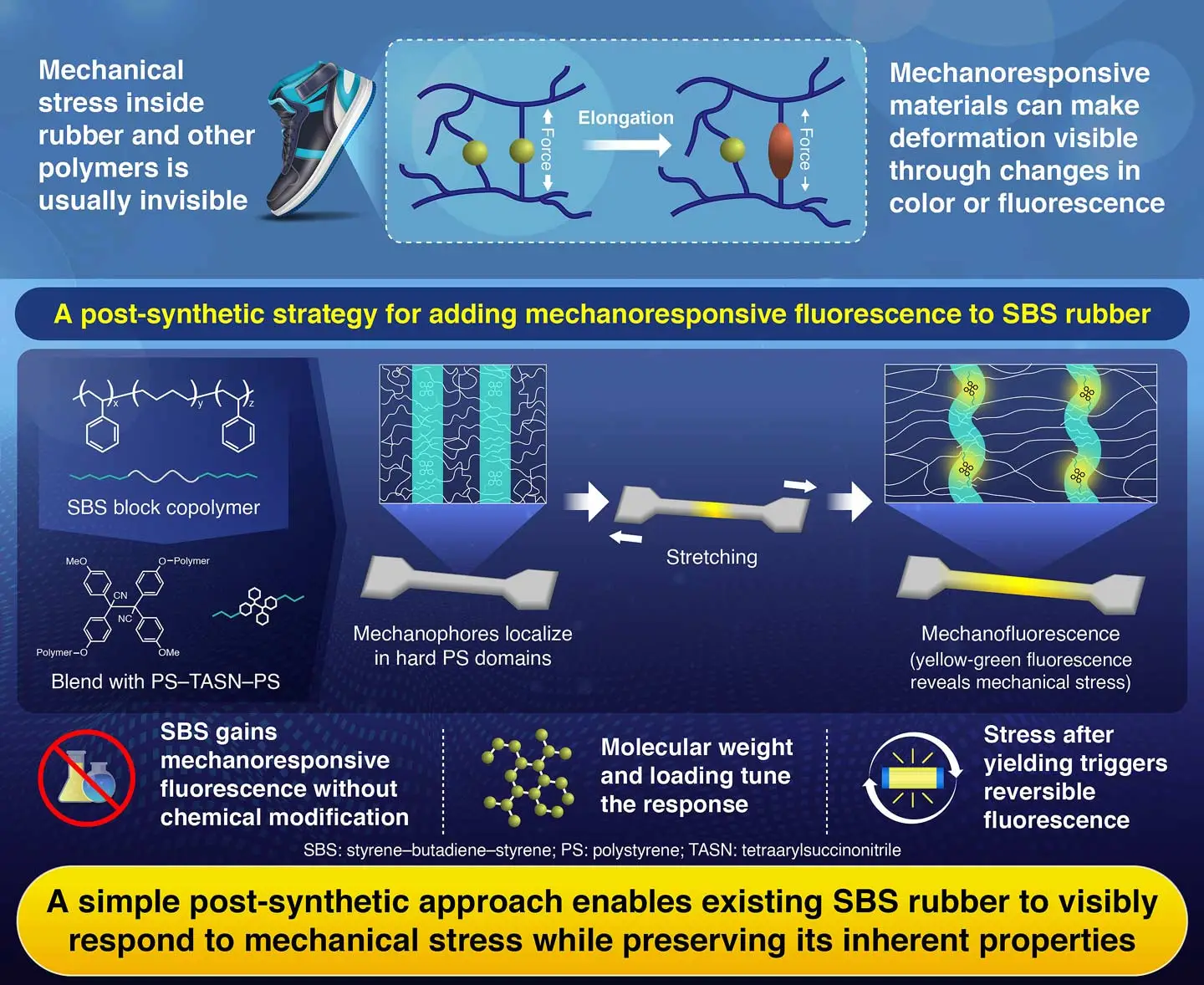
Polymeric materials, such as plastics and rubbers, are essential in everyday life. However, detecting where mechanical stress is concentrated inside them remains a challenge. Materials that can visibly indicate stress or damage could help improve the safety, reliability, and lifetime of polymer-based products. This has driven a growing interest in mechanoresponsive materials that change their optical properties when subjected to mechanical force.
In this context, a research team from Institute of Science Tokyo (Science Tokyo) in Japan, led by Professor Hideyuki Otsuka, along with Dr. Kuniaki Ishizuki and Assistant Professor Akira Takahashi, developed a simple post-synthetic strategy for adding stress-responsive fluorescence to an existing polymer. Their study, published online in the journal Advanced Materials on 17 August 2026, demonstrates that blending a mechanophore-containing polymer with styrene–butadiene–styrene (SBS) block copolymer can produce reversible fluorescence when the material is stretched without chemically modifying the original polymer.
Conventional mechanoresponsive polymers typically require mechanophores, which are mechanically responsive molecular units. These are incorporated directly into the polymer during synthesis. But while this approach enables precise control over the material’s response, it may require complex synthesis pathways and may not be readily applicable to widely used polymers. Finding different ways to introduce mechanoresponsive functionality after synthesis could therefore make these smart materials easier to develop and use.
The researchers addressed this challenge by taking advantage of the microphase-separated structure naturally formed by SBS. SBS is a block copolymer, a type of polymer made by joining different polymer segments into distinct blocks. SBS contains rigid polystyrene (PS) domains dispersed within softer polybutadiene domains, giving the material both hard and flexible regions. The team synthesized PS containing a tetraarylsuccinonitrile (TASN) mechanophore and blended it with commercially available SBS. Because the added polymer has the same chemical composition as the PS domains in SBS, it selectively localizes within these rigid regions of PS through microphase separation. This arrangement allows mechanical stress to be efficiently transferred from the surrounding polymer to the mechanophores without chemically altering the host material.
“By using the existing microphase-separated structure of a block copolymer, we found a simple way to introduce mechanoresponsive functionality without the need for redesigning the original polymer,” says Otsuka.
When the resulting material is stretched, the mechanical force causes the TASN mechanophore to undergo a bond cleavage, generating highly fluorescent diarylacetonitrile radicals. Under ultraviolet light, these radicals produce a distinct yellow-green fluorescence, making the otherwise invisible mechanical response observable. Experiments confirmed that the SBS blend films containing the mechanophore showed clear fluorescence after tensile deformation, while unmodified SBS did not. The fluorescence therefore provides a direct visual signal of mechanical activation within the polymer.
Additionally, the team also found that the fluorescent response could be tuned by changing the amount and molecular weight of the mechanophore-containing polymer, while the resulting blends preserved or, in some cases, enhanced the mechanical properties of SBS. The response was also reversible: the fluorescence faded as the mechanically generated radicals recombined and reappeared when the material was stretched again after a 24-hour relaxation period. Further experiments showed that mechanochemical activation increased after the material reached its yield point, indicating that mechanical stress was increasingly transferred to the rigid PS domains during deformation.
“The microphase-separated structure of a block copolymer can serve as an effective pathway for transferring mechanical force to functional molecules. By matching the molecular characteristics of the added polymer to the existing domains, we can introduce a new function while maintaining the original properties of the material,” comments Otsuka.
This innovative post-synthetic strategy offers a practical route to adding stress-sensing functions to existing polymer materials without extensive chemical modification. In the future, the approach could be extended to other phase-separated polymers and functional molecules, opening possibilities for smarter materials that can visualize mechanical stress and damage.
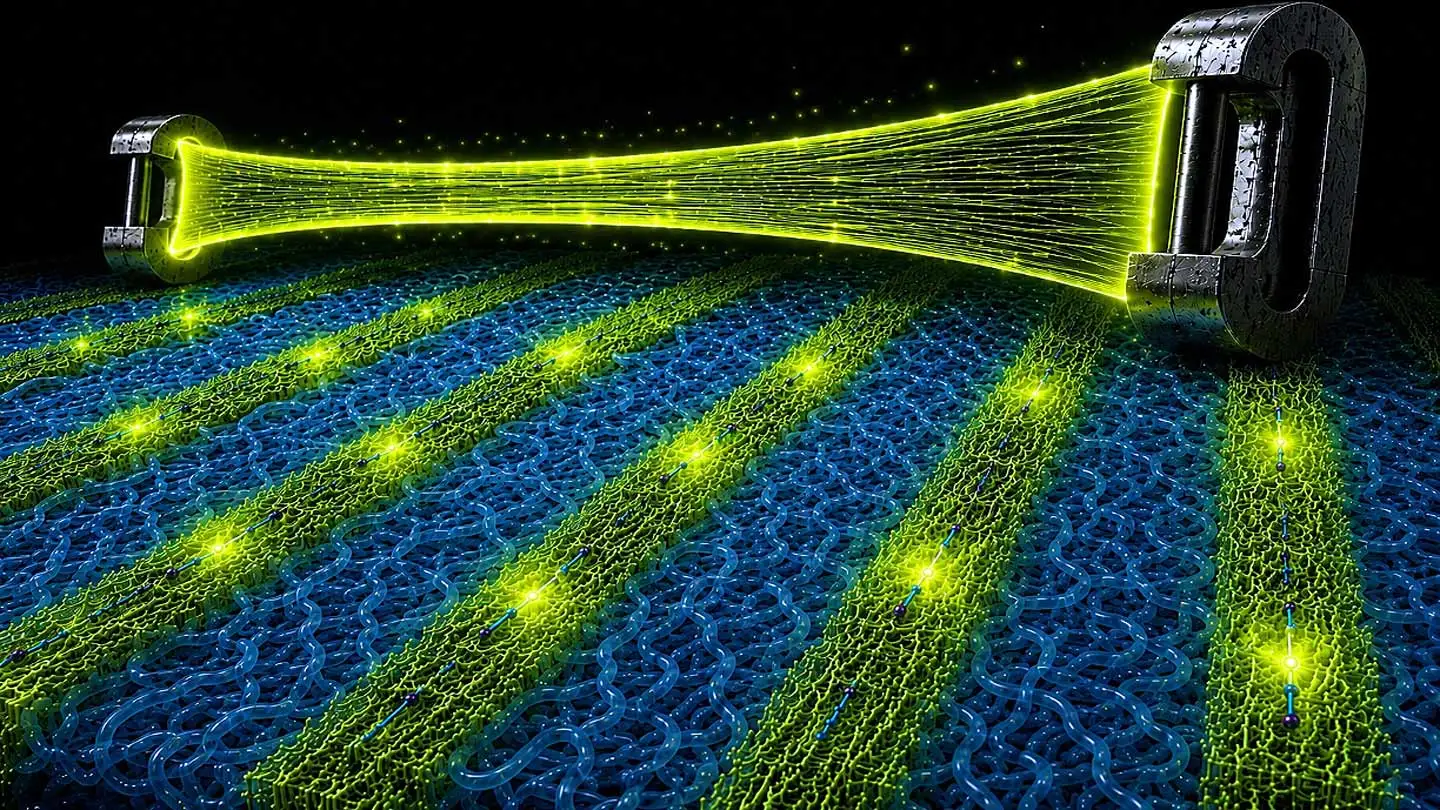
Image caption: Illustration of a styrene–butadiene–styrene polymer material being stretched and emitting yellow-green fluorescence in response to mechanical stress.
Image credit: Institute of Science Tokyo, Japan
License type: Original Content
Usage restrictions: For use in scientific news only. Attribution is required. The image may not be modified in ways that alter its meaning or context

Image caption: Researchers developed a post-synthetic blending strategy that enables existing block copolymers to visibly respond to mechanical stress.
Image credit: Institute of Science Tokyo, Japan
License type: Original Content
Usage restrictions: For use in scientific news only. Attribution is required. The image may not be modified in ways that alter its meaning or context
Reference
- Authors:
- Kuniaki Ishizuki1, Akira Kodaka1, Akira Takahashi1, Hideyuki Otsuka1,2
- Title:
- Stress Transfer within Microphase-Separated Structures: A Post-Synthetic Strategy to Impart Mechanoresponsiveness to Block Copolymer Materials
- Journal:
- Advanced Materials
- DOI:
- 10.1002/adma.74610
- Affiliations:
- 1Department of Chemical Science and Engineering, Institute of Science Tokyo, Japan
2Research Center for Autonomous Systems Materialogy (ASMat), Institute of Science Tokyo, Japan
Related articles
Further information
Professor Hideyuki Otsuka
Department of Chemical Science and Engineering, Institute of Science Tokyo
- otsuka@mct.isct.ac.jp
Contact
Public Relations Division, Institute of Science Tokyo
- media@adm.isct.ac.jp
- Tel
- +81-3-5734-2975