Unveiling a novel and durable mechanoresponsive material
Researchers develop a versatile mechanophore that glows when mechanically stressed and avoids false warnings from heat and UV
A newly designed robust mechanophore provides early warning against mechanical failure while resisting heat and UV, report researchers from Institute of Science Tokyo. They combined computational chemistry techniques with thermal and photochemical testing to show that their mechanophore scaffold, called DAANAC, stays inert under environmental stress yet emits a clear yellow signal when mechanically activated. This could pave the way for smart, self-reporting materials in construction, transportation, and electronics.
Designing Mechanically Responsive Molecules That Resist Light and Heat
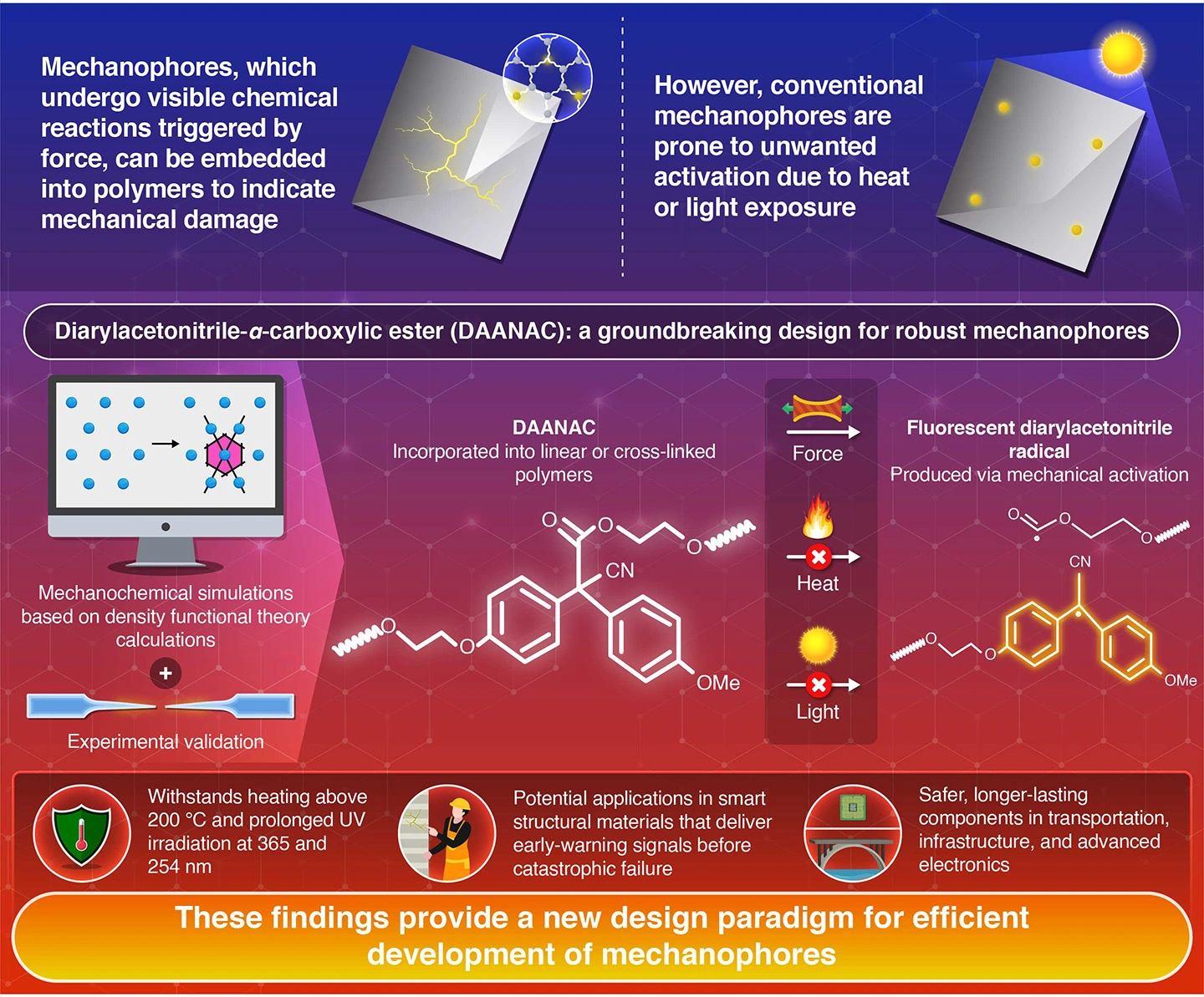
High-performance polymers, such as plastics and elastomers, are essential materials in modern life that are present in everything from airplane parts to bridges and electronics. Because sudden failures in these sectors can be extremely dangerous and costly, ensuring the safety and longevity of high-performance polymers is a critical challenge. Since damage is often invisible at the molecular level until it is too late, scientists have been actively developing compounds known as ‘mechanophores.’ These molecular sensors, which can be embedded into the bulk of a polymeric material, serve as an early warning system by chemically reacting to mechanical stress and producing visible light via fluorescence or other phenomena.
Unfortunately, most conventional covalent mechanophores rely on chemically weak bonds, making them prone to unwanted activation when exposed to common environmental triggers like heat or ultraviolet (UV) light. This means that a polymer intended for industrial use or outdoor infrastructure could potentially give a false alarm or lose its damage-sensing ability prematurely just by getting exposed to sunlight or heating up during operation. Thus, there is a need for robust, selective, and durable mechanophores that respond exclusively to mechanical force.
Against this backdrop, a research team led by Professor Hideyuki Otsuka from the Department of Chemical Science and Engineering, Institute of Science Tokyo (Science Tokyo), Japan, has developed an exceptional solution. In their latest paper, made available online on November 23, 2025, and published in Volume 147, Issue 49 of the Journal of the American Chemical Society on December 10, 2025, they report a novel molecular scaffold for robust mechanophores called diarylacetonitrile-α-carboxylic ester (DAANAC).
DAANAC was carefully designed using advanced computational chemistry techniques for mechanochemical simulations based on density functional theory calculations. It consists of a stable and fluorescent diarylacetonitrile radical coupled to an alkoxycarbonyl radical that quenches fluorescence while attached. DAANAC features a relatively strong covalent bond between these radicals, allowing it to withstand environmental stress while remaining sensitive to mechanical force.
The research team conducted a series of experiments to validate their design. When tested as a model compound, DAANAC demonstrated excellent thermal stability, showing no signs of decomposition even when heated above 200 °C. It also proved to be photochemically inert, capable of withstanding prolonged exposure to UV irradiation. When DAANAC units were incorporated into linear and cross-linked polymers, which represent typical real-life use cases for mechanophores, the application of mechanical force, such as grinding or stretching, broke the bonds between the constituent radicals. In turn, this produced a distinct yellow fluorescent signal.
Additionally, tests on cross-linked polymers confirmed that the inclusion of DAANAC did not compromise the material’s intrinsic strength or thermal stability. "Our findings establish DAANAC as a unique fluorescent mechanophore that bridges the gap between force responsiveness and structural robustness, expanding the design space for durable mechanoresponsive polymers," says Otsuka.
Overall, the development of DAANAC opens the door to creating safer, longer-lasting components in multiple key sectors. "This innovation provides a new design paradigm for smart structural materials that remain stable during use but deliver early warning signals before catastrophic failure," explains Otsuka. Potential applications in the near future include revolutionary components in transportation, infrastructure, and advanced electronics, where materials can literally report their own damage status using light before serious harm occurs.
Reference
- Authors:
- Yuto Uchida1, Hajime Sugita1, Akira Takahashi1, and Hideyuki Otsuka1,2
- Title:
- A Thermally and Photochemically Stable Fluorescent Radical-type Mechanophore for Durable Mechanoresponsive Polymers
- Journal:
- Journal of the American Chemical Society
- DOI:
- 10.1021/jacs.5c15553
- Affiliations:
- 1Department of Chemical Science and Engineering, Institute of Science Tokyo, Japan
2Research Center for Autonomous Systems Materialogy (ASMat), Institute of Science Tokyo, Japan
Related articles
Further information
Professor Hideyuki Otsuka
Department of Materials Science and Engineering, Institute of Science Tokyo
Contact
Public Relations Division, Institute of Science Tokyo
- media@adm.isct.ac.jp
- Tel
- +81-3-5734-2975