Uncovering the evolution of Edo-period Japanese ceramic jars with AI
Researcher uses machine learning and geometric morphometrics to reveal how major Edo-period historical developments reshaped everyday ceramic production
Edo-period “Ogame” (“large jars”) became increasingly standardized over time, developing distinct shapes for everyday and burial use, reports a new archeological study from Institute of Science Tokyo, Japan. Using AI-assisted techniques and geometric morphometrics, the researcher analyzed 243 historic vessels to quantitatively track these changes. The findings provide the first quantitative evidence that major Edo-period historical events influenced not only expensive porcelains production but also everyday ceramics, offering new insights into early modern Japanese society.
Uncovering the Hidden History of Edo-Period Jars with AI
Archeological artifacts offer valuable insights into the history of past societies. These reveal not only technological developments but also the changing economic systems, cultural traditions, and everyday practices of the people who lived during that time. Pottery is one of the most informative archaeological materials because its shape often reflects not only how it was manufactured and used, but also the broader historical developments that shaped its production. However, identifying subtle changes in ceramic forms has traditionally relied on visual comparisons, making it difficult to quantitatively trace how pottery evolved over time and what these changes reveal about past societies.
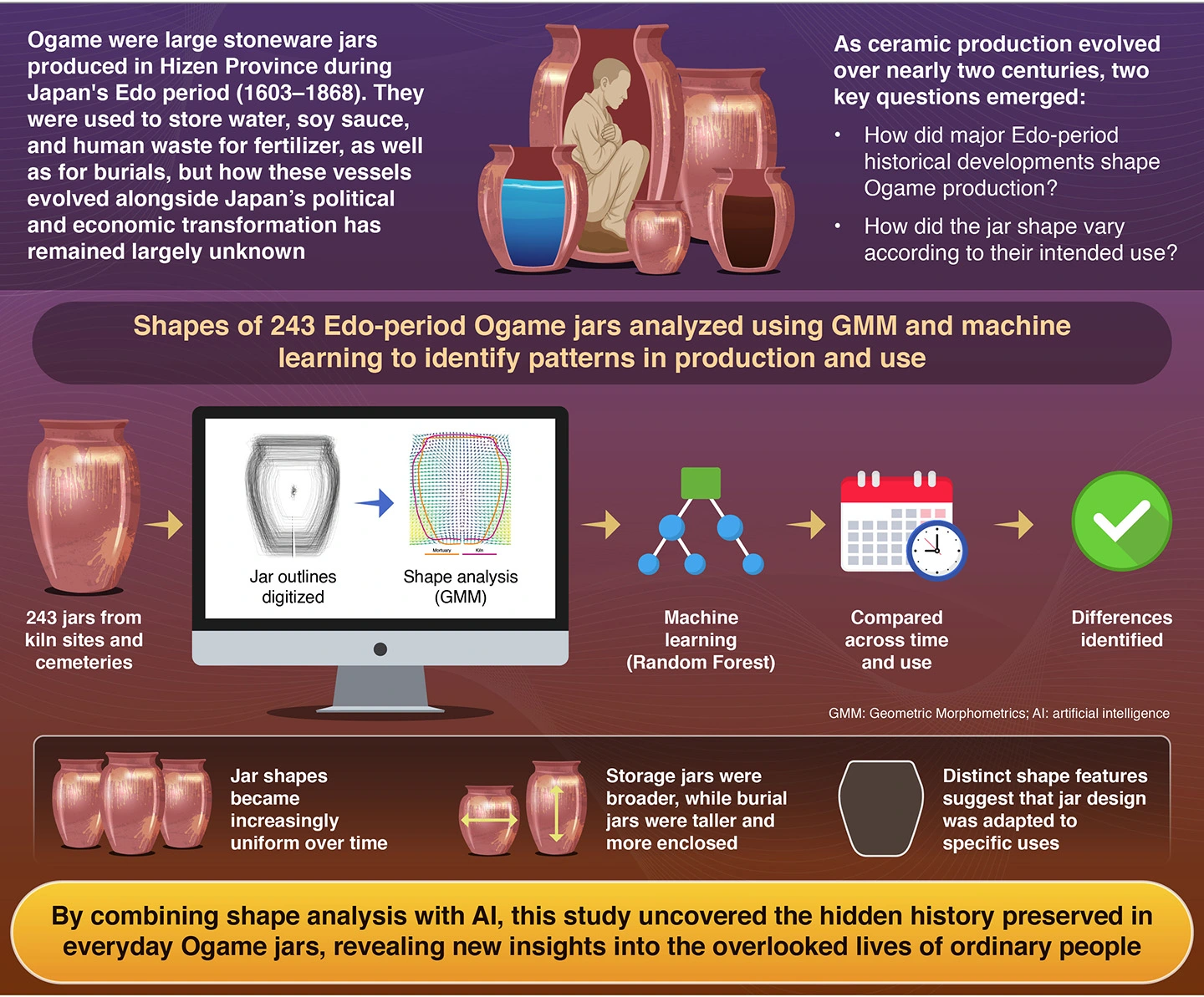
Investigating this, Associate Professor James Frances Loftus from the Institute of Future Science, the Institute for Liberal Arts and the School of Environment and Society, Institute of Science Tokyo (Science Tokyo), Japan, investigated how the shapes of large ceramic vessels known as “Ogame” evolved during Japan's Edo period (1603–1868). Published in the journal Open Archaeology on month day, year, the study combines Geometric Morphometrics (GMM) (quantitative measurement and analysis of shape) with a Random Forest machine learning model to analyze the shapes of 243 jars recovered from 11 kiln and mortuary sites across the Saga and Fukuoka regions of Japan. The artificial intelligence (AI)-based approach also enabled the researcher to classify jars that lacked secure dates, addressing a longstanding challenge in historical archaeology.
“Even ordinary household pottery can preserve a surprisingly rich record of technological and social change,” explains Loftus. “By combining GMM with machine learning, this study was able to quantify subtle changes in pottery shape that would have been difficult to recognize consistently through visual observation alone.”
Ogame were indispensable containers in early modern Japan, serving a wide range of purposes including storing water and soy sauce, transporting agricultural fertilizers, collecting human waste, and even functioning as burial jars. Supporting both everyday life and burial practices, these versatile vessels played an important role throughout Edo-period society. Although previous studies have shown that the consolidation of Tokugawa domain control, the Qing maritime trade ban, and the expansion of domestic production networks transformed the production and distribution of porcelain, far less attention has been paid to whether these same historical developments also influenced everyday utilitarian ceramics such as Ogame. To measure the differences in their morphology, researcher digitized the outlines of each vessel using Elliptical Fourier Analysis, which is a GMM technique that captures subtle changes in shape. He then trained a Random Forest model to classify undated jars into different chronological stages based on these morphological characteristics.
The results revealed that jars produced during the early 17th century displayed considerable variation in shape, whereas vessels made during the 18th century became increasingly uniform. This transition coincided with major historical developments, including the consolidation of the Tokugawa shogunate, the Qing maritime trade ban, and the expansion of domestic production networks. While archaeologists have long argued that these developments transformed ceramic production, this study provides the first quantitative evidence demonstrating that these broader historical changes were reflected in the evolving forms of everyday pottery. These shifts in patterns suggest that increasing regulation and specialization of ceramic workshops shaped production, while allowing the vessels to be adapted for specific cultural needs.
The researcher also discovered that the shape of vessels reflected differences in function. Jars recovered from the kiln sites generally had broad shoulders, flared rims, and relatively compact lower bodies, making them well suited for storing and transporting liquids and fertilizers. In contrast, the jars which were excavated from burial sites displayed taller, narrower, and more enclosed structures, indicating that they were deliberately designed or selected for funerary purposes rather than simply being reused from domestic settings.
“This study provides the first quantitative evidence that Edo-period Ogame became increasingly standardized over time while also adapting to different functions in response to broader historical developments. Furthermore, it highlights the potential of AI-assisted shape analysis to reveal how subtle changes in pottery morphology reflect wider technological, social, economic, and political change,” says Loftus.
Written historical records often focus on political elites and major events, whereas everyday artifacts such as Ogame offer valuable evidence of the lives of ordinary people. By combining archaeological expertise with AI-assisted analysis, the study demonstrates how material culture can complement historical records to reveal social and economic changes that might otherwise remain hidden.
In the future, Loftus hopes to integrate quantitative shape analysis with other archaeological science techniques, such as portable X-ray fluorescence and compositional analyses, to investigate Edo-period ceramics as well as pottery from different regions and time periods, providing a more quantitative framework for archaeological research worldwide. Integrating GMM with machine learning could help archaeologists reconstruct the manufacturing systems and also study the cultural interactions with greater scientific accuracy—opening new possibilities for understanding past societies through the objects they created.
Reference
- Authors:
- James Frances Loftus1*
- Title:
- Water, Soy Sauce, Feces, and Death: A Geometric Morphometric and Machine Learning Analysis of Edo-Period Ogame Jars, Japan
- Journal:
- Open Archaeology
- Affiliations:
- 1Institute of Future Science, the Institute for Liberal Arts, and the School of Environment and Society, Institute of Science Tokyo, Japan
Related articles
Further information
Associate Professor James Frances Loftus
Institute of Future Science, the Institute for Liberal Arts, and the School of Environment and Society, Institute of Science Tokyo
- loftus@ila.isct.ac.jp
Contact
Public Relations Division, Institute of Science Tokyo
- media@adm.isct.ac.jp
- Tel
- +81-3-5734-2975