A prosthodontic digital guide for reproducing lip–instrument positioning for wind instruments
A proof-of-concept workflow combines facial and intraoral scans to reproduce the spatial relationship between an air-reed instrument and the player’s lips
A digitally fabricated guide, developed by researchers at Science Tokyo, captures and reproduces the spatial relationship between a musician’s lips and an air-reed instrument, such as a shakuhachi flute. By combining facial and intraoral scans using CAD and 3D printing, the team created a lightweight positioning guide based on an experienced player’s embouchure. The application demonstrates how digital prosthodontic workflows could provide physical spatial references for musical training and other extraoral applications.
Digital Guide-Based Reproduction of Lip-Instrument Positioning
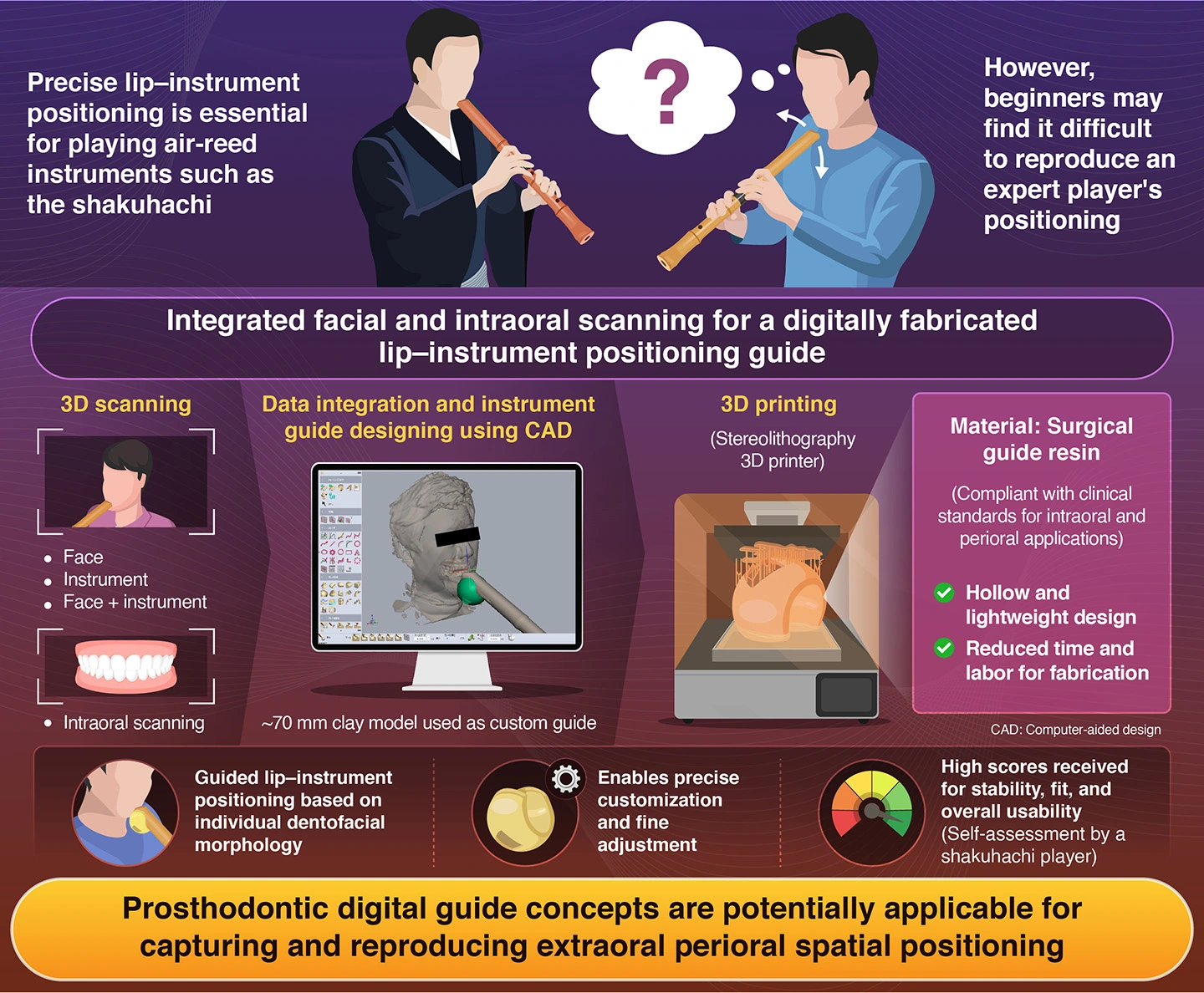
Precise positioning of the lips can make a major difference when playing air-reed instruments such as a shakuhachi flute (a traditional Japanese end-blown flute) or a recorder. Players must learn to coordinate the shape of their lips, the angle of their breath, and the position of the instrument to produce the desired sound. Yet, these spatial relationships are difficult to see and communicate, particularly for beginners who traditionally learn through observation, instruction, and repeated practice.
A research group led by Assistant Professor Tamaki Hada and Professor Manabu Kanazawa of the Institute of Science Tokyo (Science Tokyo), in collaboration with Associate Professor Dozan Fujiwara of the Tokyo University of the Arts in Japan, has now demonstrated a new way to turn an experienced player’s embouchure (the way a player applies their lips to the mouthpiece of a wind instrument) into a physical positioning reference.
The study, published online on July 11, 2026, in the Journal of Prosthodontic Research, extends a concept commonly used in digital prosthodontics to an extraoral application.
“We developed a workflow to fabricate a guide that records and reproduces the positional relationship between an expert player's lips and the shakuhachi during performance,” explains Hada.
To design the guide, the researchers obtained intraoral and facial scans of an experienced male shakuhachi player, along with a scan of the instrument. The musician then assumed his optimal playing position, allowing the researchers to digitally capture the spatial relationship between his face, lips, and the instrument during sound production.
The researchers then combined these datasets using CAD software. They used dental landmarks, the occlusal plane, and facial reference information to reproduce the relationship between the player’s lips and the shakuhachi’s blowing opening.
From the integrated digital model, the team designed a spherical clay model approximately 70 mm in diameter in the gap between the musician’s chin and the shakuhachi. The model was subsequently converted into a hollow guide, and a window was incorporated to allow the uncured resin to drain and to facilitate post-curing.
The guide design data were imported into the printing software. The 3D guide was printed using stereolithography 3D printing. Autoclavable, biocompatible photopolymer material, commonly used for dental surgical guides, was used to ensure compatibility with disinfection and sterilization procedures.
Unlike conventional assistive devices, the proposed guide enables guided lip–instrument positioning based on each player’s individual dentofacial morphology, rather than relying solely on subjective sensory feedback or experiential instruction. The digital workflow may also reduce the time and labor associated with conventional plaster-cast fabrication. The hollow and lightweight guide improves comfort for the player, while its bracing arm can be precisely customized for fine positional adjustments.
When an expert musician evaluated the completed guide, it received high scores for stability, fit, and overall usability. The guide also made it easier to identify potential problems during use.
The concept explores an intriguing new application for digital prosthodontic technology. “Beyond music education, we expect this concept could potentially be extended to maxillofacial prosthetics, orofacial rehabilitation, and other extraoral devices requiring precise perioral spatial control,” concludes Hada.
Reference
- Authors:
- Tamaki Hada1.2, Dozan Fujiwara3, Maiko Iwaki4, Masanao Inokoshi1,2, Manabu Kanazawa5,6
- Title:
- Extension of prosthodontic digital guide workflow to reproduce lip–object spatial relationships: Application to an air-reed instrument
- Journal:
- Journal of Prosthodontic Research
- Affiliations:
- 1Oral Devices and Materials, Graduate School of Medical and Dental Sciences, Institute of Science Tokyo, Japan
2Oral Science Center, Institute of Biomedical Engineering, Institute of Science Tokyo, Japan
3Traditional Japanese Music, Faculty of Music, Tokyo University of the Arts, Japan
4Digital Dentistry, Graduate School of Medical and Dental Sciences, Institute of Science Tokyo, Japan
5Gerodontology and Oral Rehabilitation, Graduate School of Medical and Dental Sciences, Institute of Science Tokyo, Japan
6Clinic of General, Special Care and Geriatric Dentistry, University of Zurich, Switzerland
Related articles
Further information
Assistant Professor Tamaki Hada
Oral Devices and Materials, Graduate School of Medical and Dental Sciences, and Oral Science Center, Institute of Biomedical Engineering, Institute of Science Tokyo
- t.hada.gerd@tmd.ac.jp
Contact
Public Relations Division, Institute of Science Tokyo
- media@adm.isct.ac.jp
- Tel
- +81-3-5734-2975