Supramolecular nanofibers paired with nanohole substrate improve exciton transport in organic solid
A new study reports boosted exciton transport efficiency with anthracene-based self-assembling nanofibers when coupled with plasmonic gold nanohole array substrates
Self-assembling, anthracene-based supramolecular nanofibers can enable excitons to migrate hundreds of nanometers, according to a new experimental finding by researchers at Science Tokyo. Coupling these nanofibers with a plasmonic nanohole gold substrate further doubles exciton diffusivity. By mitigating the limited diffusivity of singlet excitons in organic semiconductors, this offers a new strategy for improving optoelectronic technologies.
Supramolecular Nanofibers Coupled with Plasmonic Gold Nanohole Substrates Overcome Exciton Diffusion Limits
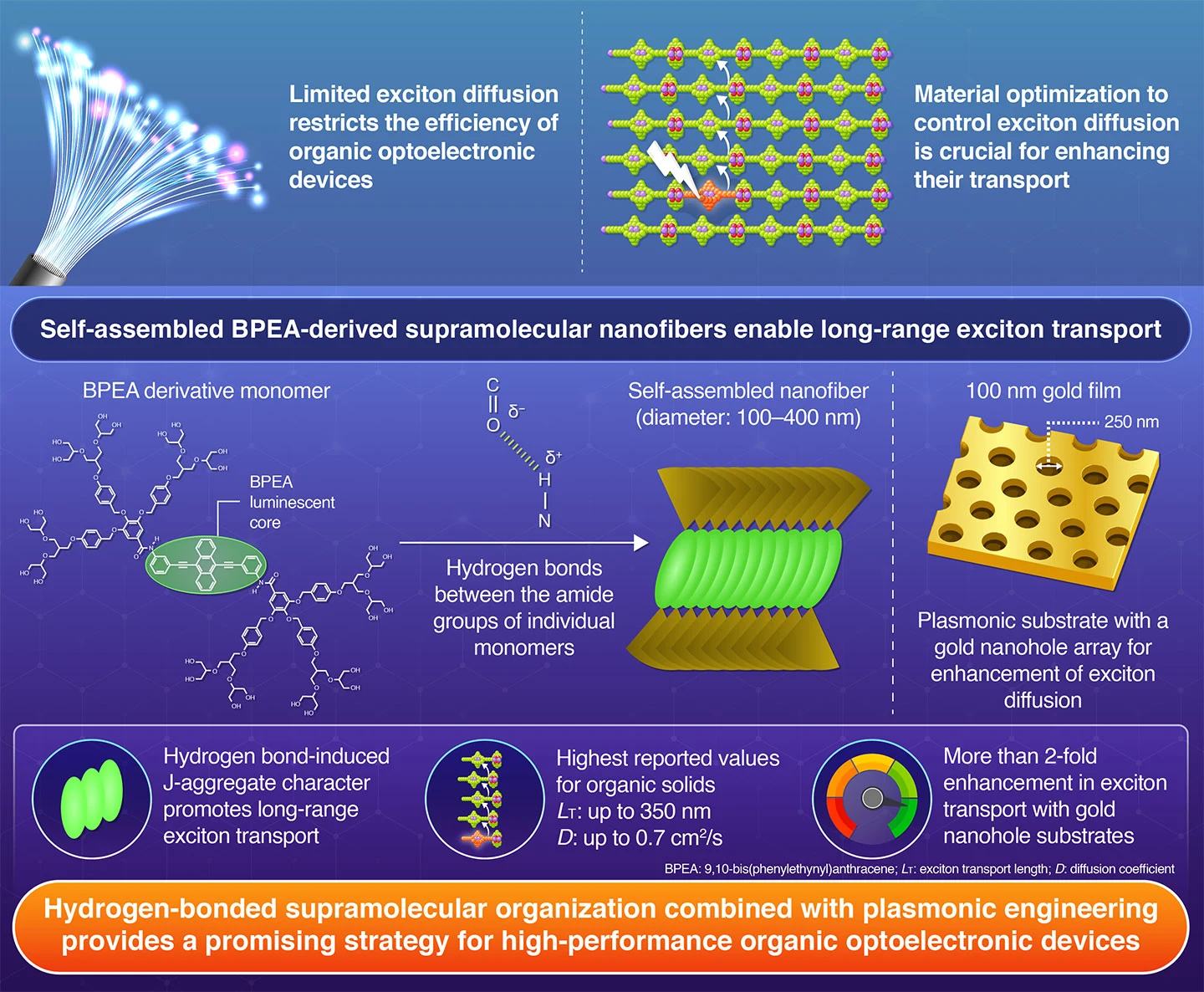
For decades, one of the biggest challenges in organic optoelectronics has been the limited diffusivity of excitons. Created when light is absorbed, excitons diffuse through the semiconducting material before they can dissociate into free charge carriers to generate electricity. However, excitons in conventional organic semiconductors typically diffuse only up to 5–20 nm before recombining, limiting the performance of optoelectronic devices.
Now, researchers from Institute of Science Tokyo (Science Tokyo) in Japan have managed to overcome this long-standing limitation by combining molecular self-assembly with plasmonic nanotechnology. The breakthrough comes from a study conducted by a collaborative research team comprising Professor Martin Vacha and Associate Professor Yoshimitsu Sagara from Science Tokyo and Dr. Takatoshi Fujita from the National Institute for Quantum Science and Technology in Japan. Their findings were made available online on July 09, 2026, and were published in Volume 26, Issue 28 of the journal Nano Letters on July 22, 2026.
"Developing a universal design principle for long-range exciton transport has remained an elusive goal, necessitating a deeper comprehension of intrinsic molecular factors to strategically enhance migration within organic systems," explains Vacha.
The team designed molecules based on 9,10-bis (phenylethynyl) anthracene (BPEA) and modified the BPEA chromophore with amide groups to promote self-assembly through hydrogen bonding. These interactions organize the molecules into highly ordered one-dimensional nanofibers, while hydrophilic dendritic side chains ensured sufficient solubility. The molecular arrangement forms what are called "J-aggregates," ordered assemblies known to facilitate efficient electronic coupling and energy transport.
The researchers combined confocal fluorescence microscopy with position-dependent fluorescence lifetime measurements to assess exciton migration. By tracking how fluorescence broadened over time after laser excitation, they found that excitons travelled remarkably long distances along the nanofibers. The nanofibers exhibited transport lengths of up to 350 nm and diffusion coefficients reaching up to 0.7 cm2/s, which rank among the highest reported for organic solids.
The researchers also investigated the mechanisms driving the high performance of these nanofibers. Quantum-chemical calculations revealed that excitons are delocalized across two to three neighbouring molecular units. Furthermore, significant mixing between locally excited and charge-transfer states strengthens intermolecular electronic coupling, promoting efficient exciton migration. Supported by a rigid, hydrogen-bonded architecture and low structural disorder, these electronic features establish highly favorable pathways for long-range energy transport.
To explore whether exciton transport could be actively controlled, the team deposited the nanofibers onto plasmonic substrates consisting of regularly spaced gold nanohole arrays. This approach increased the diffusion coefficients up to 1.3 cm2/s and extended transport lengths beyond 550 nm under optimal alignment, representing more than a two-fold enhancement compared with the performance of nanofibers on glass substrates.
Computer simulations revealed that the enhancement depends strongly on the nanofiber orientation relative to the nanohole lattice. When aligned parallel to the periodic array of the substrate, continuous electric field enhancement promoted more efficient energy transfer along the nanofibers, whereas misaligned nanofibers showed relatively weaker enhancement. This suggests that nanoscale photonic environments can be engineered to actively control exciton migration in organic materials.
By combining molecular design with plasmonic engineering, the study establishes a promising strategy for overcoming one of the fundamental limitations of organic semiconductors. "Our findings provide new insight into how energy moves through organic materials and suggest practical strategies for improving next-generation optoelectronic devices," Vacha concludes.
Reference
- Authors:
- Nithin Pathoor1, Qiwen Tan1, Wenhao Zhang1, Misa Nozaki2, Takatoshi Fujita2, Toranosuke Takagi1, Shun Omagari1, Yoshimitsu Sagara1, and Martin Vacha1*
*Corresponding author - Title:
- Long-Range Exciton Transport in Anthracene-Based Supramolecular Mesostructures and Its Control by Surface Plasmons
- Journal:
- Nano Letters
- Affiliations:
- 1Department of Materials Science and Engineering, Institute of Science Tokyo, Japan
2Institute for Quantum Life Science, National Institutes for Quantum Science and Technology, Japan
Related articles
Further information
Professor Martin Vacha
School of Materials and Chemical Technology, Institute of Science Tokyo
- vacha@mct.isct.ac.jp
Contact
Public Relations Division, Institute of Science Tokyo
- media@adm.isct.ac.jp
- Tel
- +81-3-5734-2975