ZEBRA-Prop: a lightweight language-model framework for materials property prediction
A new approach cuts training time by approximately 95% compared with an existing large language model-based approach and can run on a standard laptop
A lightweight machine-learning framework called ZEBRA-Prop, which predicts materials properties using text-based representations, has been developed by researchers from Science Tokyo. By keeping its materials-science language model frozen and training only the components needed for prediction, ZEBRA-Prop reduces training time by approximately 95% compared with LLM-Prop, an existing large language model-based approach. The new method can run on a standard laptop, potentially making language-model-based property prediction more accessible to research groups with limited computing resources.
ZEBRA-Prop Offers an Efficient Language-Model Approach to Materials Property Prediction
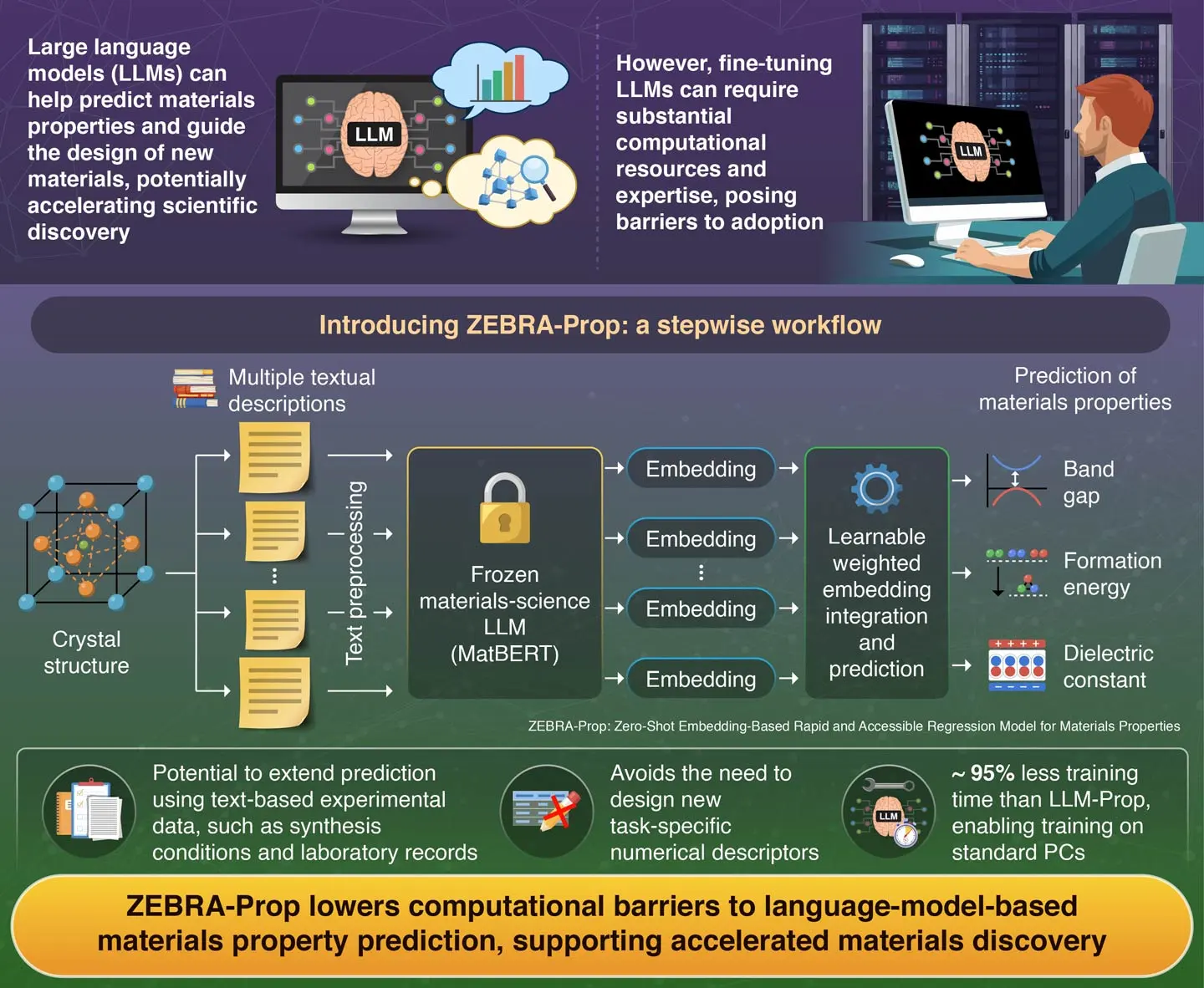
Discovering new materials often involves predicting their properties before investing time and resources in making and testing them in the laboratory. Machine-learning models are widely used to estimate important properties, such as band gap and formation energy, helping researchers narrow down candidate materials. More recently, large language models (LLMs) have offered a flexible way to represent materials through text for property prediction.
However, some LLM-based prediction methods require substantial computational resources and specialized expertise. One example is LLM-Prop, which uses task-specific fine-tuning. This can make the training process computationally demanding and create barriers for research groups without access to powerful computing hardware.
To address this challenge, a research team led by Associate Professor Akira Takahashi and master’s student Ryoma Yamamoto of the Materials and Structures Laboratory, Institute of Science Tokyo (Science Tokyo), Japan, and Professor Fumiyasu Oba of the Materials and Structures Laboratory, Science Tokyo (concurrently at the Kanagawa Institute of Industrial Science and Technology, Japan), developed ZEBRA-Prop, a lightweight machine-learning framework that uses textual descriptions of materials to predict their properties without fine-tuning the language model. The researchers also collaborated with Research Professor Kei Terayama of the Graduate School of Medical Life Science, Yokohama City University, Japan; Professor Yu Kumagai of the Institute for Materials Research, Tohoku University, Japan; and other researchers. Their paper was published in Advanced Intelligent Systems on November 11, 2026.
ZEBRA-Prop converts a material’s structural and compositional information into multiple textual descriptions. These descriptions are processed by MatBERT, a language model pretrained on materials-science literature, to generate numerical representations called embeddings. MatBERT remains frozen during training. Instead, ZEBRA-Prop learns how to weigh and combine the embeddings before passing the combined representation to a small neural network that predicts the target property.
A key advantage of this design is its reduced training cost. As Takahashi explains, “By keeping the LLM frozen and training only the embedding-integration weights and the downstream neural network, ZEBRA-Prop reduces training time by approximately 95% compared with LLM-Prop. Consequently, this approach can run even on a regular PC.” The embeddings can also be generated once and reused for different prediction tasks, reducing the need to repeat the computationally intensive step. Processing descriptions separately also allows the framework to combine information that might not fit within the language model’s input-length limit if presented all at once.
The team evaluated ZEBRA-Prop using two datasets derived from the Materials Project database, predicting properties such as the band gap, formation energy, and dielectric constants. The results showed that ZEBRA-Prop can offer a favorable balance between predictive performance and computational cost. Combining multiple textual descriptions also improved predictions by capturing complementary information about materials.
ZEBRA-Prop’s flexible text-based input could offer opportunities to incorporate data otherwise difficult to incorporate into conventional frameworks. “Because ZEBRA-Prop uses textual descriptions as input, it could potentially be extended to information, such as synthesis conditions and experimental records,” explains Takahashi.
By reducing the computational demands of language-model-based property prediction, ZEBRA-Prop could make these approaches more accessible and help researchers accelerate materials discovery.
Reference
- Authors:
- Ryoma Yamamoto1*, Akira Takahashi1*, Kei Terayama2,3, Yu Kumagai4, and Fumiyasu Oba1,3,5
- Title:
- ZEBRA-Prop: A Zero-Shot Embedding-Based Rapid and Accessible Regression Model for Materials Properties
- Journal:
- Advanced Intelligent Systems
- DOI:
- 10.1002/aisy.70592
- Affiliations:
- 1Materials and Structures Laboratory, Institute of Science Tokyo, Japan
2Graduate School of Medical Life Science, Yokohama City University, Japan
3MDX Research Center for Element Strategy, Institute of Science Tokyo, Japan
4Institute for Materials Research, Tohoku University, Japan
5Kanagawa Institute of Industrial Science and Technology (KISTEC), Japan
*Corresponding authors
Related articles
Further information
Associate Professor Akira Takahashi
Institute of Integrated research, Institute of Science Tokyo
Contact
Public Relations Division, Institute of Science Tokyo
- media@adm.isct.ac.jp
- Tel
- +81-3-5734-2975