A new route to electrically controlled helimagnetic structures
Researchers show that electric current and magnetic field can reversibly switch helical magnetic order in a chiral magnet
Helimagnetic q-orientation can be reversibly and polarity-selectively controlled by electric current in the presence of an applied magnetic field, report researchers from Institute of Science Tokyo. In Co8.5Zn8.5Mn3, they combine symmetry analysis with in situ Lorentz transmission electron microscopy to show a new framework for electrically controlling complex magnetic orders, with potential implications for future magnetic memory and spintronic devices.
Understanding the Reversible Electrical Control of Complex Magnetic Order
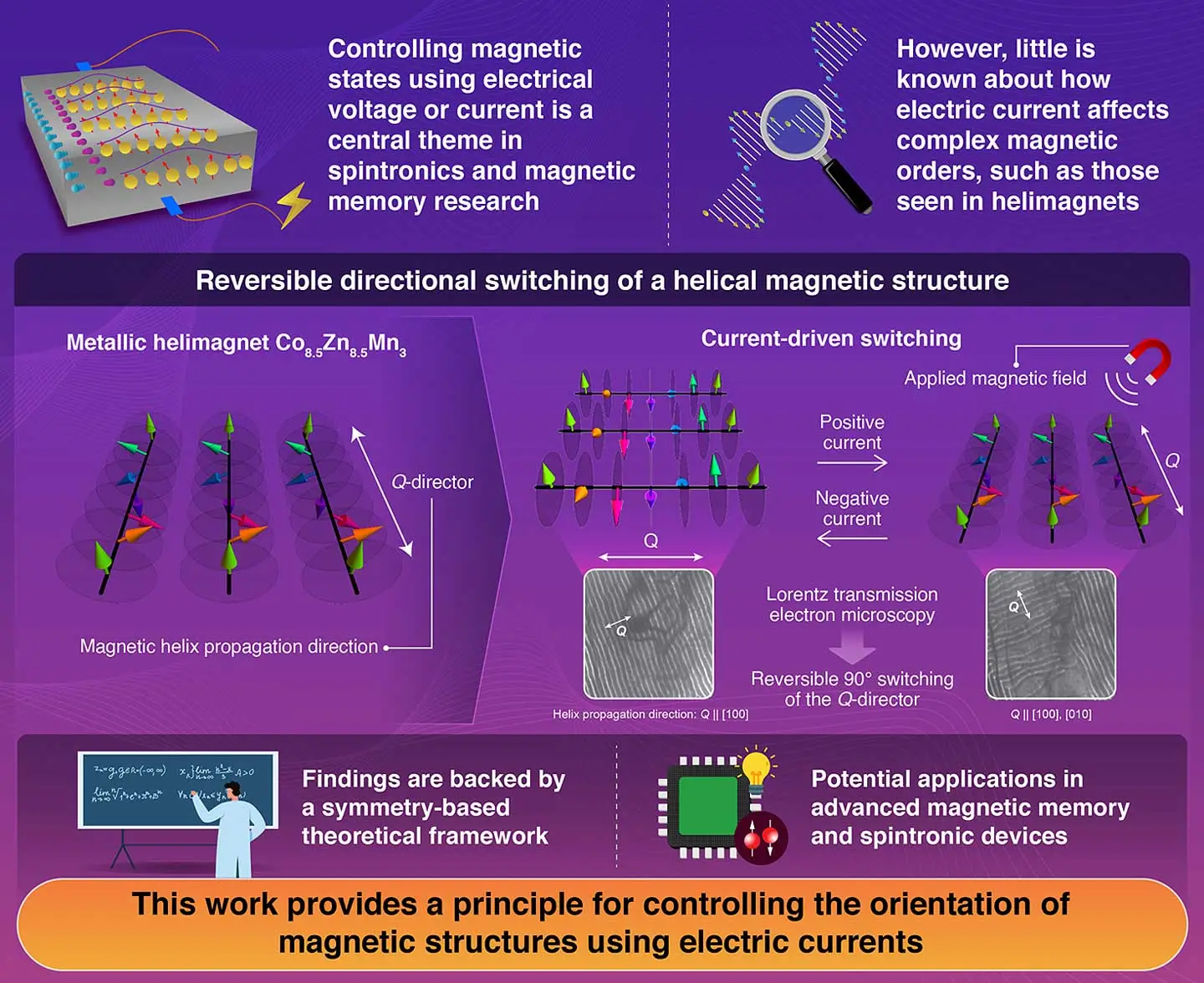
Advanced magnetic memory and spintronic devices rely on the ability to control magnetic states using electricity. Today, such technologies work by manipulating relatively simple magnetic structures found in ferromagnets, where all the magnetic moments point the same way. However, researchers are becoming increasingly interested in controlling more complex magnetic systems, since these could offer higher information density and improved efficiency.
Helimagnets are a prime example of such systems. In these materials, the magnetic moments form spiral or helical patterns that wind through the material. The direction in which these magnetic patterns propagate plays an important role in determining the material’s electrical and magnetic behavior. However, researchers had not yet established a reliable way to reversibly control the orientation of helical magnetic structures using an electric current, and current-driven techniques developed for ferromagnets do not directly carry over to helimagnetic systems.
In a study published in Volume 7 of the journal Communications Materials on July 1, 2026, a research team led by Professor Fumitaka Kagawa from Institute of Science Tokyo, Japan, along with graduate student Soju Furuta, set out to address this knowledge gap. Their work reveals that the propagation direction of a magnetic helix can be reversibly switched by changing the polarity of an electric current under an applied magnetic field.
The team focused on a helimagnetic material called Co8.5Zn8.5Mn3. To analyze its magnetic order, they used a symmetry-based description known as a “director.” This representation accurately captures the fact that the propagation direction of the magnetic helix is treated as a headless arrow, meaning that opposite directions are physically equivalent. They also conducted several experiments using in situ Lorentz transmission electron microscopy, which allowed them to directly visualize the material’s magnetic structure as electrical currents and magnetic fields were applied.
The results revealed that a current pulse could rotate the helix propagation direction by 90 degrees, and that reversing the current polarity restored the original orientation. Simply put, the team demonstrated reversible and polarity-selective switching of helimagnetic order.
Subsequent experiments showed that the resulting magnetic state depends on the relative directions of the applied current and magnetic field. The observations closely matched predictions from the team’s theoretical framework, which describes how currents and magnetic fields produce an effective control field that favors specific helix orientations. “Our work establishes that current-driven switching is achievable for helices oriented in arbitrary directions by appropriately selecting the directions of the applied current and magnetic field,” explains Furuta.
Taken together, the team’s findings provide a principle for controlling complex magnetic order using electric currents. Beyond advancing our fundamental understanding of helimagnets, their work could help expand the range of magnetic states available for future information technologies. “Our work provides a symmetry-based framework for understanding how electric current and magnetic field can select the orientation of helical magnetic structures,” says Kagawa.
As researchers continue to explore electrically controllable magnetic materials, this strategy may help broaden the design space for future spintronic and magnetic-memory technologies.
Reference
- Authors:
- Soju Furuta1, Yao Guang2, Kosuke Karube2, Yasujiro Taguchi2, Wataru Koshibae2, Xiuzhen Yu1,2, and Fumitaka Kagawa,1,2
- Title:
- Reversible reorientation of the helimagnetic q-director in a cubic chiral magnet by electric-current polarity
- Journal:
- Communications Materials
- Affiliations:
- 1Department of Physics, Institute of Science Tokyo, Japan
2RIKEN Center for Emergent Matter Science (CEMS), Japan
Related articles
Further information
Professor Fumitaka Kagawa
Department of Physics, Institute of Science Tokyo
Contact
Public Relations Division, Institute of Science Tokyo
- media@adm.isct.ac.jp
- Tel
- +81-3-5734-2975