Atomic spins set quantum fluid in motion
Einstein–de Haas effect realized in a Bose–Einstein condensate
The Einstein–de Haas effect, which links the spin of electrons to macroscopic rotation, has now been demonstrated in a quantum fluid by researchers at Science Tokyo. The researchers observed this effect in a Bose–Einstein condensate of europium atoms, showing that a change in magnetization causes the coherent transfer of angular momentum from atomic spins to fluid motion, thereby experimentally demonstrating that angular momentum is conserved at the quantum level.
Experimental Realization of the Einstein–de Haas Effect in a Spinor-Dipolar Quantum Fluid
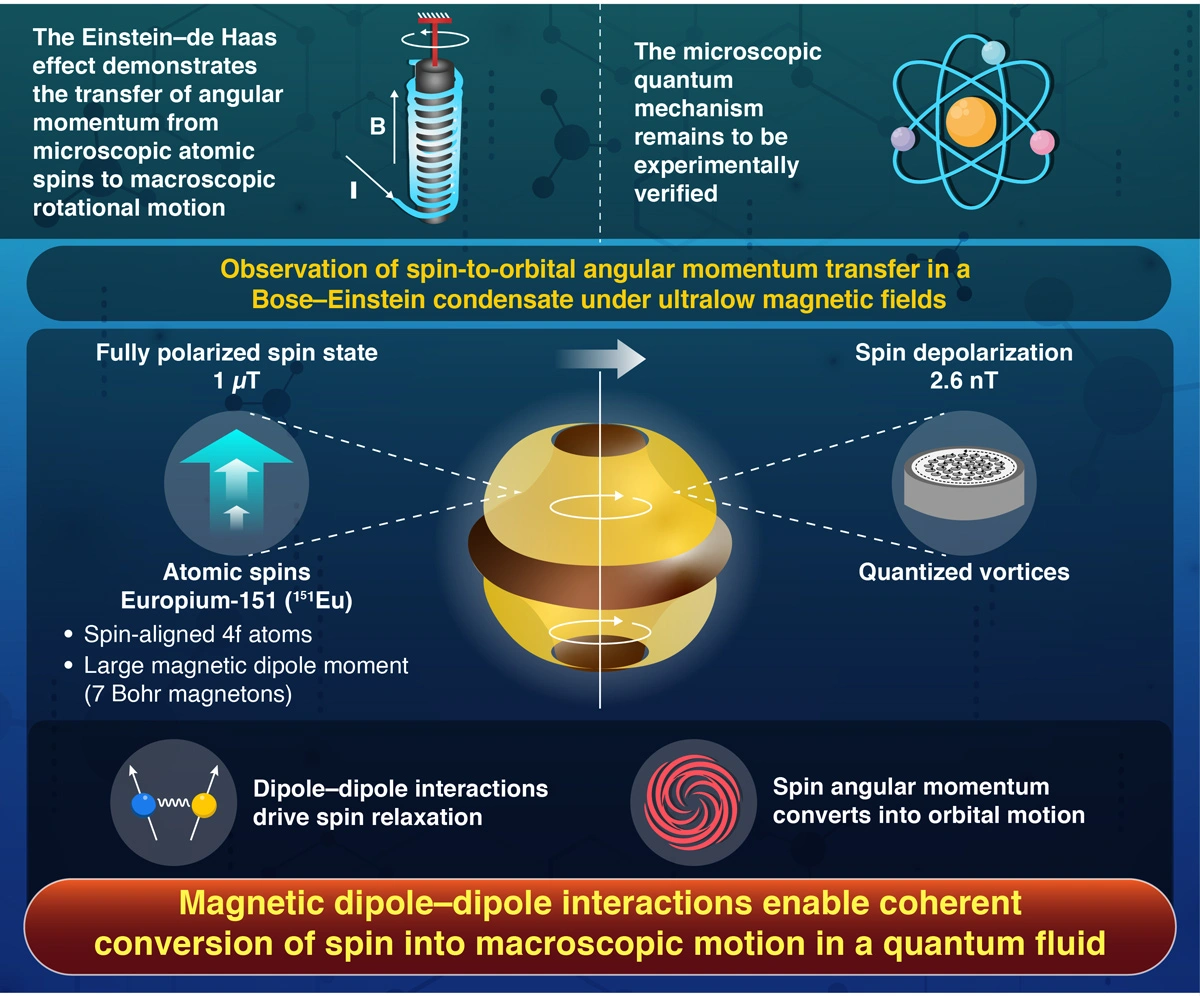
In 1915, physicists Einstein and Wander de Haas conducted an experiment demonstrating that the angular momentum contained in the spin of electrons could be transferred into the mechanical rotation of an object upon a change in its magnetization. This effect, known as the Einstein–de Haas effect, illustrates the conservation of total angular momentum, where the sum of spin and mechanical rotation must remain constant.
A new experiment conducted by researchers at the Institute of Science Tokyo (Science Tokyo), Japan, has now observed this effect in a quantum fluid—specifically, in a Bose–Einstein condensate (BEC) made from a dilute gas of europium atoms. A BEC is a state of matter formed when a dilute gas of integer-spin atoms is cooled to near absolute zero, causing a macroscopic number of particles to occupy the same motional ground state and behave collectively as a single quantum fluid.
The study, published in Volume 391, Issue 6783 of the journal Science on January 22, 2026, was led by Professor Mikio Kozuma, Specially Appointed Assistant Professor Hiroki Matsui, and Specially Appointed Assistant Professor Yuki Miyazawa of the Institute of Integrated Research, Science Tokyo, in collaboration with Professor Yuki Kawaguchi from the Department of Applied Physics, Nagoya University, Japan, and Professor Masahito Ueda from the Department of Physics, The University of Tokyo, Japan.
“This achievement represents an experimental realization of a system that allows direct access to the physics of angular momentum conversion, originally demonstrated by Einstein and de Haas, down to the microscopic mechanisms at the atomic level,” says Kozuma.
The experiment began by placing the condensate in a weak magnetic field of 1 microtesla, which aligned all atomic spins in the same direction. The entire setup was carefully shielded from external magnetic fields that could interfere with the delicate spin dynamics. The magnetic field was then reduced to an extremely low level of just a few nanoteslas, allowing the spins to relax through magnetic dipole–dipole interactions. This reduction led to spin depolarization, in which atoms redistributed among different spin states and angular momentum was converted from spin into orbital motion. As a result, quantized vortices formed, with atoms circulating around an empty core.
Using matter-wave interferometry, the researchers directly observed phase windings around these vortices, indicating that angular momentum was coherently transferred from atomic spins to quantized orbital angular momentum. Numerical simulations reproduced these observations, supporting the conclusion that the Einstein–de Haas effect was driven by magnetic dipole–dipole interactions.
The choice of europium was critical. Europium atoms possess a large magnetic dipole moment of seven Bohr magnetons, originating from seven unpaired electron spins. This makes dipole–dipole interactions between europium atoms particularly strong and experimentally accessible.
“The dilute atomic BEC used in this work constitutes an exceptionally clean quantum many-body system, in which the relevant degrees of freedom are well defined, and the strengths of the interactions coupling them can be precisely controlled. This enables us to simultaneously capture the quantum state of the spins, the atomic motion, and the interactions linking them, and to track their time evolution based on quantum mechanics,” says Kozuma.
This finding highlights the conservation of angular momentum between microscopic spin and macroscopic mechanical rotation in the quantum world and demonstrates how this mechanism can give rise to entirely new quantum states of matter. “This observation opens a pathway to exploring ground-state phases with broken chiral symmetry, spin textures, and mass circulation, as well as the Barnett effect in dipolar quantum gases,” says Kozuma.
Reference
- Authors:
- Hiroki Matsui1, Yuki Miyazawa1, Ryoto Goto2, Chihiro Nakano2, Yuki Kawaguchi3,4, Masahito Ueda5, and Mikio Kozuma1,2*
*Corresponding author - Title:
- Observation of the Einstein–de Haas Effect in a Bose–Einstein Condensate
- Journal:
- Science
- Affiliations:
- 1Institute of Integrated Research, Institute of Science Tokyo, Japan
2Department of Physics, Institute of Science Tokyo, Japan
3Department of Applied Physics, Nagoya University, Japan
4Research Center for Crystalline Materials Engineering, Nagoya University, Japan
5Department of Physics, The University of Tokyo, Japan
Related articles
Further information
Professor Mikio Kozuma
Institute of Integrated Research, Institute of Science Tokyo
Contact
Public Relations Division, Institute of Science Tokyo
- media@adm.isct.ac.jp
- Tel
- +81-3-5734-2975