Shedding light on how hydrogen cyanide formed on early Earth
Researchers identify a mineral-mediated chemical pathway for hydrogen cyanide production, compatible with our current understanding of Earth’s history
Manganese dioxide can convert amino acids into hydrogen cyanide (HCN) without requiring methane, solving a long-standing puzzle about the origin of this key prebiotic molecule on early Earth, as reported by researchers from Science Tokyo. Although HCN is central to origin-of-life theories, recent evidence suggests early Earth's atmosphere didn’t contain sufficient methane needed for classic HCN-producing reactions. The newly found chemical pathway shows that HCN could instead have been continuously supplied from abundant amino acids.
Identifying a Plausible Origin of Hydrogen Cyanide (HCN) on Early Earth
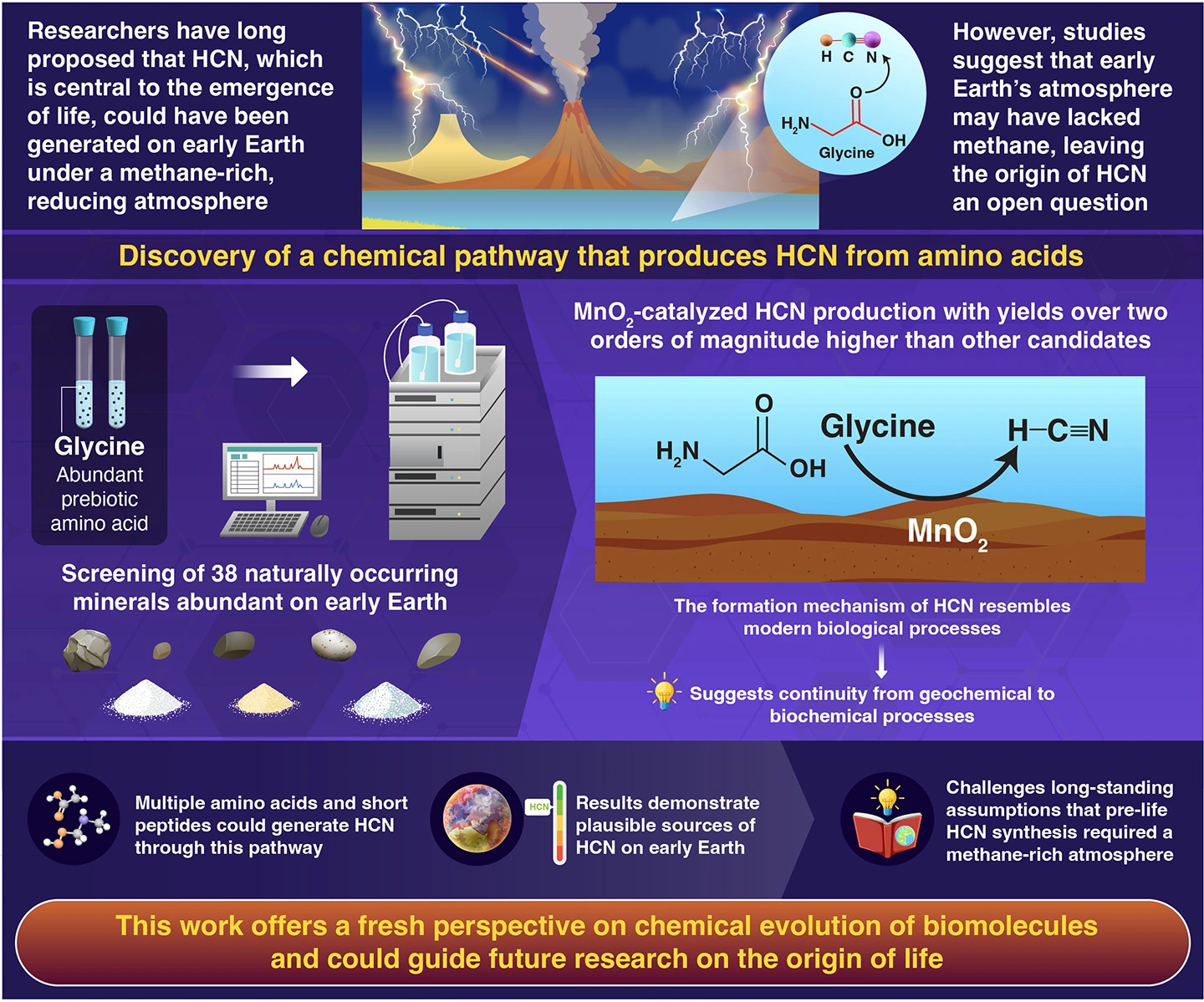
The question of how life first emerged on Earth has been the subject of intense scientific research for decades. At the center of many origin-of-life theories lies hydrogen cyanide (HCN), a small but highly reactive molecule that can give rise to a wide range of biological building blocks. Several laboratory studies, such as the landmark Miller-Urey experiment in 1953, have shown that HCN can produce various amino acids, nucleobases, and sugars under methane-rich conditions with reducing atmosphere, providing the chemical ingredients needed for life on early Earth.
However, recent geological evidence has cast doubt on a long-standing model regarding the origin of HCN itself. Scientists have found that early Earth’s atmosphere most likely did not contain abundant methane, which is a key ingredient in classic HCN-producing reactions. If methane levels were indeed low, it raises an important question: Where did HCN on early Earth come from?
Seeking to address this puzzle, a research team led by Professor Ryuhei Nakamura and Dr. Yamei Li from the Earth-Life Science Institute (ELSI), Institute of Science Tokyo (Science Tokyo), Japan, investigated alternative ways that HCN might have formed on our planet over 3 billion years ago. Their findings, made available online on March 23, 2026, and published in Volume 123, Issue 13 in the journal Proceedings of the National Academy of Sciences on March 31, 2026, describe a previously unrecognized chemical pathway that generates HCN in a way that is compatible with our modern understanding of Earth’s history.
The researchers theorized that minerals present on early Earth might have helped transform amino acids into HCN in water. To explore this possibility, researchers screened 38 naturally occurring minerals to test whether they could convert glycine—the simplest and likely the most abundant amino acid in prebiotic environments—into HCN under oxygen-free or non-reducing conditions. The results revealed that one mineral in particular, manganese dioxide (MnO2), strongly promoted the reaction. In fact, MnO2 produced cyanide concentrations up to two orders of magnitude higher than any other mineral tested.
Further experiments showed that this reaction was highly versatile, proceeding under a wide range of conditions resembling those of early Earth. Specifically, HCN formation occurred in water across a broad pH range, from acidic to strongly alkaline environments, and at temperatures between 6 and 60 °C. The reaction also occurred at extremely low amino acid concentrations.
Using isotope-labeling techniques, the researchers confirmed that HCN forms directly from the carbon backbone of glycine; MnO2 effectively oxidizes the amino acid, breaking a carbon–carbon bond and releasing HCN along with byproducts such as ammonia and formate. Importantly, the team also found that several other protein-forming amino acids and even short peptides could generate HCN through the same mineral-mediated pathway. "Together, our results demonstrate that HCN could have been continuously supplied on early Earth without invoking methane-rich air, instead arising from abundant amino acids produced by methane-independent prebiotic pathways or delivered by meteorites," explains Nakamura.
Beyond identifying a new source of HCN, this discovery also hints at deeper connections between prebiotic chemistry and modern biology. "Because modern biological systems also generate HCN from amino acids through similar intermediates, the newly identified reaction provides a striking chemical parallel between prebiotic processes and contemporary life-evolution pathways, offering a fresh perspective on chemical evolution," remarks Li.
Overall, this work broadens our understanding of how key prebiotic molecules may have formed, opening new avenues for exploring the chemical steps that ultimately led to life on Earth.
Reference
- Authors:
- Zening Yang1,2,3, Yamei Li1,3*, Norio Kitadai4, Masahiro Yamamoto4, Yuichiro Ueno1,4,5, Yanjing Lu1,2,3, Ailong Li3, Kiyohiro Adachi6, Akira Yamaguchi2,3, Daisuke Hashizume6, and Ryuhei Nakamura1,2,3*
- Title:
- Mineral-facilitated aqueous synthesis of hydrogen cyanide from prebiotically abundant amino acids for chemical evolution
- Journal:
- Proceedings of the National Academy of Sciences
- Affiliations:
- 1Earth-Life Science Institute (ELSI), Institute of Science Tokyo, Japan
2Department of Chemical Science and Engineering, , Institute of Science Tokyo, Japan
3Biofunctional Catalyst Research Team, RIKEN Center for Sustainable Resource Science (CSRS), Japan
4Japan Agency for Marine-Earth Science and Technology (JAMSTEC), Japan
5Department of Earth and Planetary Sciences, Institute of Science Tokyo, Japan
6Materials Characterization Support Team, RIKEN Center for Emergent Matter Science (CEMS), Japan
**Yamei Li was affiliated with the Earth-Life Science Institute (ELSI), Institute of Science Tokyo, and RIKEN at the time of the study, and is currently at the University of Science and Technology of China.
Related articles
Further information
Professor Ryuhei Nakamura
Earth-Life Science Institute (ELSI), Institute of Science Tokyo
- ryuhei.nakamura@riken.jp
Contact
Public Relations Division, Institute of Science Tokyo
- media@adm.isct.ac.jp
- Tel
- +81-3-5734-2975