Busseiron: Understanding the origin and evolution of a distinct branch of physics in Japan
Researchers explore the history of Busseiron’s path from a loosely defined label for matter-related research to an established discipline
A new etymological study shows that the terms for scientific disciplines can take shape through naming and classification as much as through theories and institutional usage, as reported by a researcher from Japan. Focusing on Busseiron, a Japanese term for the study of matter, the study traced its use across textbooks, journals, and scientific meetings. Analysis revealed how the term gradually brought together diverse matter-related research and became a durable branch of physics in Japan.
Understanding the Evolution of a Unique Japanese Term for a Physics Discipline
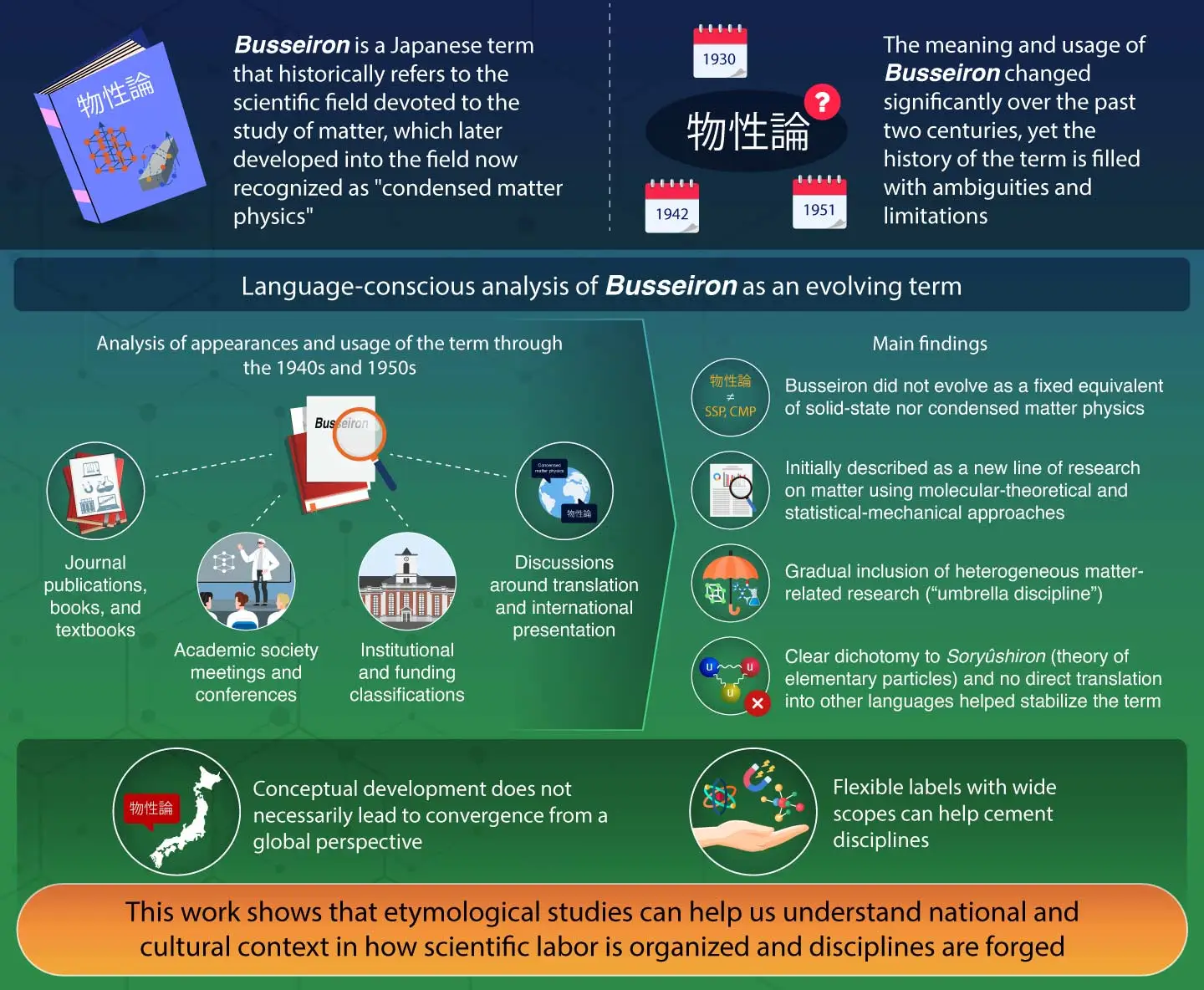
The study of matter, namely its structure, properties, and behavior, has long been one of the central pillars of modern physics. In Japan, this area of research came to be known by the distinctive term Busseiron during the 20th century, which roughly translates to “theory of the properties of matter.” Over the course of a few decades, Busseiron—also referred to in later usage as Bussei Butsurigaku, or simply Bussei—grew into a full-fledged academic discipline, one that would eventually overlap substantially with what is now called condensed matter physics.
Interestingly, the term Busseiron has often been treated as a uniquely Japanese label, with a somewhat unclear scope. Its meaning shifted over time and did not map neatly onto Western categories such as “solid-state physics” or “physical chemistry.” When analyzing the terms used for disciplines, historians of science have typically focused on the development of theories, research communities, and institutions, leaving the role of language largely unexamined. This makes Busseiron a particularly useful case for asking a more basic question: how does the field take shape and endure through the words scientists settle on to describe it?
A new study by Researcher Hiroto Kono of the National Museum of Nature and Science, with support from Professor Masashi Shirabe of the School of Environment and Society, Institute of Science Tokyo (Science Tokyo), Japan, takes up this question. Published in the journal Isis, this work examines how Busseiron evolved into the name of an academic discipline that stood the test of time. By tracing how the term was used, debated, and institutionalized, Kono reconstructed the historical process through which a major branch of Japanese physics developed. The study was made available online on April 07, 2026, and published in Volume 117, Number 2 of the journal on June 01, 2026.
First, Kono examined textbooks, journal articles, conference programs, and roundtable discussions from the 20th century. He tracked how Busseiron’s scope expanded over time, comparing this with the parallel development of solid-state and condensed matter physics in the West. This analysis showed that Busseiron did not simply grow out of the specific wartime research that first used the name. Instead, its meaning kept broadening, absorbing new topics ranging from ferroelectricity to electron emission to polymer chemistry, eventually including subjects that had originally been excluded from it.
One factor that held this loosely defined field together was a clear dichotomy against Soryûshiron, the Japanese term for the theory of elementary particle physics. Anything related to matter yet distinct from particle physics could be placed under the Busseiron label, which had become an umbrella term by the end of the 1940s. Notably, an attempt by some of the field’s own founders to replace the word with “chemical physics” failed, and the looser term persisted instead. “This study offers a new perspective by showing that the formation of academic disciplines can be understood not only through the development of theories and research communities, but also through the history of names and language,” Kono explains.
One of the main takeaways from this work is that even as research becomes increasingly international, the terminology scientists use can remain deeply shaped by local language and history. “As this Japanese case attests, etymological studies offer new possibilities for exploring the role of national contexts in the development of disciplines in an age when the globalization of science tends to be taken for granted,” concludes Kono.
Reference
- Authors:
- Hiroto Kono1*
- Title:
- Coining a Discipline: The Formation and Perpetuation of a Japanese Branch of Physics of Matter
- Journal:
- Isis
- DOI:
- 10.1086/740958
- Affiliations:
- 1National Museum of Nature and Science, Japan
*Corresponding author
Related articles
Professor Masashi Shirabe
School of Environment and Society, Institute of Science Tokyo
Contact
Public Relations Division, Institute of Science Tokyo
- media@adm.isct.ac.jp
- Tel
- +81-3-5734-2975