When smell meets virtual reality: wearable olfactory device for a realistic VR experience
New scent technology blends up to eight fragrances for immersive virtual experiences
A multi-channel wearable scent display developed at Institute of Science Tokyo allows a user to experience multiple scents while exploring virtual environments. Based on virtual scenes, the device can blend up to eight fragrances in real time and deliver them with precise control of odor intensity. By synchronizing smell with virtual reality content, the device enables better immersion and realism—opening new possibilities for enhanced digital entertainment, realistic simulation training, and future digital scent technologies.
Next-Generation Virtual Reality Powered by Wearable Scent Technology
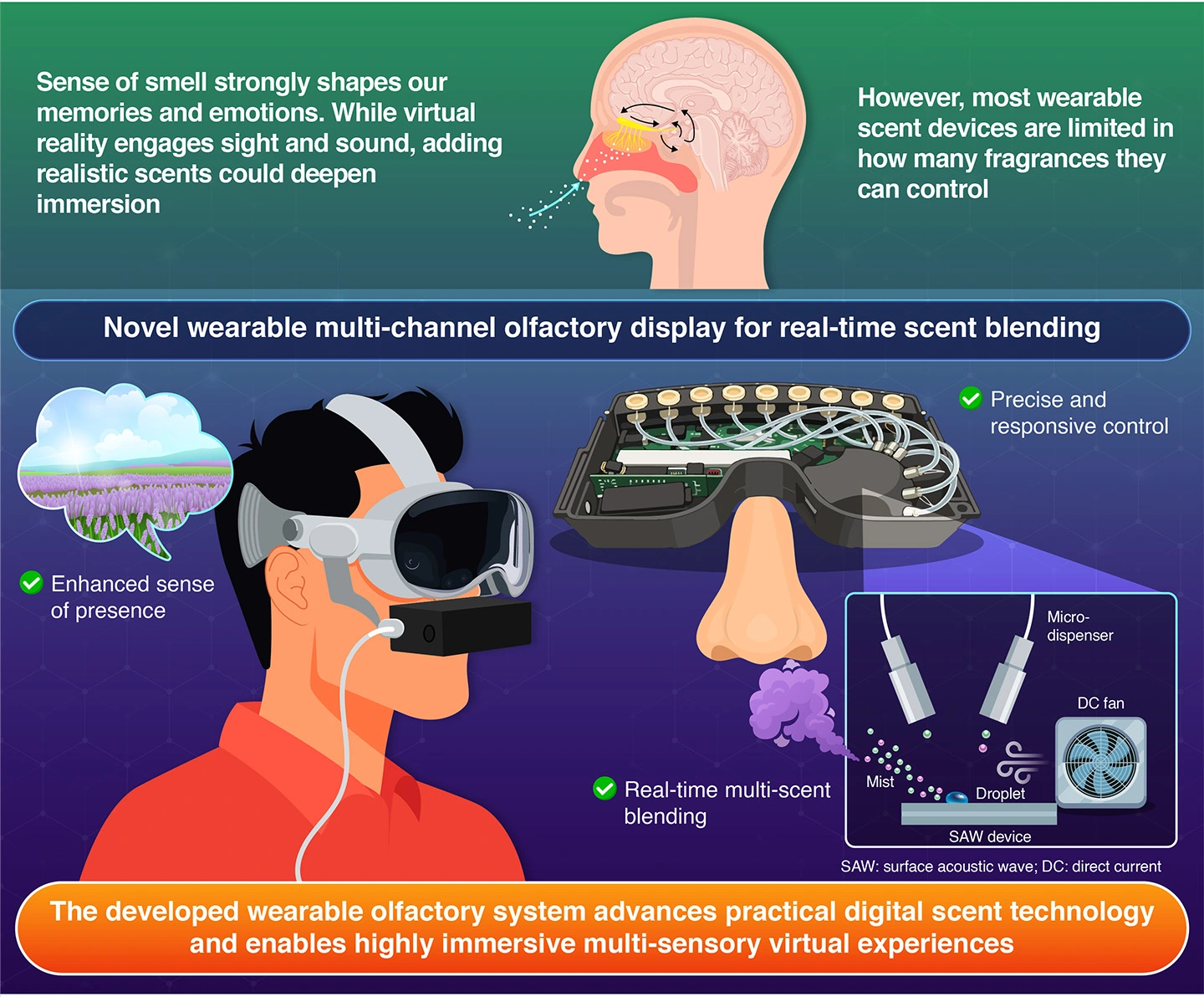
Virtual Reality (VR) technologies are rapidly advancing, allowing users to see and hear highly realistic virtual environments. But most VR systems only rely on visual and auditory experiences, leaving out one of the most powerful human senses—the sense of smell. Research shows that the sense of smell is strongly connected to memory, emotions, and environmental perception. However, incorporating multiple scents into VR experiences remains challenging.
Olfactory displays are devices that generate scents in response to digital content. Although promising, most of these devices are bulky and difficult to integrate into wearable VR systems. To overcome this, a team of researchers led by Specially Appointed Professor Takamichi Nakamoto from Laboratory for Future Interdisciplinary Research of Science and Technology (FIRST), Institute of Integrated Research, Institute of Science Tokyo (Science Tokyo), Japan, along with Doctoral Student Zhe Zou from the Department of Information and Communications Engineering, School of Engineering, Science Tokyo, and Kelvin Cheng, R&D Manager at Rakuten Mobile, Inc. and Rakuten Institute of Technology, Japan, has developed a multi-channel wearable olfactory display capable of generating blended scents in real time. Their findings were published in the IEEE Sensors Journal on February 23, 2026.
"We created a small-sized scent generation system that can be worn together with a VR device, so a user can experience scents that match the virtual environments as they explore, and a single user can use it at the same time," explains Nakamoto.
One of the key features of this device is its ability to blend multiple scents to match the VR display in real-time. It can blend up to eight different fragrance components simultaneously, and by adjusting their mixing ratio, the system can reproduce a wide range of scents. The researchers achieved this by optimizing the methods for supplying and controlling fragrances while limiting the size of the driving circuit.
"We wanted to develop a system that could reproduce complex scents quickly during immersive virtual experiences," notes Nakamoto.
To make this precise control possible, the team used several specialized components within the device. For scent generation, they used a microdispenser that releases extremely small droplets of liquid fragrance, along with a surface acoustic wave atomizer that uses ultrasound to convert the liquid droplets into a fine mist, which can be easily detected as scent. Additionally, they also incorporated an electroosmotic pump (a device that moves liquids using electrical forces) to accurately control the amount of fragrance delivered to the microdispenser at any given time. Together, these components ensure stable scent generation with minimal delay.
The researchers then tested the device by measuring how accurately it controlled the odor concentration and how quickly it generated scent. Through multiple experiments, they optimized the system to produce scent levels suitable for human perception in practical settings.
"We also created virtual travel content using these devices, so that users could visit various virtual locations and experience the scent at those places for a realistic travel experience," adds Nakamoto.
After testing, the participants reported that adding scents significantly improved the sense of presence in the virtual environment. The device was also demonstrated at multiple international conferences and events, where many attendees experienced the technology first-hand. According to the authors, combining the smell-based feedback with visual and auditory cues transforms the perception of the virtual environment, making it feel far more realistic and engaging.
Beyond entertainment, the technology could have potential applications in advancing simulation-based training and therapeutic programs to stimulate memory and rehabilitation, especially for elderly people, as well as immersive demonstrations for fragrance products. As digital scent technology continues to evolve, this innovation marks a significant step in bringing multi-sensory virtual experiences closer to reality.
Reference
- Authors:
- Zhe Zou1, Takamichi Nakamoto2*, Hsueh Han Wu3, Kelvin Cheng3,4, Sungho Lee3, and Shoichi Hasegawa2
*Corresponding author - Title:
- Development of an Eight-Channel Wearable Olfactory Display for Virtual Reality
- Journal:
- IEEE Sensors Journal
- Affiliations:
- 1School of Engineering, Institute of Science Tokyo, Japan
2Institute of Integrated Research, Institute of Science Tokyo, Japan
3Rakuten Mobile Inc., Japan
4Rakuten Institute of Technology, Rakuten Group Inc., Tokyo, Japan
Related articles
Further information
Specially Appointed Professor Takamichi Nakamoto
Institute of Integrated Research, Institute of Science Tokyo
Contact
Public Relations Division, Institute of Science Tokyo
- media@adm.isct.ac.jp
- Tel
- +81-3-5734-2975