How Macau strengthened its typhoon resilience without massive seawalls
Earlier warnings, evacuation guidance, and public trust helped reduce disaster impacts during Typhoon attacks in Macau
Non-structural disaster measures, including early warnings and evacuation systems, helped improve coastal resilience and reduce storm-surge impacts in Macau, report researchers at Science Tokyo. After analyzing the city’s responses to three major typhoons, which included resident interviews, evaluations of early warning systems, evacuation procedures, and other typhoon mitigation efforts, the study found that earlier issuance of typhoon warnings, color-coded storm-surge alerts, and government-led evacuation guidance significantly improved public trust and reduced disaster impacts.
Building Coastal Resilience Through Non-Structural Measures:
Lessons from Macau
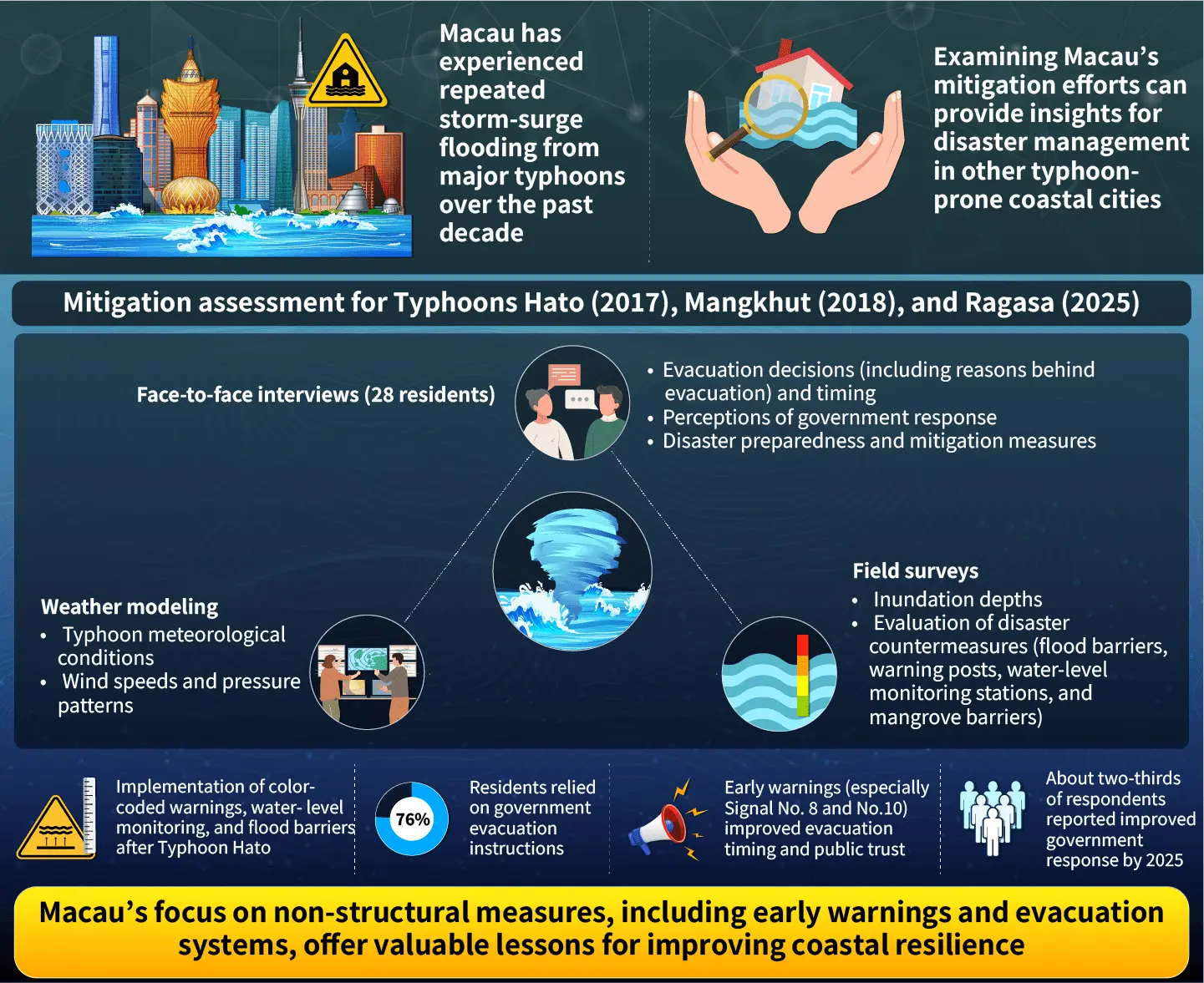
The success of disaster mitigation depends not only on physical infrastructure, but also on timely warnings and evacuation systems that clearly communicate risks to the public. Macau provides an important example of how disaster preparedness and evacuation systems can improve resilience against typhoons. Located in the Pearl River Delta and surrounded by the South China Sea to the east and south, the city is highly exposed to coastal flooding caused by storm surges. Despite its exposure to storm surges and extremely high population density, the city’s resilience has improved in recent years.
Against this backdrop, Professor Hiroshi Takagi from the School of Environment and Society, Institute of Science Tokyo (Science Tokyo), Japan, investigated the reasons behind this improvement in order to identify lessons that may help other coastal cities facing similar risks.
“As external observers, we examine how the Macau government and the public have responded to recent major typhoons, and assess the effectiveness of these responses. This study provides an external assessment of Macau's mitigation efforts, with implications for other typhoon-prone coastal cities,” explains Takagi.
The findings which were made available online in the International Journal of Disaster Risk Reduction on April 17, 2026, and to be published in Volume 139 on June 01, 2026, point to the importance of non-structural disaster countermeasures in improving coastal resilience.
Macau experienced severe storm-surge flooding during three major typhoons over the last decade: Typhoon Hato in 2017, Mangkhut in 2018, and Ragasa in 2025. To assess emergency responses and evacuation procedures, the research team conducted resident interviews following each typhoon, including 28 residents surveyed after Typhoon Ragasa in 2025, regarding their perception on the effectiveness of evacuation measures, their reasons for evacuating, and the kinds of disaster measures they wanted in the future.
Typhoon Hato in 2017 became a turning point for disaster management in Macau. The storm caused catastrophic storm-surge flooding in urban districts, and delays in warning issuance led to strong public criticism, ultimately resulting in the resignation of the Meteorological Bureau Director. In response, Macau strengthened many of its non-structural or soft disaster countermeasures. The city began issuing higher-level warnings in its typhoon warning system earlier, providing residents with more time to evacuate before severe flooding began. A separate storm-surge warning system using five color-coded levels was also introduced and communicated to residents. Other measures included the installation of color-coded storm-surge hazard indication poles that visually indicated flood risk levels, government evacuation patrols, and government subsidies for the installation of deployable flood barriers in commercial establishments.
These improvements were met with positive feedback from residents. About two-thirds of respondents answered that the government's response during Typhoon Ragasa had improved significantly compared to previous typhoons. Residents mentioned shorter power outages, quicker issuance of evacuation instructions, installation of drainage pumps, deployment of portable floodgates, government patrols urging residents to return home, and prompt post-typhoon cleanup.
The study notes that Macau’s disaster strategy differs from approaches used in Japan, where coastal protection often focuses on large seawalls, floodgates, and dikes. Instead, Macau emphasizes non-structural measures such as evacuation guidance, communication, monitoring systems, and public awareness.
“Although no major coastal defenses, such as tall seawalls, have been built since Typhoon Hato, a suite of soft measures, including earlier warnings, government-led evacuations, storm-surge warning posts, water-level stations, portable floodgates, mangrove afforestation, and residents' memories of past inundation, reflects enhanced resilience among authorities and citizens,” says Takagi.
The findings highlight the importance of public trust in government evacuation measures, clear communication, early evacuation guidance, and adaptive non-structural measures in significantly reducing disaster impacts in densely populated urban areas.
Reference
- Authors:
- Hiroshi Takagi* and Yuzhe Zhao
- Title:
- Storm surge responses in Macau: Early warnings and soft adaptation
- Journal:
- International Journal of Disaster Risk Reduction
- Affiliations:
- 1Affiliations: School of Environment and Society, Institute of Science Tokyo, Japan
*Corresponding author
Related articles
Further information
Professor Hiroshi Takagi
School of Environment and Society, Institute of Science Tokyo
Contact
Public Relations Division, Institute of Science Tokyo
- media@adm.isct.ac.jp
- Tel
- +81-3-5734-2975