Ohue Laboratory students win top prize at 2nd Joint EU-OPENSCREEN/SLAS Machine Learning Challenge
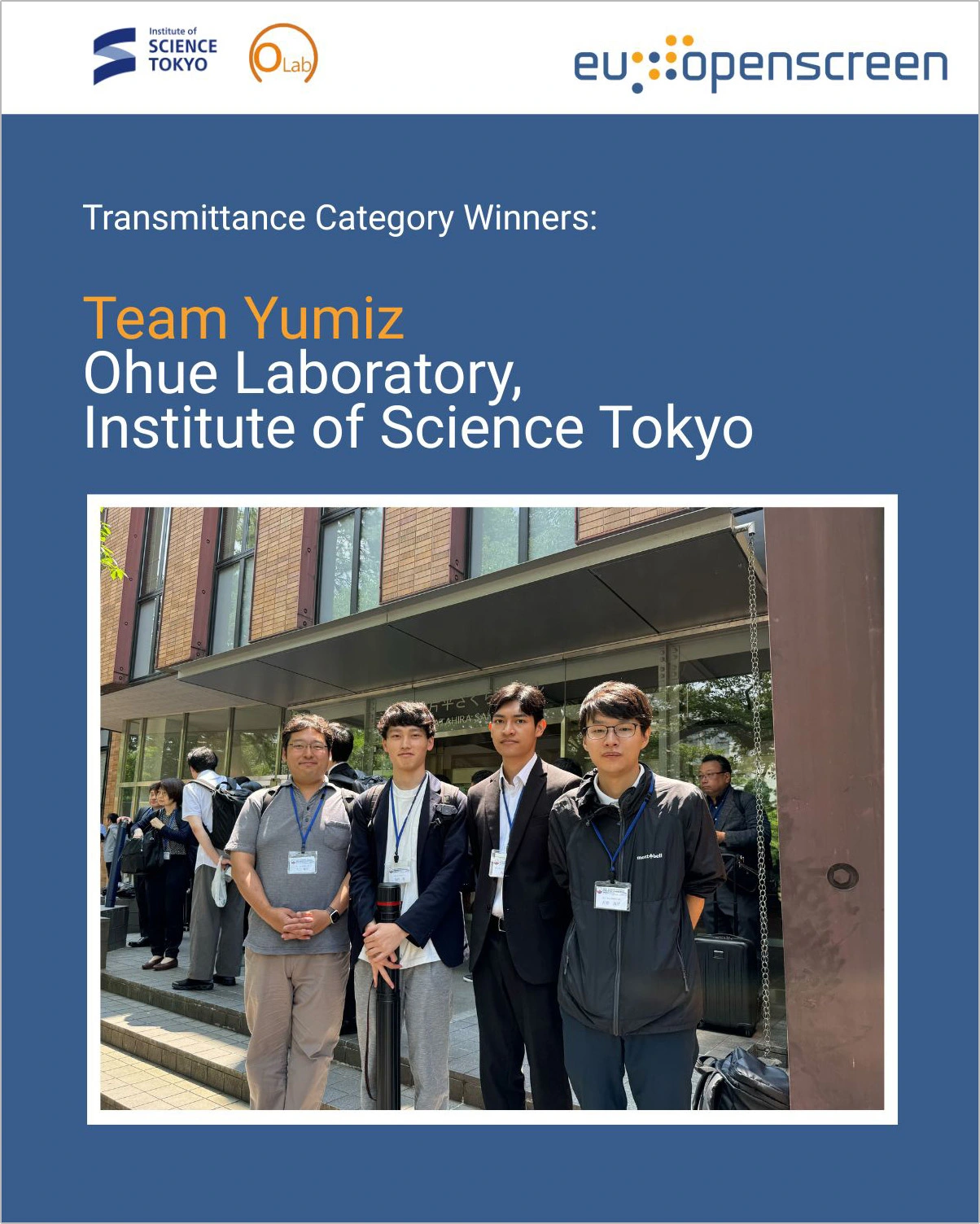
Team Yumiz, consisting of three students from Science Tokyo’s Ohue Laboratory, has won First Prize in the Transmittance Category of the 2nd Joint EU-OPENSCREEN/SLAS Machine Learning Challenge, an international machine learning competition joined by teams of researchers and students from around the world.
Organized by EU-OPENSCREEN, a not-for-profit European Research Infrastructure Consortium (ERIC) that supports chemical biology research across Europe, and the Society for Laboratory Automation and Screening (SLAS), an international scientific society dedicated to advancing automation technology and high-throughput screening in the life sciences, this competition focuses on developing methods to accurately predict the spectroscopic properties of compounds using machine learning. This methodology is recognized as a critical challenge with potential applications in drug discovery and materials science.
The participants’ entries were comprehensively evaluated based on prediction accuracy and generalization performance. Second-year doctoral student Kairi Furui, second-year doctoral student Apakorn Kengkanna, and second-year master’s student Koh Sakano, all from the Department of Computer Science, used a weighted ensemble that combined 1D, 2D and 3D molecular information. Tree-based and deep learning models were trained together and validated with 5-fold Murcko scaffold cross-validation to ensure reliable and generalizable results.
The trio received their award on February 9 at a ceremony held during the SLAS2026 International Conference and Exhibition in Boston, USA.
In recent years, "AI for Science" — an initiative aimed at revolutionizing scientific research systems through artificial intelligence — has been designated a key policy priority in Japan, making the development of infrastructure for generating and utilizing data to support AI development an urgent priority. The findings of Team Yumiz demonstrate the international competitiveness of young researchers driving the advancement of data-driven science, while also reaffirming the potential for applying machine learning technologies to the field of chemistry.
Moving forward, Science Tokyo anticipates the application of these findings to real-world data and their implementation in society through industry-academia collaboration.