Smartphone app "SciBaby" helps soothe crying Infants and put them to sleep
90% of infants stop crying within 13 minutes and half of them fall asleep naturally
Key highlights
- The SciBaby smartphone app uses scientific evidence to provides audio and music guidance on the effective timing for carrying, walking, and putting a crying baby to sleep.
- By connecting with a leg-worn pulse sensor, the app visualizes the infant's physiological state, contributing to the development of AI algorithms that predict optimal sleep timing for individual infants.
Overview
A joint research group led by Professor Kumi Kuroda and Researcher Kento Harachi from the School of Life Science and Technology, along with Professor Natsue Yoshimura from the School of Computing at Science Tokyo, has developed "SciBaby". This research-oriented smartphone app is designed to scientifically support parents and caregivers struggling with infant crying and sleep issues.
For more details, please visit the official SciBaby website.
Science behind the app
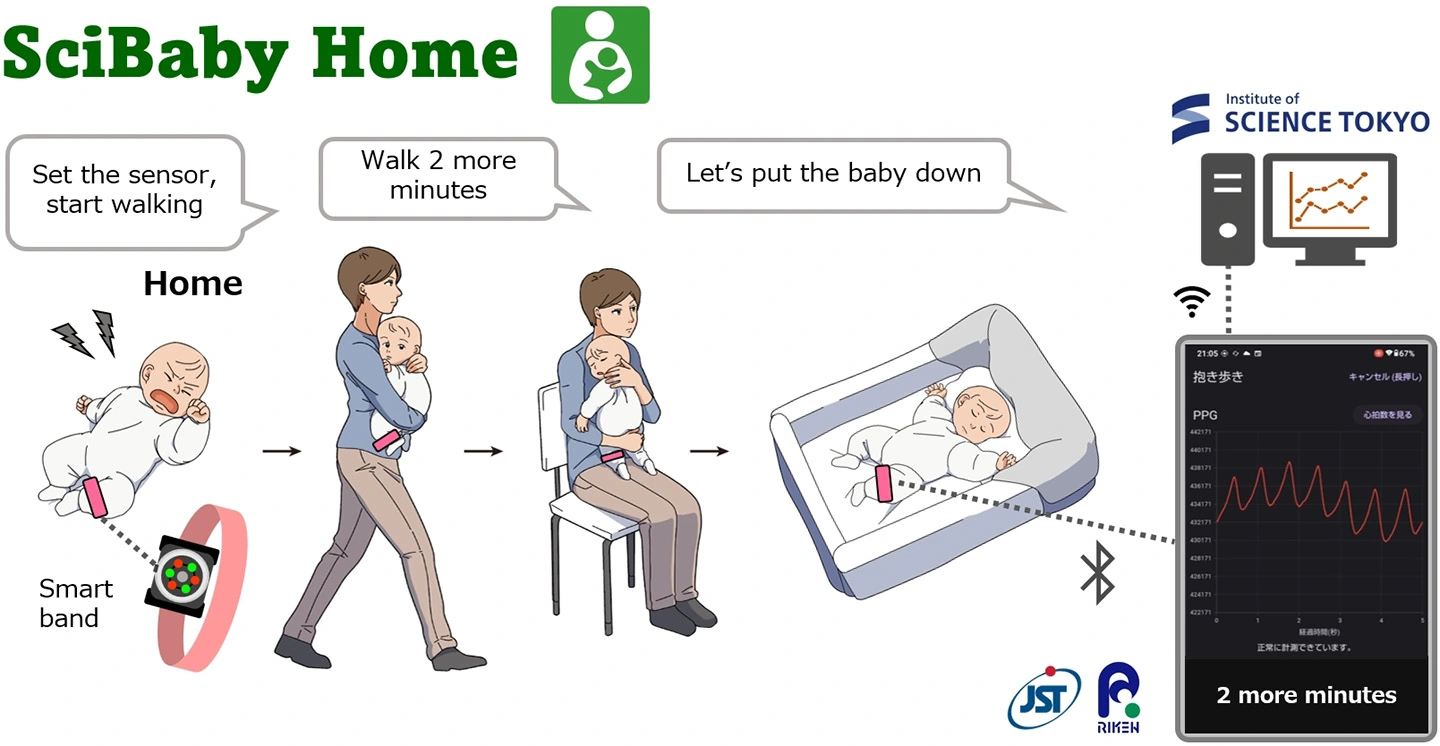
The app is based on the "transport response," a phenomenon discovered by the Kuroda Lab in 2013 where mammalian infants instinctively calm down when carried. In 2022, the team demonstrated that five minutes of continuous walking followed by eight minutes of seated holding is highly effective for inducing sleep. SciBaby assists parents and caregivers in practicing this method safely and effectively.
Experimental results and AI development
Interim results from 300 trials with 30 infants showed that 84.4% of crying infants stopped crying after five minutes of walking. Furthermore, 58.4% fell asleep by the end of the subsequent 8-minute seated holding period. A larger demonstration experiment involving 89 infants confirmed that 89.7% stopped crying after a 5-minute walk, and 93.6% after 10 minutes.
However, since approximately 20% of infants wake up when being placed in bed, the team is using data collected via the Polar Verity Sense sensor to develop AI capable of predicting the precise optimal moment for the transition.
How SciBaby works
When an infant is fussy, parents can activate the "Walk-and-Carry mode". The app connects via Bluetooth to a leg-worn pulse sensor to monitor the baby's heart rate (International Patent PCT/JP2023/008805). SciBaby provides music at an ideal walking tempo and signals when to transition from walking to sitting, and finally to bed. (Please refer to our user manual for the precise placement of the sensor.)
Social impact
While SciBaby is not a replacement for daily childcare routines, it provides a science-backed tool for difficult situations, such as when a parent is absent or the family is away from home. By identifying the best soothing methods for individual infants, this research has the potential to support not only households but also nurseries and hospitals. Additionally, to accommodate situations where carrying is not possible, the team is collaborating with Combi Corporation to verify the effectiveness of electric baby racks.
Future outlook
Following the Android release in February 2025, the iOS and English versions were officially launched in April 2026. This milestone allows a wider range of users to participate in the research. Future updates will include AI-driven personalized sleep timing alerts and tools to evaluate nighttime sleep quality, potentially assisting in the diagnosis of pediatric sleep disorders.
Comments by Professor Kuroda
Infants often cry for no apparent reason until they reach one year of age. Since persistent crying, especially at night, is a major stressor for caregivers, there is a clear need for safe and effective soothing methods. SciBaby translates our research into a practical tool for home use. With the release of the iOS version, we hope to make childcare more manageable while deepening our scientific understanding of infant physiological states.

Funding and support
This research is supported by the JST CREST program (JPMJCR23N4) under the "Innovating Life Science Research through Data-Driven and AI-Driven Digital Transformation" area. The app was developed with cooperation from miracleave Co., Ltd. and in collaboration with Combi Corporation.
(Disclaimer: Effects vary by individual. Science Tokyo assumes no responsibility for damages arising from the use of these results.)
Related articles
Contact
Professor Kumi Kuroda
School of Life Science and Technology, Institute of Science Tokyo