Understanding the physics at the anode of sodium-ion batteries
Researchers reveal new mechanisms governing the storage and the movement of sodium ions in hard carbon anodes
Supercomputer-based simulations reveal the intricacies of sodium-ion clustering and transport in hard carbon nano-pores, report researchers from Science Tokyo. Their results show that a bottleneck effect can lead to the sluggish diffusion of ions in sodium-ion batteries, while also providing useful nanostructural design guidelines to increase the energy density of hard carbon anode. By implementing these insights, the realization of carbon-neutral society can be accelerated.
Understanding the Behavior of Sodium (Na) Ions in the Anode of Na-Ion Batteries
Sodium-ion batteries (NIBs) are gaining traction as a next-generation technology to complement the widely used lithium-ion batteries (LIBs). NIBs offer clear advantages versus LIBs in terms of sustainability and cost, as they rely on sodium—an element that, unlike lithium, is abundant almost everywhere on Earth. However, for NIBs to achieve widespread adoption, they must reach energy densities comparable to LIBs.
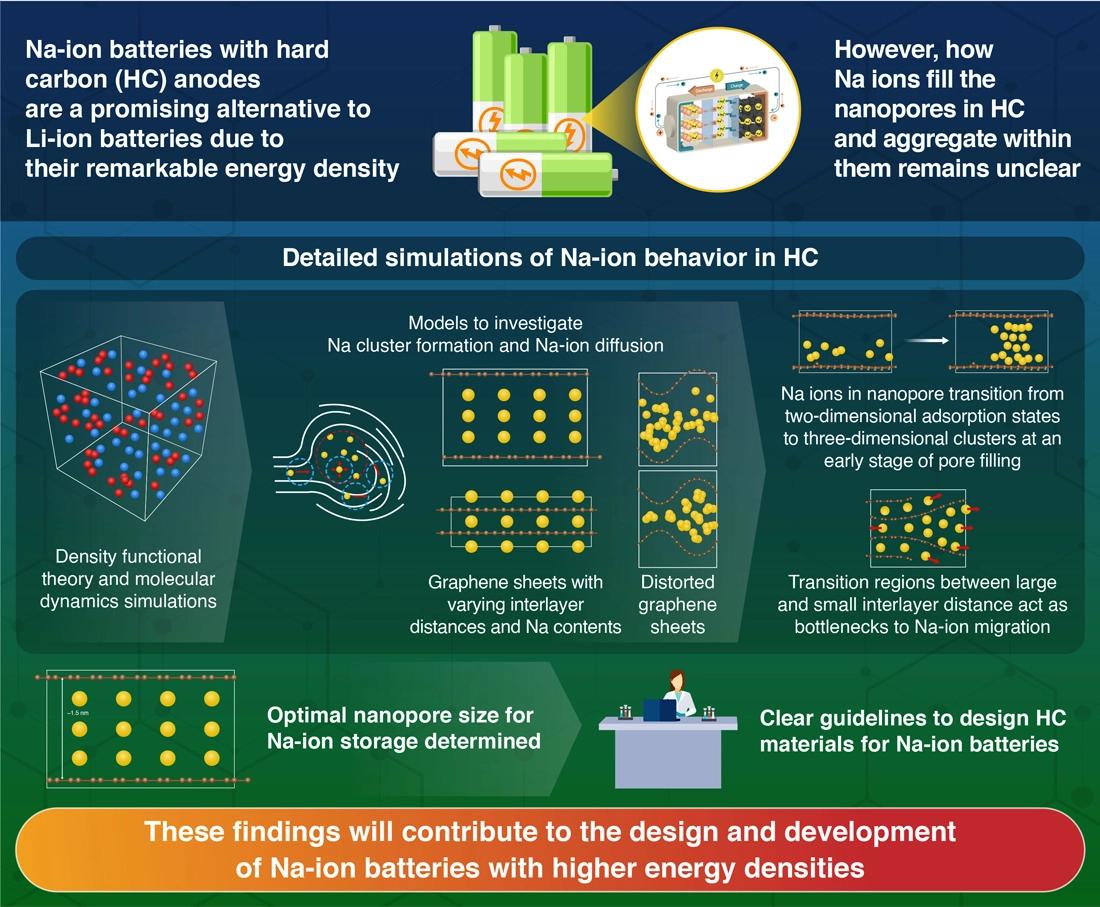
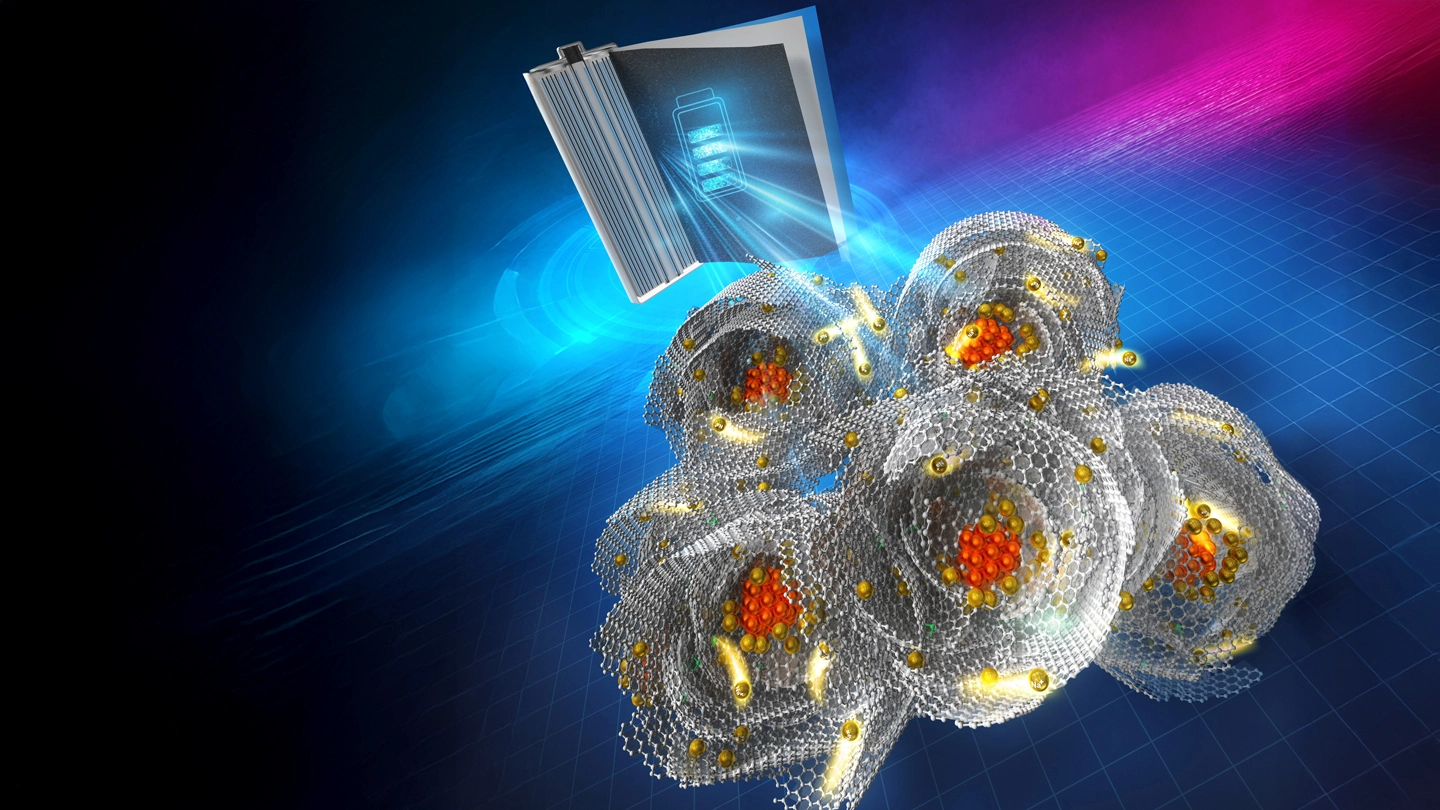
State-of-the-art NIB designs use hard carbon (HC), a porous and amorphous type of carbon, as an anode material. Scientists believe that sodium ions aggregate into tiny quasi-metallic clusters within HC nano-pores, and this “pore filling” process remains as the main mechanism contributing to extended reversible capacity of HC anode. Despite some computational studies on this topic, the fundamental processes governing sodium storage and transport in HC remain unclear. Specifically, researchers have struggled to explain how sodium ions can gather to form clusters inside HC pores at operational temperatures, and why the overall movement of sodium ions through the material is sluggish.
Against this backdrop, a group led by Professor Yoshitaka Tateyama from the Laboratory for Chemistry and Life Science, Institute of Science Tokyo (Science Tokyo), Japan, set out to model this complex nanoscopic behavior to address these long-standing questions. In their latest study, which was published online in the journal Advanced Energy Materials on November 17, 2025, the team ran high-accuracy density functional theory-based molecular dynamics (DFT-MD) simulations on powerful supercomputers, including Fugaku, to create localized models of the HC structure.
The simulations explored different arrangements of sodium ions and graphene sheets as self-contained representations of the nanopores and graphitic regions in HC. The results provided unprecedented clarity on the mechanisms controlling both capacity and reaction kinetics at the anode in NIBs. First, the simulations revealed that sodium ions in nanopores transition early from a two-dimensional adsorption state to a three-dimensional, quasi-metallic cluster state.
Based on the above finding, the team theoretically determined the optimal nanopore diameter for stable sodium storage, which turned out to be approximately 1.5 nm and matched experimental results. They also found that certain defect-adsorbed sodium ions, rather than acting as nucleation sites, benefit sodium cluster formation through reducing Na-C interaction and available space of upcoming sodium ions in HC nano-pores.
Moreover, the DFT-MD simulations revealed that while sodium ions exhibit locally fast diffusion in well-connected areas of HC, branching or reconnection regions act as severe bottlenecks to ion migration. These narrower transition regions become clogged by sodium ions until enough repulsive force builds up to remove the blockage, creating a rate-limiting step that explains the material’s sluggish performance. “By integrating these new insights, our study provides clearer design guidelines for HC materials capable of storing sodium efficiently, thereby contributing to the development of better NIBs,” remarks Tateyama.
High-energy-density batteries are essential for storing electricity generated by solar and wind farms. In this sense, NIBs could be a key enabler in the current shift toward renewable energy generation systems. “Ultimately, the widespread adoption of NIBs will increase the overall supply of batteries in society, supporting the realization of a carbon-neutral future,” concludes Tateyama.
Reference
- Authors:
- Che-an Lin1,*, Huu Duc Luong1, Ryoma Sasaki1, and Yoshitaka Tateyama1,*
- Title:
- Unveiling Dominant Processes of Na Cluster Formation and Na-Ion Diffusion in Hard Carbon Nano-Pore: A DFT-MD Study
- Journal:
- Advanced Energy Materials
- Affiliations:
- 1Laboratory for Chemistry and Life Science, Institute of Science Tokyo, Japan
*Corresponding authors
Related articles
Further information
Professor Yoshitaka Tateyama
Institute of Integrated Research, Institute of Science Tokyo
Contact
Public Relations Division, Institute of Science Tokyo
- media@adm.isct.ac.jp
- Tel
- +81-3-5734-2975