Unveiling how quantum fluctuations influence asymmetric electrical transport in chiral magnets
Researchers develop theoretical framework based on quantum fluctuations that explains unusual conduction behavior in magnetic materials
Quantum fluctuations influence direction-dependent electrical transport in chiral magnets, report researchers from Science Tokyo. In chiral magnetic systems, electric current flows differently depending on its direction, but the role of quantum effects in this behavior has remained unclear. Through theoretical analysis, the researchers showed that chiral magnetic systems exhibit logarithmic temperature dependence at low temperature, offering new insights into electron transport in magnetic materials. These findings are expected to play a crucial role in spintronics.
A Quantum-Mechanical Perspective of Nonreciprocal Electrical Transport in Chiral Magnets
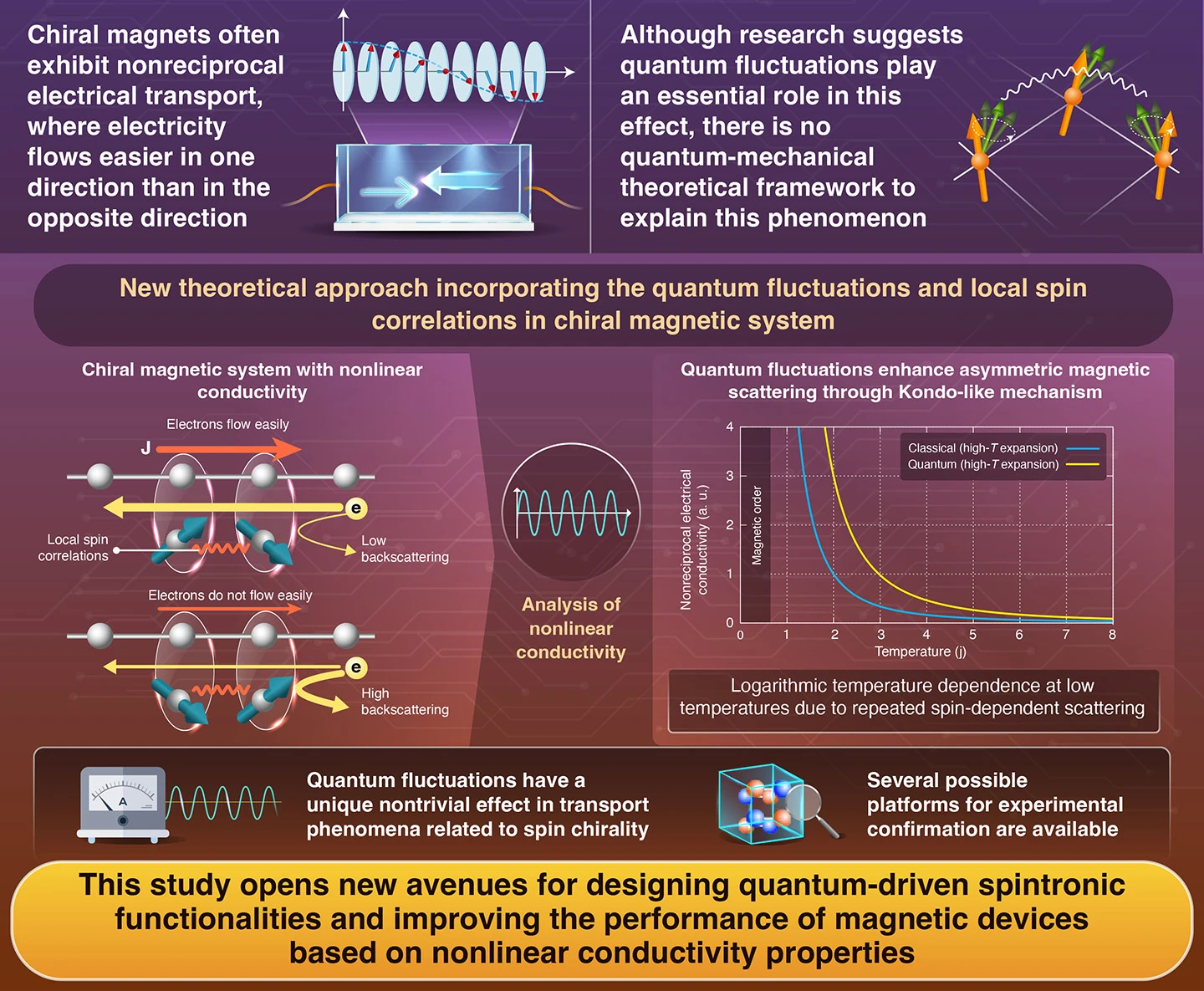
Chiral magnets are a special class of magnetic materials in which the atomic-scale magnetic moments twist into complex patterns, such as helices and vortices. These unusual spin structures can give rise to equally unusual electrical behavior. One example is nonreciprocal current, in which electric current flows more easily in one direction than the other. This effect is attracting growing interest among physicists not only because it reveals subtle aspects of electron–spin interactions, but also because it could be useful for magnetic sensing and spintronic devices.
Despite research efforts, our theoretical understanding of nonreciprocal transport in chiral magnets has remained incomplete. Previous work has mostly treated magnetic moments as if they were classical objects with localized spins. However, in several chiral magnets such as MnSi, experiments suggest that quantum fluctuations may strongly influence how electrons move through the material. Until now, there has been no clear quantum-mechanical framework explaining how such fluctuations affect nonreciprocal current.
Motivated by this gap, a research team led by Associate Professor Hiroaki Ishizuka from the Department of Physics, Institute of Science Tokyo (Science Tokyo), Japan, set out to build a theory that could account for these quantum effects. Their paper, made available online on July 15, 2026, and published in Volume 137, Issue 3 of the journal Physical Review Letters on July 17, 2026, uncovers a surprising link between nonreciprocal current in chiral magnets and a well-known quantum phenomenon seen in metals.
The researchers focused on the electrical magnetochiral effect, a type of nonreciprocal response in which the current contains a component proportional to the square of the applied electric field. Using a quantum model known as the Kondo lattice model, the team analyzed how conduction electrons scatter from localized magnetic moments in a chiral magnetic environment. They approached the problem in two complementary ways: one based on Green’s function calculations and another combining scattering theory with semiclassical Boltzmann transport theory.
Both approaches allowed them to explicitly track how quantum fluctuations of magnetic moments affect the way electrons scatter as they move through the material. Their calculations revealed that the nonreciprocal electrical conductivity develops a distinctive logarithmic dependence on temperature; this type of signature has no counterpart in classical models of magnetism.
Digging into the microscopic origin of this behavior, the team found that it arises from a mechanism similar to the Kondo effect. This phenomenon was first described in 1964 and involves the anomalous scattering of electrons off magnetic impurities at low temperatures. In the chiral magnetic system, the Kondo-like effect stems from quantum interference between an electron being scattered once by a magnetic moment and being scattered twice by that same moment. This subtlety only emerges because of the quantum nature of spin. "Our results indicate that a nontrivial effect unique to quantum fluctuations exists in the transport phenomena related to spin chirality," explains Ishizuka.
Looking ahead, the researchers point to several real materials, including MnSi, as promising candidates for experimentally confirming these predictions. This new theoretical framework for describing how quantum fluctuations influence nonlinear current in chiral magnets could lead to exciting applications, as Ishizuka concludes, "By demonstrating that Kondo-type quantum effects can significantly enhance nonreciprocal responses, our study opens new avenues for designing quantum-driven spintronic functionalities and improving the performance of magnetic devices based on nonlinear transport properties."
Reference
- Authors:
- Hajime Murata1 and Hiroaki Ishizuka1
- Title:
- Kondo Effect in Nonreciprocal Response
- Journal:
- Physical Review Letters
- DOI:
- 10.1103/y243-ygbf
- Affiliations:
- 1Department of Physics, Institute of Science Tokyo, Japan
Related articles
Further information
Associate Professor Hiroaki Ishizuka
Department of Physics, Institute of Science Tokyo
Contact
Public Relations Division, Institute of Science Tokyo
- media@adm.isct.ac.jp
- Tel
- +81-3-5734-2975