Flipping the switch on material chirality: modifying chirality with electricity
A voltage-driven method enables reversible, tunable chiral states
A way to electrically modify the chirality of organic–inorganic hybrid materials, in which chiral molecules adsorb onto inorganic surfaces, has been demonstrated by researchers at Science Tokyo. By using an electric double-layer transistor with a chiral electrolyte, specific chirality was imposed on an otherwise achiral molybdenum disulfide surface. This reversible method enables tunable chiral electronic states and opens new possibilities for advanced spintronic devices and the emerging field of “chiral iontronics.”
Using Electricity to Control Chirality in Semiconductor Materials
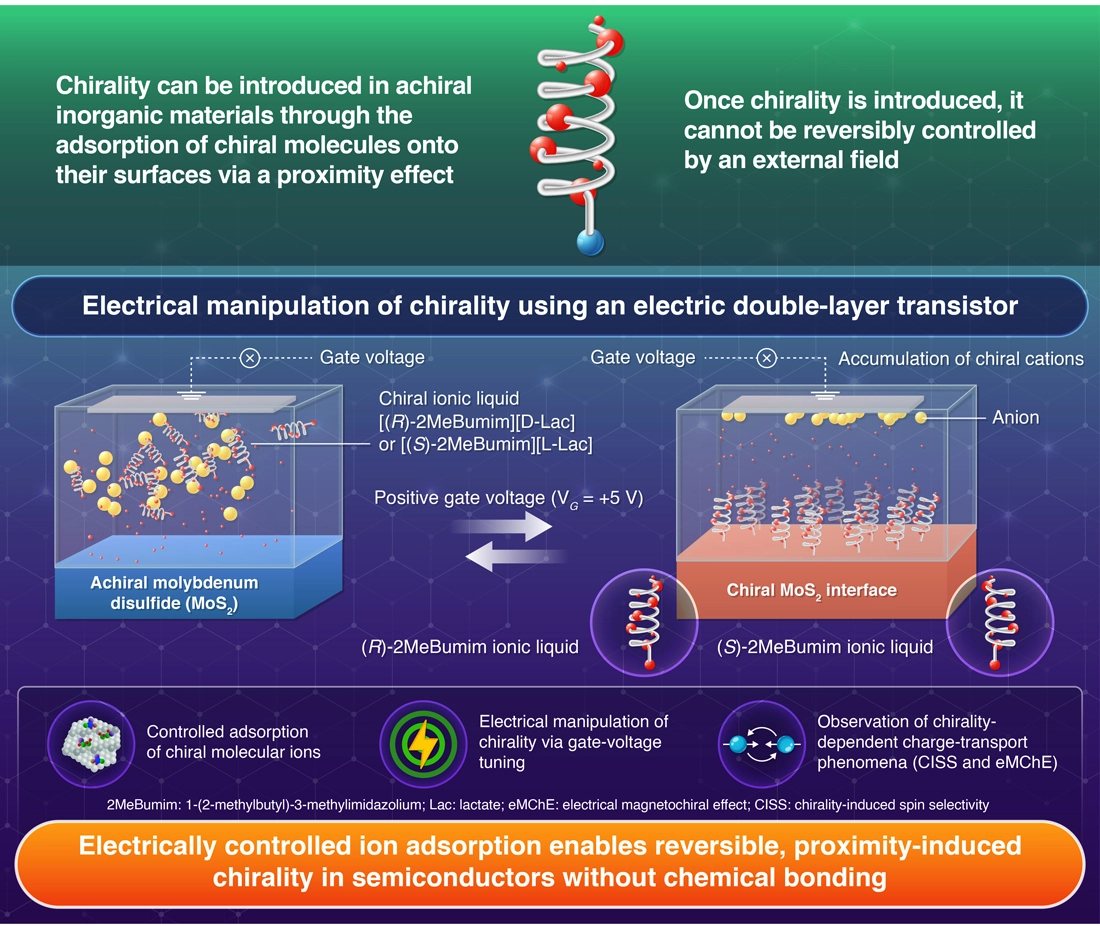
Chirality is a geometric property in which an object, like a left and right hand, cannot be superimposed on its mirror image. This orientation gives rise to unique physical effects, such as controlling the spin of electrons and how materials interact with light. In recent years, scientists have been able to introduce chirality into materials by attaching chiral molecules to the surface of otherwise non-chiral inorganic structures, creating hybrid materials with chiral electronic properties. However, once this chirality is established, it typically cannot be altered or reversed using external stimuli, limiting its practical use in real devices.
Now, researchers at Institute of Science Tokyo (Science Tokyo), Japan, have developed a method to manipulate this handedness on demand using electricity. This approach, published in Volume 11, Issue 47 of the journal Science Advances on November 21, 2025, provides a new way to impart chirality to semiconductors without the need for permanent chemical bonding.
The research team was led by Professor Kouji Taniguchi, Assistant Professor Po-Jung Huang, and Associate Professor Yoshio Ando of the Department of Chemistry, School of Science, Science Tokyo, in collaboration with a team led by Associate Professor Toshiya Ideue, Assistant Professor Miuko Tanaka, and Master’s student Yukito Nishio of the Institute for Solid State Physics, The University of Tokyo, Japan.
“We demonstrate the artificial introduction of chirality into an achiral molybdenum disulfide (MoS2) surface by controlling the adsorption of enantiopure molecular cations via an electric double-layer transistor (EDLT) with chiral ionic liquids,” explains Taniguchi.
An EDLT is a type of field-effect transistor that uses an electrolyte to apply extremely strong electric fields to material surfaces, enabling control of electrical conductivity. In this study, scientists constructed an EDLT device on a single crystal of MoS2, a naturally achiral material. The device included source and drain electrodes to measure current, a gate electrode to apply voltage, and a chiral ionic liquid.
When a positive gate voltage was applied, chiral positive ions accumulated directly on the MoS2 surface, forming a thin interfacial layer that altered the electronic state of the material.
The induced chirality was confirmed through two key transport phenomena: chirality-induced spin selectivity, which refers to the preferential transmission of electrons with a specific spin through a chiral system, and the electrical magnetochiral effect (eMChE), which is a non-reciprocal electrical response that appears only when a system is both chiral and exposed to a magnetic field.
When an ionic liquid with a right-handed molecular ion was used, electrons flowing through MoS2 showed a preference for one spin direction. When the left-handed version was used, the spin preference reversed. The researchers also detected clear eMChE signals, confirming the generation of a chiral electronic state.
The importance of this discovery lies in its reversibility and control. The chirality of the semiconductor interface could be turned on with a voltage, and its "handedness" was determined by the choice of the chiral ionic liquid. This discovery opens the door to a new research area known as “chiral iontronics,” where electronic and spintronic devices could be controlled through electrically tunable chirality.
“This distinctive characteristic is expected to trigger the development of previously unexplored electronic and spintronic devices by leveraging electrically controllable chirality-dependent functionalities. The proximity-induced chirality established in this study could open avenues for a new research field,” says Taniguchi.
Reference
- Authors:
- Po-Jung Huang1*, Yoshio Ando1, Miuko Tanaka2, Yukito Nishio2, Toshiya Ideue2, and Kouji Taniguchi1*
- Title:
- Proximity-induced chirality at the achiral conductive interface by electrical control of enantiopure ion adsorption
- Journal:
- Science Advances
- Affiliations:
- 1Department of chemistry, Institute of Science Tokyo, Japan
2Institute for Solid State Physics, The University of Tokyo, Japan
*Corresponding authors
Related articles
Further information
Professor Kouji Taniguchi
School of Science, Institute of Science Tokyo
Contact
Public Relations Division, Institute of Science Tokyo
- media@adm.isct.ac.jp
- Tel
- +81-3-5734-2975