Mining without Digging: Liquid metal tin turns desalination brine into a magnesium resource
Vacuum degassing enables high-efficiency magnesium recovery from seawater desalination brine using liquid tin
Researchers at Institute of Science Tokyo (Science Tokyo) have developed a new liquid-metal process that can recover freshwater and magnesium resources from the concentrated brine discharged by seawater desalination plants. By combining liquid-tin direct-contact distillation with vacuum degassing, the method removes chlorine- and sulfur-containing species from the tin and enables magnesium-rich precipitates, with MgO as the major crystalline phase, to be recovered during cooling. In laboratory tests, the magnesium concentration in the recovered precipitate reached about 280 times that of the original brine, while the Mg/Na ratio reached up to about 5,300 times that of the original brine. The amount of magnesium recovered was estimated to correspond to more than 99% of the magnesium taken up by the liquid tin.
Mining Without Digging: Extracting Magnesium from Desalination Brine
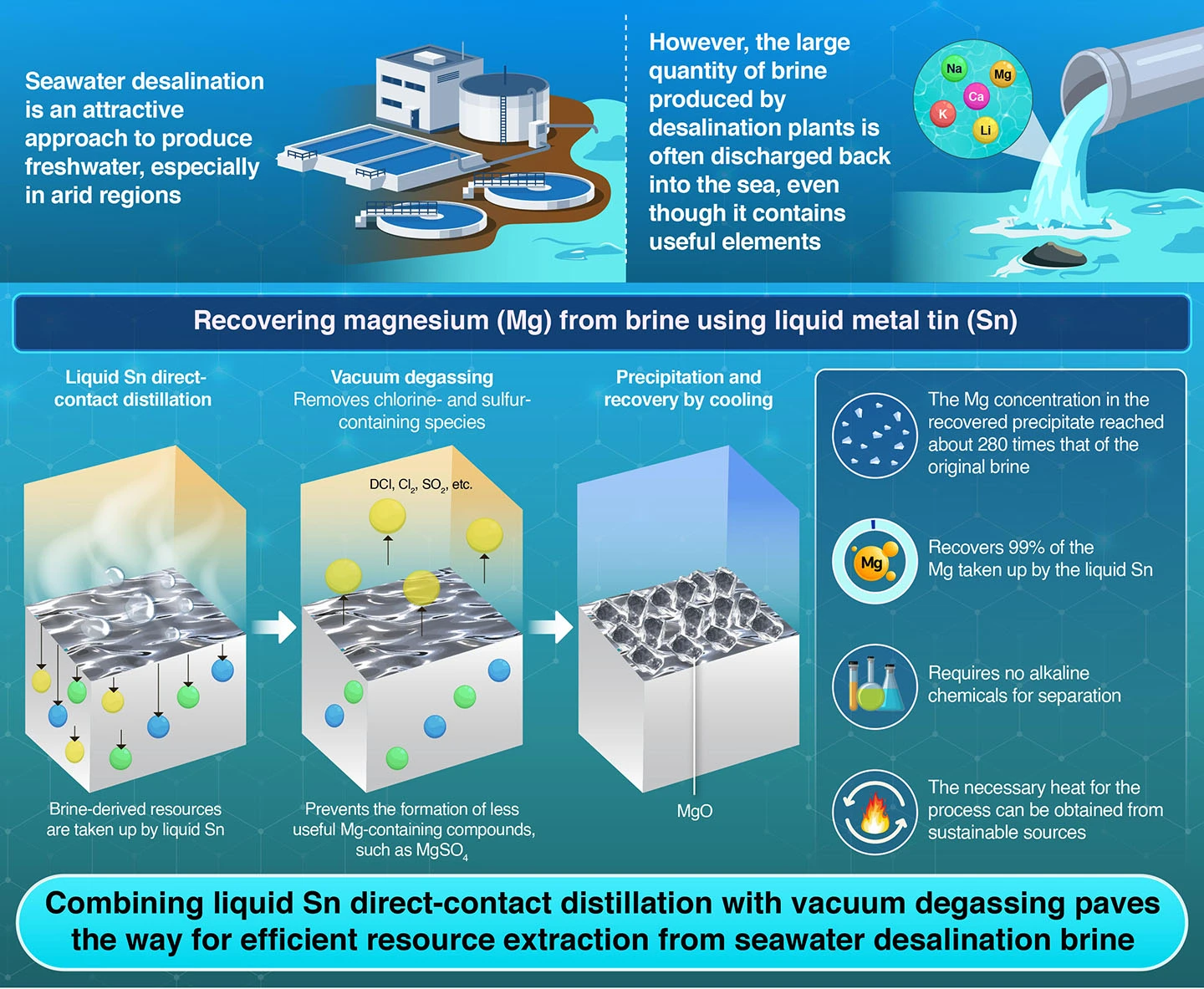
Water scarcity is becoming increasingly serious worldwide as population growth and climate change increase demand for freshwater. Seawater desalination is therefore attracting growing attention, especially in arid regions. However, desalination plants also generate large volumes of highly concentrated brine. Globally, roughly 50 trillion liters of brine are produced every year, exceeding the amount of freshwater produced by desalination.
This brine is usually diluted and discharged back into the sea, even though it contains useful elements such as sodium and magnesium at concentrations higher than those in seawater. Magnesium, in particular, is used in a wide range of industries including automobiles, aerospace, batteries, cement, and refractory materials. Conventional magnesium-recovery methods can require substantial quantities of chemicals or electricity and can generate secondary waste.
A research team comprising doctoral student Toranosuke Horikawa of the School of Engineering and Associate Professor Masatoshi Kondo of the Laboratory for Zero-Carbon Energy, Institute of Integrated Research, Science Tokyo, has been developing an alternative approach based on liquid tin. Their earlier work showed that when desalination brine is brought into direct contact with hot liquid tin, water evaporates and can be recovered as distilled water, while elements such as magnesium, sodium, calcium, and potassium are taken up by the liquid metal.
A remaining challenge was that chlorine and sulfur from the brine were also incorporated into the tin. These elements can react with magnesium to form compounds such as magnesium sulfate, limiting the range of industrial applications of the recovered material. The team therefore introduced a vacuum-degassing step to remove these unwanted nonmetallic components before recovering magnesium.
In the experiments, about 8 g of tin was melted at 573-673 K (about 300-400°C), and artificial brine prepared with heavy water (used for isotope tracing in gas analysis) was supplied onto the liquid surface at 0.1 mL per minute. The water evaporated and was collected separately, while magnesium, sodium, chlorine, sulfur, and other brine-derived components were incorporated into the liquid tin.
The brine-loaded tin was then heated under a high vacuum of about 10-3 Pa from 573 or 673 K to 973 K (about 700°C) at 2.5 K per minute and held for approximately 10 minutes. Gas analysis showed that chlorine- and sulfur-containing species were released as gases including HCl, DCl, Cl2, SO2, and H2S. From the change in the mass of the liquid tin before and after treatment, about 59-67% of the brine-derived gaseous components were estimated to have been removed.
After vacuum degassing, the tin was slowly cooled while the vacuum was maintained. As the temperature decreased, the solubility of dissolved elements in liquid tin fell and precipitates formed through recovery by cooling (solubility-driven precipitation). Microscopic observations showed that magnesium-rich and sodium-rich regions formed at different locations, indicating that the elements could be separated during cooling.
When 20 mL of brine was processed at 673 K, the magnesium concentration in the precipitate reached up to about 280 times that of the original brine, and the Mg/Na ratio increased by about 5,300-fold. The amount of magnesium recovered was estimated to be equivalent to more than 99% of the magnesium absorbed into the liquid tin. Electron microscopy and electron backscatter diffraction further showed that the major crystalline phase in the magnesium-rich precipitate was MgO.
Because the process separates and concentrates magnesium without relying on large additions of alkaline chemicals, it may reduce chemical consumption and secondary waste compared with conventional precipitation methods. The heat required for the liquid-tin process could potentially be supplied by concentrated solar thermal energy or high-temperature industrial waste heat.
A conceptual design estimated that, under idealized conditions, the electricity required for vacuum degassing could be about 1.7 kWh per kilogram of magnesium recovered. For a solar-driven module designed for a sunny, water-stressed region such as Egypt, a 15-m-diameter solar concentrator was estimated to have the potential to produce about 970 kg of freshwater and recover about 2.8 kg of magnesium per day.
The researchers describe the broader concept as 'mining without digging': obtaining valuable resources not from newly excavated ores, but from water streams that are currently treated as waste. The next step is to develop a continuous system in which liquid tin is circulated through freshwater production, vacuum degassing, magnesium precipitation and recovery, and tin reuse. Long-term stability, compatibility with structural materials, purification of the recovered magnesium product, energy use, and economic feasibility will also need to be evaluated before practical deployment.
Reference
- Authors:
- Toranosuke Horikawa*1 and Masatoshi Kondo*2
- Title:
- Recovery of magnesium from seawater brine using liquid tin direct-contact desalination assisted by vacuum degassing
- Journal:
- Desalination
- Online publication:
- July 31, 2026
- Affiliations:
- 1School of Engineering, Department of Mechanical Engineering, Institute of Science Tokyo, Japan
2Institute for Integrated Research, Laboratory for Zero-Carbon Energy, Institute of Science Tokyo, Japan
Related articles
Further information
Associate Professor Masanori Kondo
Institute for Integrated Research, Laboratory for Zero-Carbon Energy, Institute of Science Tokyo
Contact
Public Relations Division, Institute of Science Tokyo
- media@adm.isct.ac.jp
- Tel
- +81-3-5734-2975