Storing hydrogen with electricity! A new solid electrolyte could transform the future of energy
Next-generation hydrogen storage technology that stores and uses negatively charged hydrogen inside a solid
What the research is about
Hydrogen power generation, which exhausts only water when burned, is often described as the ultimate clean energy. However, a major challenge has been how to safely store the hydrogen needed for power generation. Compressing hydrogen into high-pressure tanks or liquefying it at ultra-low temperatures below −253℃ can store large amounts of hydrogen in a small volume, but handling high-pressure gas and cryogenic liquid requires great care. Above all, hydrogen is a flammable gas. The difficulty of hydrogen storage has long troubled researchers.

One promising approach is to confine hydrogen inside a solid for storage. In fact, this idea is not new: research on hydrogen-absorbing alloys that can store and release hydrogen began in the 1960s, and in the 1980s a mechanism was proposed to electrically insert and extract hydrogen as ions. Yet these methods faced many issues, such as the need to heat the hydrogen-storing metal to temperatures above 300℃, and the degradation of the metal after repeated storage and release cycles. In recent years, hydrogen storage materials that operate at room temperature have also been reported, but storing and retrieving hydrogen has remained difficult—reactions may stop partway, for example—leaving practical use still far out of reach.
Why this matters
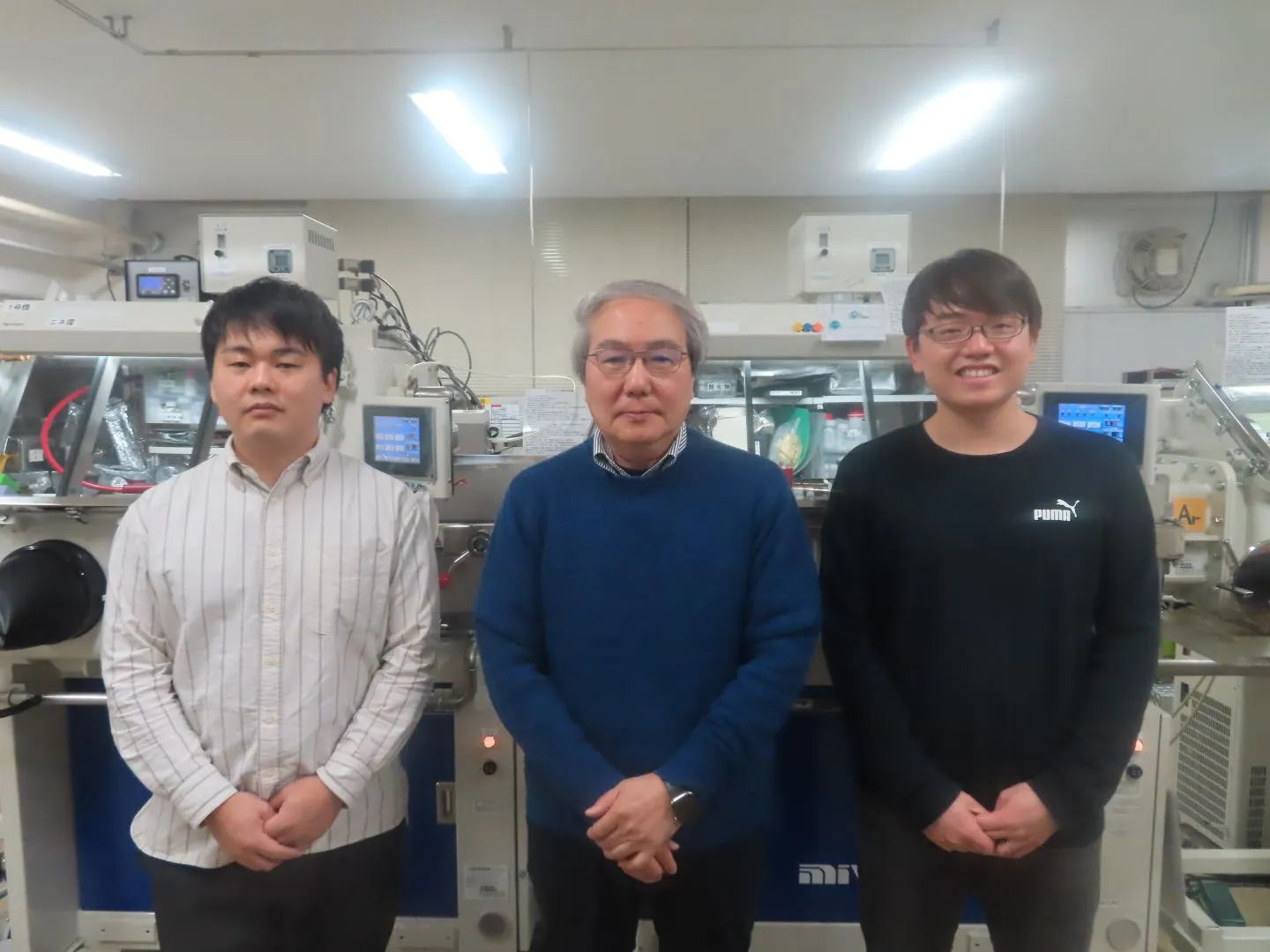
A research team at Institute of Science Tokyo (Science Tokyo) led by Institute Professor Ryoji Kanno, Assistant Professor Naoki Matsui, and Takashi Hirose (then a postdoctoral researcher; now an assistant professor at Science Tokyo) has developed a new solid electrolyte, Ba₀.₅Ca₀.₃₅Na₀.₁₅H₁.₈₅, that can address key challenges in hydrogen storage technology all at once. In this material, hydrogen can move readily even at room temperature as H⁻ (hydride ions: negatively charged hydrogen that carries one extra electron).
Molecular-motion simulations revealed that H⁻ moves three-dimensionally through the gaps between metal atoms in the crystal of the solid electrolyte—through tetrahedral and octahedral voids. Such a structure, in which ions can move this freely, is rare, and it is this feature that produces the material’s high ionic conductivity.
The team combined this solid electrolyte with magnesium (Mg). By applying an electric current, they drove hydride ions to move and inserted them into Mg. They also confirmed that reversing the direction of the current allows switching freely between “inserting” and “extracting” hydride ions in Mg. In other words, the system functions as if it opens and closes a door that lets the metal accept hydrogen.
Using a prototype hydrogen storage device, the team successfully stored hydrogen at 90℃ at an amount corresponding to 7.7% of the mass of Mg. This level of performance previously required temperatures above 300℃, meaning it was achieved at less than one-third of the conventional temperature. At an even lower temperature of around 60℃, they also succeeded in repeatedly storing and extracting hydrogen at more than 84% of the theoretical maximum. In doing so, they demonstrated for the first time in the world that a safe, rechargeable hydrogen storage device—one that can be “charged” with electricity—can be realized.
What’s next
This technology provides a foundation for new hydrogen storage devices that can store hydrogen and electrical energy safely and efficiently, and retrieve them when needed. It is expected to make a major contribution toward realizing efficient systems that use hydrogen as an energy carrier.
If safe and highly efficient hydrogen storage and power-generation systems become available, it may no longer be a dream to reshape how society manages energy—such as energy management in homes and factories, and effective use of surplus electricity from renewable energy sources.
Comment from the researchers
To realize a hydrogen-based society, technologies that enable hydrogen to be stored safely and used freely are essential. This achievement is a first step toward that future. There is still room for improvement, but we will continue our research with the goal of making “hydrogen stored with electricity” something that feels completely normal.
(Naoki Matsui, Assistant Professor, Research Center for All-Solid-State Battery, Institute of Integrated Research, Science Tokyo)
Dive deeper



Contact
- Remarks
- Research Support Service Desk