Detecting the body's magnetic fields with a low-power Ramsey-based magnetometer
The sensor overcomes thermal limitations of conventional systems, enabling close-proximity detection of picotesla-level biomagnetic signals
A Ramsey-based diamond quantum magnetometer developed by researchers at Science Tokyo enables highly sensitive biomagnetic measurements without compromising thermal safety. Using a low-power laser, a light-trapping diamond waveguide, and a compact microwave antenna, the temperature rise in the sensor is just 13 K with a sensor-to-sample distance of 2 mm, enabling detection of picotesla-level (10-12 T) magnetic fields. The sensor enables safe, close-proximity biomagnetic measurements for future magnetocardiography and magnetoencephalography applications.
Overcoming Thermal Barriers in Biomagnetic Sensing
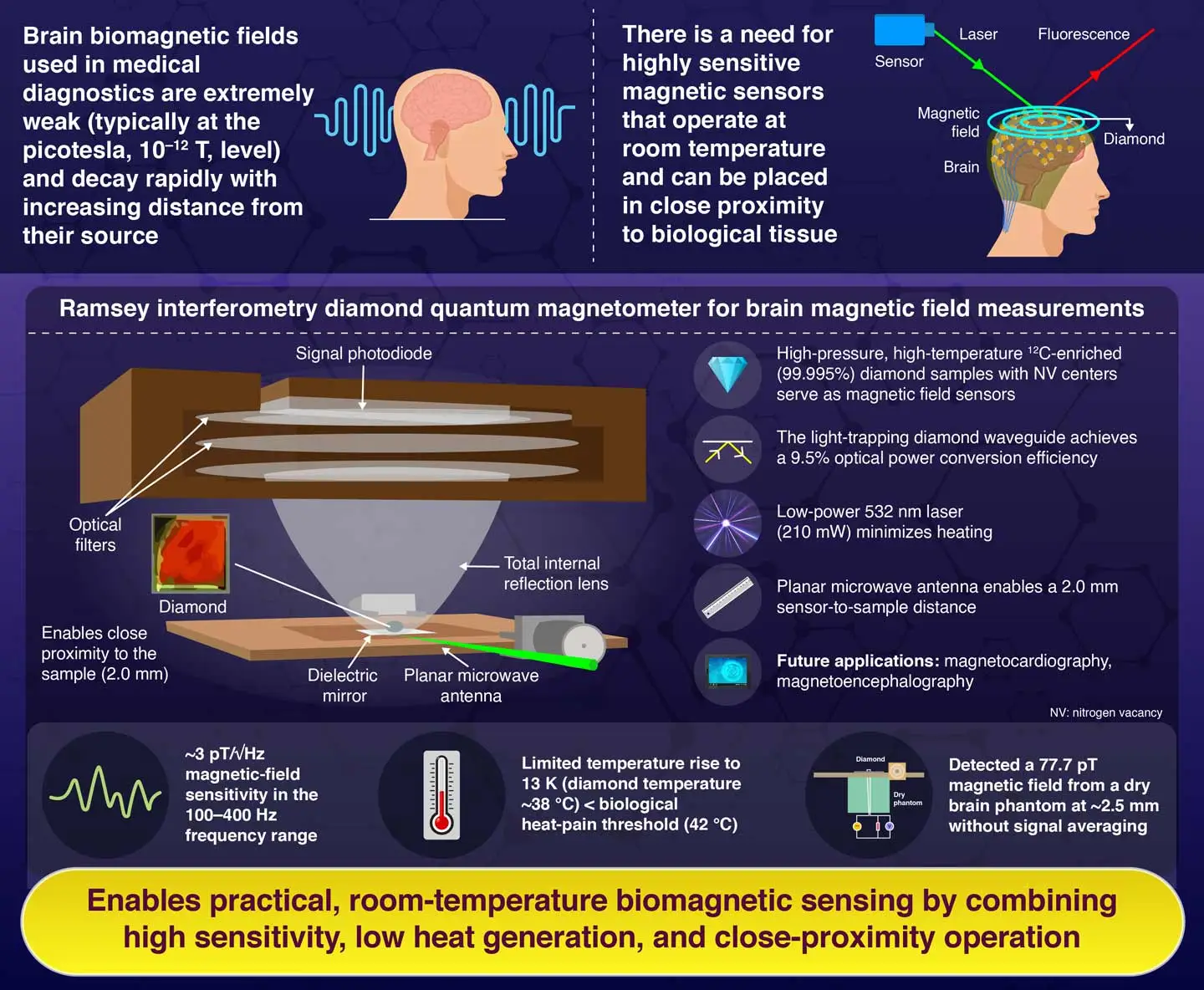
Our bodies generate extremely weak magnetic fields as electric currents flow through the heart, brain, and other tissues. These signals are used in magnetocardiography and magnetoencephalography to assess heart function and brain activity, respectively. These fields can be detected at room temperature using diamond sensors containing nitrogen-vacancy (NV) centers, in which a carbon atom is replaced by a nitrogen atom adjacent to an empty lattice site.
However, conventional NV-center sensors typically require watt-level lasers to detect the extremely weak biomagnetic fields, which are usually below the picotesla level. These high-power lasers generate significant heat, limiting how close the sensor can be placed to biological tissue. Since biomagnetic fields rapidly weaken with distance, overcoming thermal and close-proximity challenges is essential for practical biomagnetic sensing.
A research team led by Professor Takayuki Iwasaki from the Department of Electrical and Electronic Engineering, School of Engineering, Institute of Science Tokyo (Science Tokyo), Japan, has developed a diamond quantum magnetometer that operates using a low-power laser of just 210 mW. The new sensor limits its temperature rise to only 13 K while allowing it to be placed just 2 mm from the sample, enabling close-proximity biomagnetic measurements without compromising thermal safety.
The team also included PhD student Yuta Araki, Researcher Takeharu Sekiguchi, and Designated Professor Mutsuko Hatano, all from the same institute; Group Leader Tokuyuki Teraji from the Semiconductor Defect Design Group, Research Center for Electronic and Optical Materials, National Institute for Materials Science (NIMS), Japan; Center Director Takeshi Ohshima from the Quantum Materials and Applications Research Center (QUARC), Takasaki Institute for Advanced Quantum Science, National Institutes for Quantum Science and Technology (QST), Japan; and Section Manager Takayuki Shibata from the Advanced Research and Innovation Center, DENSO CORPORATION, Japan. The paper will be published in Applied Physics Letters on July 22, 2026, and has been selected as a Featured Article by the journal. It is also scheduled to be featured in the AIP science news outlet Scilight.
"This achievement represents an important step towards practical biomagnetic measurements using diamond quantum sensors by simultaneously realizing room-temperature operation, low heat generation, and short-range sensing," says Iwasaki.
The sensor consists of a diamond containing a large number of negatively charged NV centers. It operates using Ramsey interferometry, in which the quantum spin state of the NV centers evolves between two microwave pulses. Laser pulses initialize and read out the spin state, allowing the magnetic field to be determined. To maintain high sensitivity with a low-power laser, the researchers needed to use the excitation light much more efficiently. To achieve this, they designed a light-trapping diamond waveguide, which guides the laser light through the diamond by repeated total internal reflection. This allows the laser light to interact with many more NV centers, producing much stronger fluorescence without increasing the laser power. As a result, the system collected approximately 20 mW of fluorescence from an incident laser power of 210 mW, corresponding to an optical power conversion efficiency of 9.5%. This efficiency allows the sensor to operate with laser powers about ten times lower than those typically used for biomagnetic measurements.
The researchers also designed a compact printed-circuit-board microwave antenna, allowing the sensor to be positioned just 2 mm from the sample. Together, these design improvements enabled the sensor to achieve a magnetic field sensitivity of approximately 3 pT/√Hz in the 100–400 Hz frequency range while maintaining the diamond temperature at approximately 38°C, safely below the 42°C biological heat-pain threshold.
When tested with a dry phantom that simulates brain magnetic signals, the sensor successfully detected a magnetic field of 77.7 pT at a sensor-to-sample distance of approximately 2.5 mm.
The proposed Ramsey-based sensor overcomes the thermal limitations that have traditionally restricted pulsed quantum sensing, demonstrating that highly sensitive biomagnetic measurements can be performed safely at close range, making it a promising platform for future biomagnetic sensing applications.
"We anticipate this work will serve as a crucial stepping stone for the quantum sensing community, proving that practical, high-sensitivity pulsed measurements are viable for biological applications," says Iwasaki.
Reference
- Authors:
- Yuta Araki1, Takeharu Sekiguchi1, Yuji Hatano1, Naota Sekiguchi1, Chikara Shinei2,3, Masashi Miyakawa4, Takashi Taniguchi4, Tokuyuki Teraji2, Hiroshi Abe5, Shinobu Onoda5, Takeshi Ohshima5,6, Takayuki Shibata7, Mutsuko Hatano1, and Takayuki Iwasaki1*
- Title:
- A Highly Sensitive Diamond NV Magnetometer Using Ramsey Interferometry with a Short Sensor-to-Sample Distance
- Journal:
- Applied Physics Letters
- Affiliations:
- 1Department of Electrical and Electronic Engineering, Institute of Science Tokyo, Japan
2Research Center for Electronic and Optical Materials, National Institute for Materials Science, Japan
3Department of Applied Physics, University of Tsukuba, Japan
4Research Center for Materials Nanoarchitectonics, National Institute for Materials Science, Japan
5Takasaki Institute for Advanced Quantum Science, National Institutes for Quantum Science and Technology (QST), Japan
6Department of Materials Science, Tohoku University, Japan
7Advanced Research and Innovation Center, DENSO CORPORATION, Japan
*Corresponding author
Related articles
Further information
Professor Takayuki Iwasaki
School of Engineering, Institute of Science Tokyo
Contact
Public Relations Division, Institute of Science Tokyo
- media@adm.isct.ac.jp
- Tel
- +81-3-5734-2975