From fruits to feathers: how a fruit-rich diet shaped the evolution of manakins
Researchers reveal link between enhanced taste perception and complex courtship displays of manakins
Genetic adaptations that helped neotropical manakins detect and digest fruit may have laid the foundation for the evolution of elaborate courtship displays and vivid plumage observed in manakins. An international research team, including researchers from Institute of Science Tokyo, Japan, combined genomic, functional, and evolutionary analyses to show that changes in taste perception and digestion preceded the emergence of these vibrant traits—revealing how simple physiological changes could drive behavioral evolution and biodiversity.
How Fruit-Eating Shaped the Evolution of Manakins
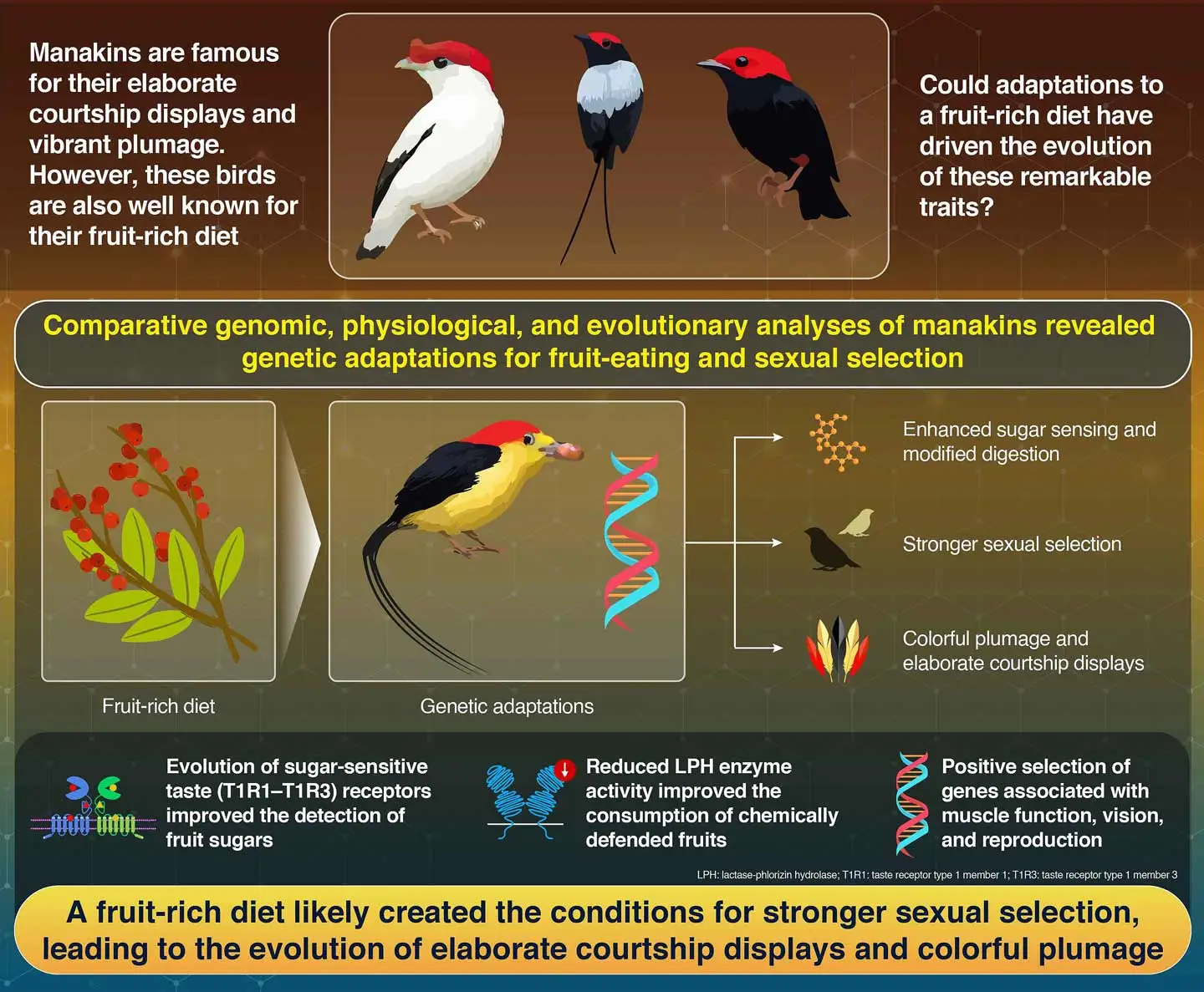
Natural selection has shaped a variety of surprising traits in animals, from dazzling colors to extraordinary survival strategies. Among birds, neotropical manakins are known for their striking appearance. Particularly, male manakins, which are renowned for their brilliant plumage and complex courtship displays, including performing rapid aerial acrobatics and producing distinctive sounds with their wings to attract mates. Performing these requires substantial energy, suggesting that the ability to detect and digest fruits may have provided the resources needed to support them.
Exploring this, researchers at Institute of Science Tokyo (Science Tokyo), Japan, investigated whether the adaptations to a fruit-rich diet preceded the evolution of courtship displays and colorful plumage. Led by Dr. Maude W. Baldwin from the Max Planck Institute and Associate Professor Christopher N. Balakrishnan from East Carolina University, in collaboration with Associate Professor Yasuka Toda from the School of Life Science and Technology, Science Tokyo, and Professor Yoshiro Ishimaru from Meiji University, the study explored how dietary adaptations shaped the evolutionary history of Neotropical manakins. Their findings were made available online on June 10, 2026, and published in Volume 36, Issue 12 of Current Biology journal on June 22, 2026.
Using comparative genomic analyses of five manakin species, the researchers investigated how genetic changes may have contributed to the evolution of fruit-eating and elaborate courtship traits. They also conducted laboratory experiments and evolutionary reconstructions to validate the links between these adaptations.
“Our analyses revealed evidence of positive selection in genes related to taste receptors, digestive enzymes, and other physiological functions associated with fruit consumption,” explain Baldwin and Balakrishnan.
“Furthermore, functional experiments revealed that the birds—having lost their sweet taste receptors, likely during the era of carnivorous dinosaurs—repurposed an umami taste receptor, known as the T1R1–T1R3 receptor, to detect sugars. This adaptation improved the birds’ ability to detect energy-rich fruits,” says Toda.
Additionally, the researchers also noted reduced activity of a digestive enzyme called lactase-phlorizin hydrolase in manakins. This change may have allowed the birds to also consume unripe or chemically defended fruits, without causing any harm during digestion. This means that the birds could exploit a wider variety of fruit resources. Together, these results indicate that these adaptations enhanced the detection and efficient use of fruits as a dependable and nutrient-rich food source.
In reconstructing the evolutionary history of these traits, the researchers found that the physiological adaptations for a fruit-rich diet appeared before the evolution of elaborate courtship displays and colorful plumage. “Acquiring the ability to exploit a fruit-rich diet might have supported the energetic conditions that later allowed strong sexual selection, driving the elaborate behavior of manakins,” suggests Toda.
These findings provide new insights into how basic physiological systems can affect the course of evolution. Rather than acting independently, changes in sensory perception and digestion can unfold sequentially with the evolution of traits in behavior and reproduction, indicating that one change can create opportunities for the next. By revealing how adaptations in taste perception and digestion preceded the emergence of complex behavioral and reproductive traits, the study underscores how dietary transitions can drive species diversification.
Looking ahead, the researchers plan to use similar integrative approaches combining genomics, physiology, and evolutionary biology to uncover the origins of other complex traits across the animal kingdom. Understanding how seemingly small changes in biological functions can give rise to remarkable behavioral diversity could provide a broader framework to researchers for explaining the processes that generate Earth's rich biodiversity.
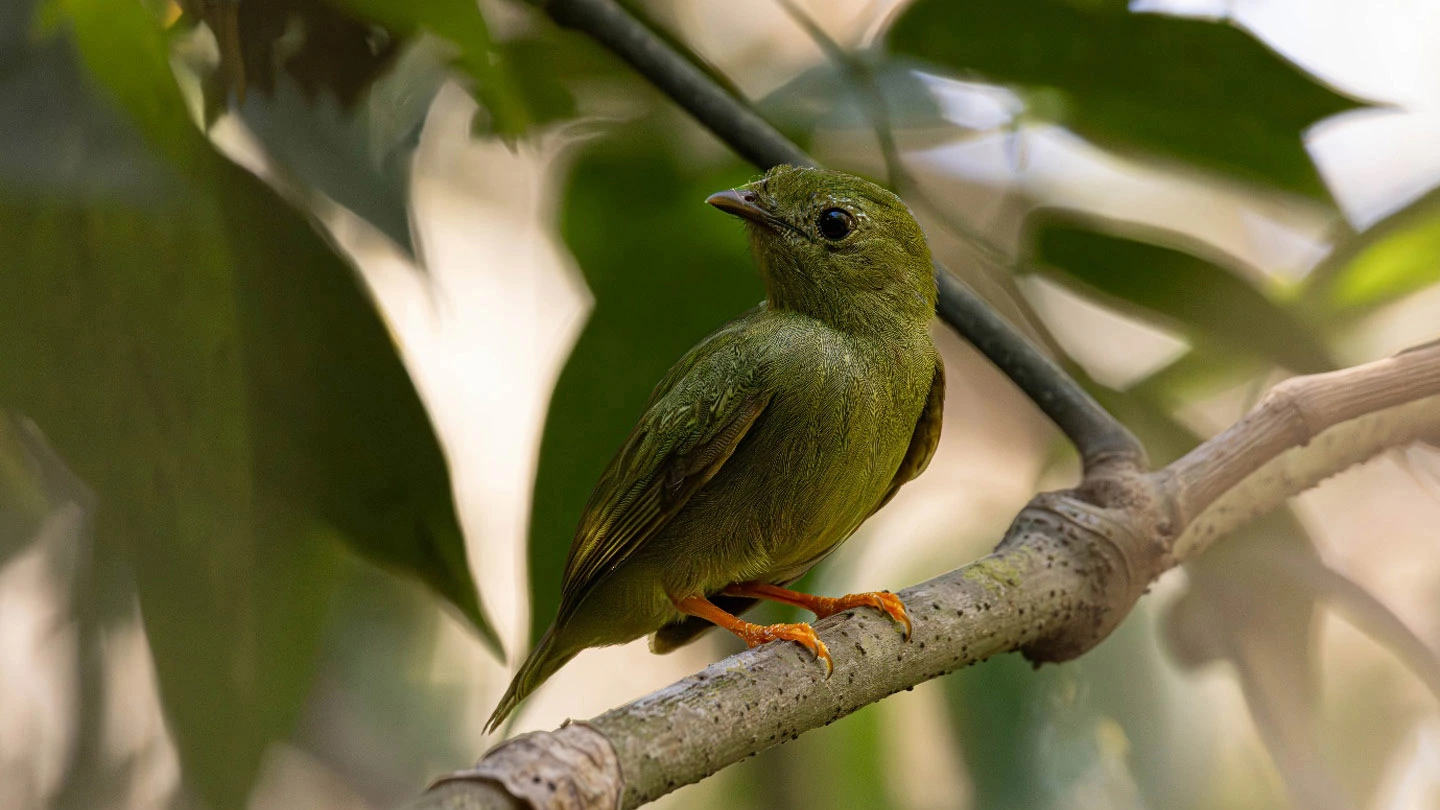
Image caption: Fruit-rich diets may have laid the foundation for the evolution of colorful plumage and elaborate courtship in Manakins
Image credit: Esteban Mendez from Isla Boca Brava, Panama
License type: Original content
Usage restrictions: Cannot be used without permission.
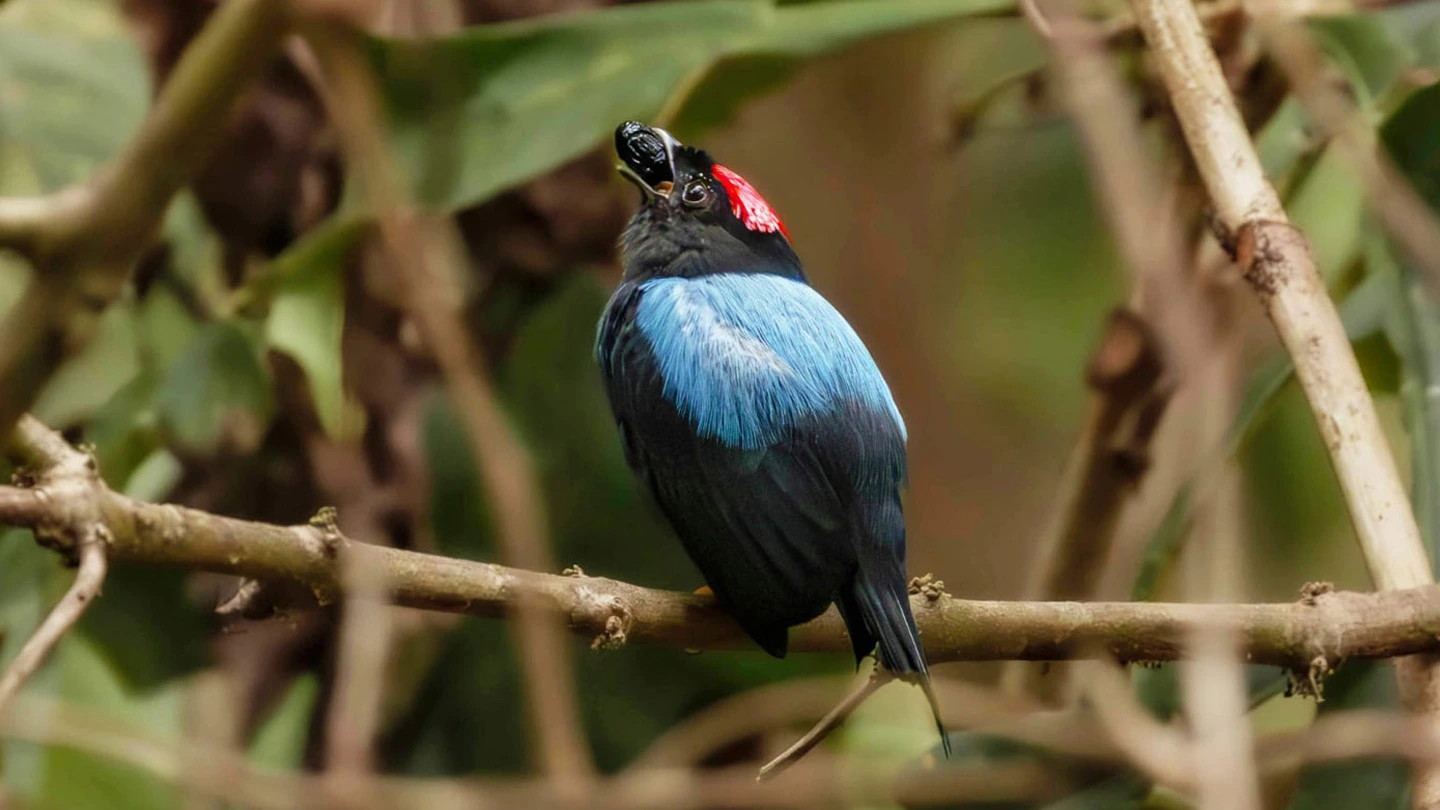
Image caption: Male manakins tend to display complex mating behaviors and have vibrant plumage
Image credit: Esteban Mendez from Isla Boca Brava, Panama
License type: Original content
Usage restrictions: Cannot be used without permission.
Reference
- Authors:
- Christopher N. Balakrishnan1,2,3, Yasuka Toda4,5, Meng-Ching Ko6, Morgan E. Wirthlin7,8,9, Robert J. Driver1,10, Peri E. Bolton1,3, Eliot T. Miller11,12,58, Daniel Mendez-Aranda6,13, Rebecca B. Dikow14, Paul B. Frandsen15, Elsie H. Shogren16,17, Kevin F.P. Bennett3,18, H. Luke Anderson3,19, Madeline G. Bursell15,20, Julia F. Cramer6, Keren R. Sadanandan6,21, Tomoya Nakagita4, Marco A. Pizo22, Daniel S. Caetano23, Marina Anciaes24, Carolina F. Ferreira25, Jacob S. Berv26,27, Kira M. Long28,29, Haw Chuan Lim30, Andre E. Moncrieff31,32, Sarah E. Kingston33, Noor D. White Carreiro3,34, Samantha R. Friedrich8, Camilo Alfonso Cuta35, James B. Pease17,36, Alexander A. Nevue8, Chad Tomlinson37, Aleksey Zimin38, Matthew I.M. Louder1, Michael S. Brewer1, Rachael A. Bay39, Kristen Ruegg40, Thomas B. Smith41,42, Yoshiro Ishimaru4, Andreas R. Pfenning7, Carolina Frankl-Vilches43, Manfred Gahr43, Claudio V. Mello8, Rebecca T. Kimball44, Edward L. Braun44, John G. Blake45,46, Lainy B. Day47, T. Brandt Ryder48,49, Ignacio T. Moore35, Brent M. Horton50, Barney A. Schlinger41,51,52, Matthew J. Fuxjager53, Wesley C. Warren54, Emily H. DuVal55, W. Alice Boyle16,56, Bette A. Loiselle45,46,57, Michael J. Braun3,18, and Maude W. Baldwin6*
- Title:
- Genomic and physiological changes in a sexually selected and frugivorous bird radiation
- Journal:
- Current Biology
- Affiliations:
- 1Department of Biology, East Carolina University, Greenville, USA
2Division of Environmental Biology, National Science Foundation, USA
3Department of Vertebrate Zoology, National Museum of Natural History, Smithsonian Institution, USA
4Department of Agricultural Chemistry, School of Agriculture, Meiji University, Japan
5School of Life Science and Technology, Institute of Science Tokyo, Japan
6Evolution of Sensory and Physiological Systems Department, Max Planck Institute for Biological Intelligence, Germany
7Department of Computational Biology, School of Computer Science & Neuroscience Institute, Carnegie Mellon University, USA
8Department of Behavioral Neuroscience, Oregon Health & Science University (OHSU), USA
9Allen Institute, Seattle, USA
10Duke University, Durham, USA
11Center for Avian Population Studies, Cornell Lab of Ornithology, USA
12American Bird Conservancy, USA
13Molecular Physiology of Somatic Sensation Laboratory, Max Delbrück Center for Molecular Medicine in the Helmholtz Association (MDC), Germany
14Yale Library, Yale University, USA
15Department of Plant and Wildlife Sciences and Bean Life Science Museum, Brigham Young University, USA
16Division of Biology, Kansas State University, USA
17Department of Biology, Wake Forest University, USA
18Department of Biology and Biological Sciences Graduate Program, University of Maryland, USA
19Department of Ecology & Evolutionary Biology, Tulane University, USA
20Bioinformatics Research Center, North Carolina State University, USA
21Department of Biological Sciences, National University of Singapore, Singapore
22Center for Research on Biodiversity and Climate Change (CBioClima), Department of Biodiversity, São Paulo State University (UNESP), Brazil
23Department of Biological Sciences, Towson University, USA
24Biodiversity Coordination, National Institute of Amazon Research (INPA), Brazil
25Graduate Program in Genetics, Conservation and Evolutionary Biology (GCBv), National Institute of Research in the Amazon (INPA), Brazil
26Department of Ecology and Evolutionary Biology, University of Michigan, USA
27Museum of Paleontology, University of Michigan, USA
28Program in Ecology, Evolution, and Conservation Biology, University of Illinois Urbana-Champaign, USA
29Center for Conservation Genomics, Smithsonian National Zoo and Conservation Biology Institute, USA
30Department of Biology, George Mason University, USA
31Department of Biological Sciences and Museum of Natural Science, Louisiana State University, USA
32Center for Conservation Genomics, Smithsonian National Zoo and Conservation Biology Institute, USA
33Sea Education Association, USA
34Biological Imaging Core, National Eye Institute, National Institutes of Health, USA
35Department of Biological Sciences, USA
36Department of Evolution, Ecology, and Organismal Biology, The Ohio State University, USA
37McDonnell Genome Institute, Washington University, USA
38Department of Biomedical Engineering, Johns Hopkins University, USA
39Department of Evolution and Ecology, University of California, USA
40Department of Biology, Colorado State University, USA
41Department of Ecology and Evolutionary Biology, University of California, USA
42Center for Tropical Research, Institute of the Environment and Sustainability, University of California, USA
43Department of Behavioural Neurobiology, Max Planck Institute for Biological Intelligence, Germany
44Department of Biology, University of Florida, USA
45Department of Wildlife Ecology and Conservation, University of Florida, USA
46Estación de Biodiversidad Tiputini, Colegio de Ciencias Biológicas y Ambientales, Universidad San Francisco de Quito, Ecuador
47Department of Biology & Neuroscience Minor, University of Mississippi, USA
48Bird Conservancy of the Rockies, USA
49Smithsonian Conservation Biology Institute, Migratory Bird Center, USA
50Department of Biology, Millersville University, USA
51Department of Integrative Biology and Physiology, University of California, USA
52Smithsonian Tropical Research Institute, Panama
53Department of Ecology, Evolution, and Organismal Biology, Brown University, USA
54Bond Life Sciences Center, Department of Animal Sciences, Department of Surgery, School of Medicine, Institute for Data Science and Informatics, University of Missouri, USA
55Department of Biological Sciences, Florida State University, USA - 56Department of Biology, University of Western Ontario, Canada
57Center for Latin American Studies, University of Florida, USA
Related articles
Further information
Associate Professor Yasuka Toda
School of Life Science and Technology, Institute of Science Tokyo
- toda.y.e867@m.isct.ac.jp
Contact
Public Relations Division, Institute of Science Tokyo
- media@adm.isct.ac.jp
- Tel
- +81-3-5734-2975