Ru/BaSiN2:O: an air-stable catalyst powered by floating electrons
The catalyst belongs to a class of materials known as electrenes and could enable sustainable ammonia production under mild conditions
A surface electrene, BaSiN2:O, developed by researchers at Science Tokyo enables efficient ammonia synthesis under mild conditions while overcoming the long-standing air instability of electrene materials. Synthesized by doping barium silicon nitride with oxygen, the material forms a stable layer of freely floating electrons on its surface. When combined with ruthenium, it delivers exceptionally high ammonia synthesis activity, paving the way for sustainable ammonia production and practical applications of electrene materials.
Air-Stable Surface Electrene Enables Efficient Low-Temperature Ammonia Synthesis
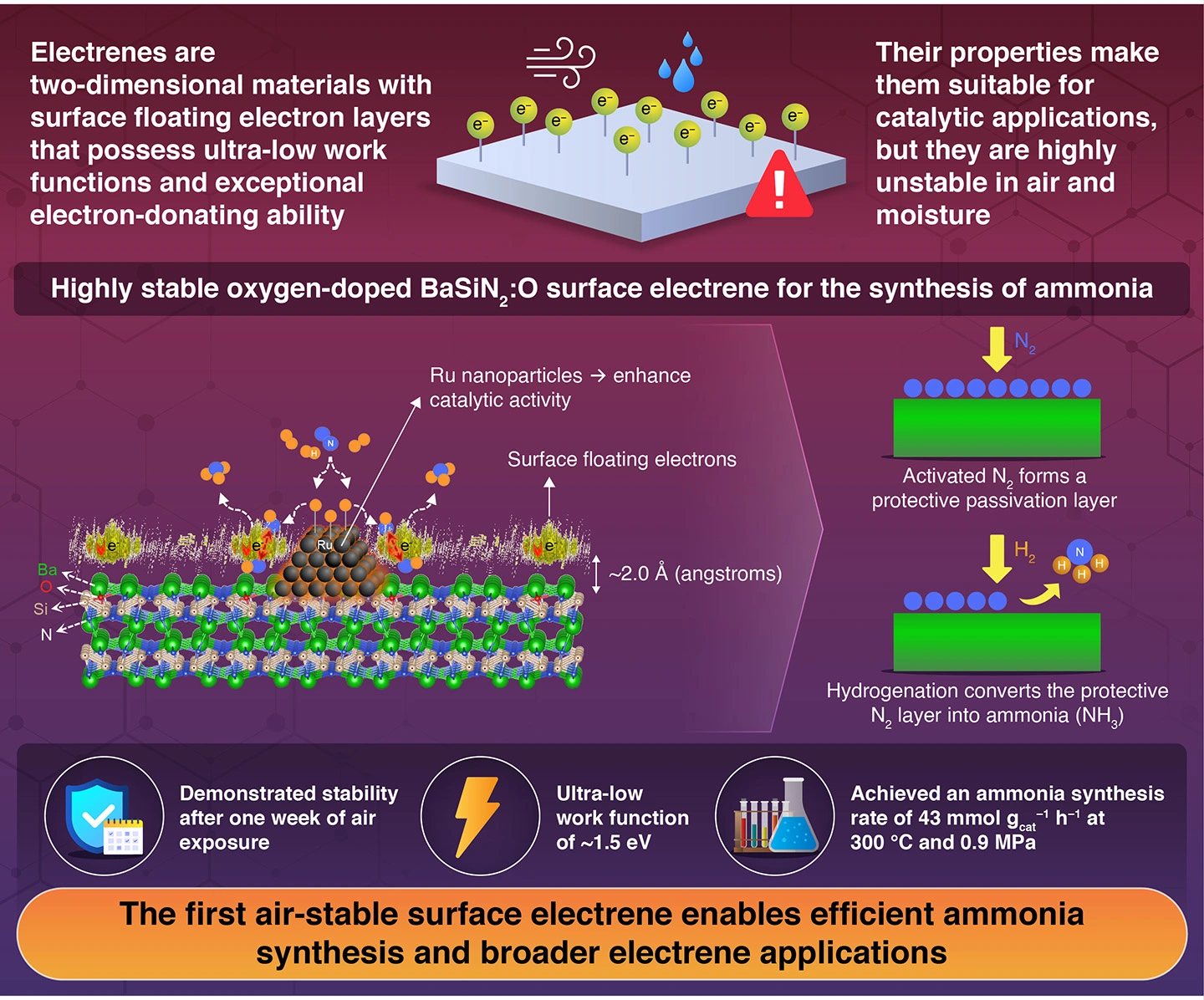
Electrenes are a class of unique two-dimensional materials that feature a freely floating layer of electrons on their surface. This characteristic gives them an ultralow work function, meaning they can easily donate electrons, making them highly promising catalysts for chemical reactions. One promising application is in the synthesis of ammonia, which currently requires extreme conditions, specifically high temperatures and high pressures, to break the strong bond of dinitrogen (N2). However, conventional electrenes are extremely sensitive to air and moisture, which rapidly degrades their catalytic performance.
To address this limitation, a research team led by Professor Hideo Hosono from the MDX Research Center for Element Strategy, Institute of Science Tokyo (Science Tokyo), Japan, has developed the first air-stable surface electrene. The team also included Assistant Professor Zhujun Zhang, (now at Nanjing Tech University, China) and Professor Masaki Kitano from Science Tokyo. The study was published online in the journal Nature Communications on June 23, 2026. The team introduced a small amount of oxygen into barium silicon nitride (BaSiN2), which resulted in the production of BaSiN2:O. This electrene can stably catalyze ammonia synthesis under relatively mild reaction conditions.
"To the best of our knowledge, BaSiN2:O represents the first-ever example of an air-stable surface electrene. It opens a new pathway towards highly efficient and robust catalysts for sustainable ammonia production, as well as broader applications of electrene-based materials in chemistry, energy, and electronics," says Hosono.
Replacing a small number of surface nitrogen atoms with oxygen creates a stable layer of floating electrons, giving the material an ultralow work function of about 1.5 eV, lower than that of cesium, and an electron layer that extends about 2 angstrom (10–10 m) beyond the surface. The material possesses a self-protection mechanism. When exposed to nitrogen gas, its surface electrons spontaneously transfer to N2 molecules, forming a chemically adsorbed nitrogen layer that coats and protects the surface. This passivation layer gives the material its remarkable resistance to air. This protective layer is removed by treating the material with hydrogen, which converts the activated nitrogen into ammonia. This restores the floating electrons on the surface, allowing the cycle to repeat without damaging the catalyst.
While BaSiN2:O could activate nitrogen molecules, it was less effective at activating hydrogen. To address this limitation, the researchers added ruthenium (Ru) nanoparticles, which improve hydrogen activation and allow the activated nitrogen to be converted into ammonia much more efficiently. The resulting Ru/BaSiN2:O catalyst achieved an ammonia synthesis rate of 43 mmol g-1 h-1 at 300 °C and 0.9 MPa, outperforming previously reported electride-, hydride-, and conventional Ru-based catalysts under similar low-temperature conditions. Moreover, the material was highly stable, retaining its crystal structure after 1 week of air exposure and maintaining its catalytic activity even after repeated cycles of air exposure.
The researchers say their findings provide a new strategy for designing electrene materials that combine high catalytic activity with long-term chemical stability. By using oxygen doping and a reversible nitrogen passivation process, they overcame one of the challenges that has limited the practical use of electrenes, paving the way for their use in practical applications.
"Our work not only discovers a new type of surface electrene with significant potential for diverse applications in physics and electronics but also demonstrates a novel catalyst that combines high activity with air stability for the efficient synthesis of green ammonia at low temperatures and pressures," says Hosono.
Reference
- Authors:
- Zhujun Zhang1,2,3, Shiyao Wang3, Jiang Li3, Masato Sasase3, Masaaki Kitano3,4, and Hideo Hosono3,5
- Title:
- Creation of an air-stable surface electrene and its application to ammonia synthesis
- Journal:
- Nature Communications
- Affiliations:
- 1College of Chemical Engineering, Nanjing Tech University, China
2Suzhou National Laboratory, China
3Institute of Integrated Research, Institute of Science Tokyo, Japan
4Advanced Institute for Materials Research (WPI-AIMR), Tohoku University, Japan
5MANA Center, National Institute for Materials Science, Japan
Related articles
Further information
Honorary and Institute Professor Hideo Hosono
Institute of Integrated Research, Institute of Science Tokyo
Contact
Public Relations Division, Institute of Science Tokyo
- media@adm.isct.ac.jp
- Tel
- +81-3-5734-2975