Aperture-tuning antenna keeps 5G signals strong across wider frequencies
The antenna design optimizes signal radiation across the 57–71 GHz 5G band, aiding the development of future ultra-high-speed communication
A compact aperture-adjustable antenna developed by researchers at Science Tokyo could improve high-speed wireless communication across the wide 5G millimeter-wave frequency bands without increasing power consumption. The system maintained strong performance across 57–71 GHz band, improved signal strength by up to 62.2% at 57 GHz and 47.9% at 71 GHz, and achieved data transmission speeds of up to 56 Gb/s. These could support future Beyond 5G and 6G applications, including XR and data-intensive technologies.
Broadband Aperture-Tuning Antenna for High-Speed 5G Millimeter-Wave Communication
High-speed wireless communication has become an essential part of daily life. Activities such as video conferencing, streaming services, cloud computing, and connected smart devices all depend on the rapid transfer of large amounts of data. Future applications such as extended reality (XR), digital twins, and immersive virtual environments are expected to place even greater demands on wireless networks, requiring faster and more reliable connections that can operate with moderate power consumption.
To support this demand, 5G networks are increasingly relying on high-frequency millimeter-wave bands, which can carry significantly more information than conventional wireless frequencies. One important band, the 5G NR FR2-2 n263 band, operates between 57 and 71 gigahertz (GHz) and supports high-speed communication. However, building hardware that can work efficiently across this wide frequency range remains a challenge, as most wireless systems perform best around a central frequency and often struggle near the edges of a wide operating band.
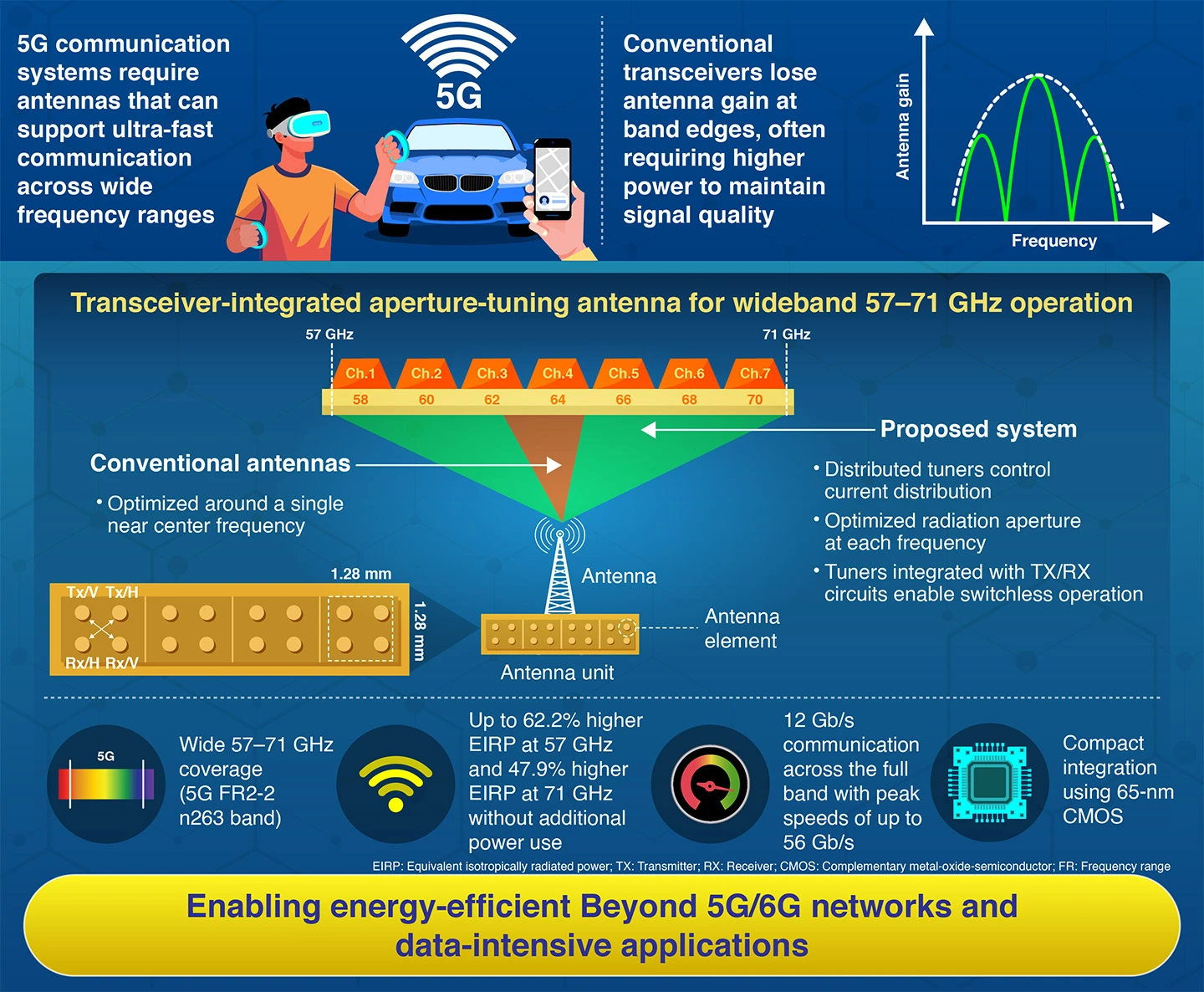
Now, a research team led by Professor Kenichi Okada from the Department of Electrical and Electronic Engineering at Institute of Science Tokyo (Science Tokyo), Japan, has developed a 60-GHz-band aperture-adjustable antenna integrated with a transceiver that can optimize how the antenna radiates signals at different frequencies. By adjusting its effective radiation aperture through changes in current distribution inside the antenna, the system maintains strong performance across the wide 57–71 GHz band, while improving signal performance without additional power consumption.
The results are scheduled to be presented at the 2026 IEEE/JSAP Symposium on VLSI Technology & Circuits, to be held in Honolulu from June 14 to June 18, 2026.
Most wireless systems are designed to work best around a central frequency, but performance drops at frequencies toward the band edges. To compensate, systems usually need to increase transmit power, which raises energy consumption. "Conventional wireless transceivers tend to suffer from degraded antenna gain and efficiency at the band edges away from the center frequency. Consequently, maintaining communication quality requires increased transmit power, leading to high power consumption," says Okada.
Traditional antenna tuning mainly relies on impedance tuning, which improves how efficiently power enters the antenna but usually works over a limited frequency range. The proposed system instead uses 60-GHz-band aperture tuning, which optimizes how the antenna radiates signals by changing the current distribution inside the antenna to improve performance at different frequencies.
The antenna and transceiver were fabricated using a standard 65-nanometer CMOS process and include multiple tuners integrated into the transmitter and receiver matching circuitry. The system uses a "cross-active" tuning arrangement that removes the need for additional switching hardware. During transmission, receiver-side tuners adjust the antenna’s radiation properties, while in receive mode, the arrangement is reversed, reducing complexity and saving space.
In tests using a 2 GHz bandwidth 64-QAM (64-quadrature amplitude modulation) signal, a modulation scheme widely used in 5G for high-data-rate transmission, the system achieved a data rate of 12 Gb/s (gigabits per second) across the entire 57–71 GHz frequency range. In addition, using a 14-GHz-bandwidth signal with 16-QAM modulation, the system achieved a peak data rate of 56 Gb/s.
The aperture-tuning system also improved equivalent isotropically radiated power (EIRP)—a measure of signal strength that combines transmit power and antenna gain—by up to 62.2% at 57 GHz and 47.9% at 71 GHz, which are the lower and upper-band-edge frequencies, without increasing power consumption.
Such a system, which is compact, energy-efficient, and capable of high-speed communication across a wide frequency range, could be integrated into 5G base stations, user devices, and future 6G infrastructure. "These results enable efficient utilization of the wide bandwidth available in 5G millimeter-wave systems. The technology is expected to contribute to Beyond 5G/6G wireless infrastructure and next-generation services such as high-definition XR," says Okada.
This work is partially supported by National Institute of Information and Communications Technology (NICT) in Japan (JPJ012368C00801).
Reference
- Authors:
- Minghao Fan, Yilun Chen, Zheng Li, Ziyuan Ren, Minzhe Tang, Junqing Liu, Yuxuan Liu, Dongfan XU, Zezheng Liu, Yudai Yamazaki, Sena Kato, Kazuaki Kunihiro, Hiroyuki Sakai, Yuncheng Zhang, and Kenichi Okada*
*Corresponding author - Title:
- A 57–71-GHz CMOS Phased-Array Transceiver with Aperture-Tuning Antenna Achieving 47.9–62.2% EIRP Efficiency Improvement
- Journal:
- Proceedings of 2026 IEEE/JSAP Symposium on VLSI Technology & Circuits
- Affiliations:
- Department of Electrical and Electronic Engineering, Institute of Science Tokyo, Japan
Related articles
Further information
Professor Kenichi Okada
School of Engineering, Institute of Science Tokyo
- okada@ee.eng.isct.ac.jp
Contact
Public Relations Division, Institute of Science Tokyo
- media@adm.isct.ac.jp
- Tel
- +81-3-5734-2975