How plants selectively silence jumping genes while protecting essential genes
Researchers reveal how histone variants direct DNA methylation to jumping genes while preventing accidental gene silencing
Histone variants help establish DNA methylation at transposons (jumping genes) while preventing this epigenetic modification from spreading to essential genes in plants, reveals a study from Institute of Science Tokyo. By revealing how these chromosome-associated proteins guide the formation of precise epigenomic patterns, the findings provide new insights into the selective silencing of transposons, laying the groundwork for future epigenome-editing technologies for crop improvement and disease research.
How Histone H2A Variants Shape Plant Epigenomes
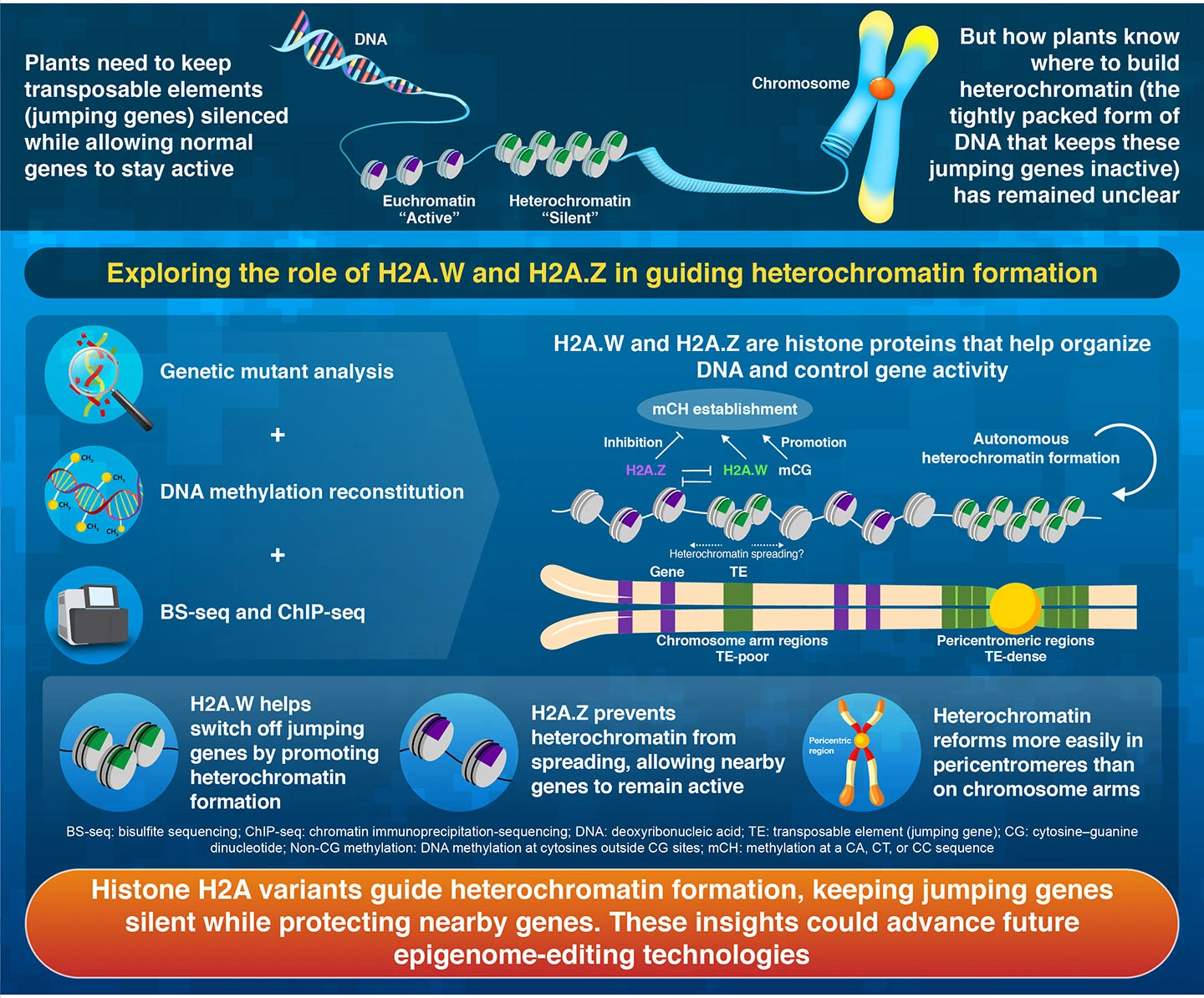
Plants and animals have multiple transposons or “jumping genes” in their genome. These are mobile DNA elements that are capable of moving to new locations within the genome. Although transposons have contributed to genome evolution, their movement can disrupt genes and compromise genome stability, leading to diseases such as cancer. To prevent this, organisms often rely on epigenetic mechanisms (cellular processes such as DNA methylation that control gene expression without changing the underlying DNA sequence) to keep these transposons inactive.
But as both transposons and essential genes coexist within the same genome, an important question arises: How do cells selectively target transposons without accidentally silencing essential genes?
To address this question, a research team led by Associate Professor Taiko Kim To and Dr. Shoda Oda from the Department of Life Science and Technology, School of Life Science and Technology, Institute of Science Tokyo (Science Tokyo), Japan, along with colleagues and researchers from The University of Tokyo, Japan; Chiba University, Japan; Kyoto Sangyo University, Japan; and Vienna Biocenter, Austria, investigated the role of histone variants (slightly different forms of the histone proteins around which DNA is wrapped) in establishing DNA methylation. Their findings were published online in the journal Nature Communications on June 30, 2026.
Using genetically engineered mutants of the model plant Arabidopsis thaliana lacking specific histone variants, the researchers restored DNA methylation through selective regulation and tracked how epigenetic patterns were re-established across the genome under different histone variant compositions. The experiments revealed that the histone variant H2A.W promotes DNA methylation at transposons, facilitating their inactivation. In contrast, H2A.Z suppresses DNA methylation and is enriched in gene regions, where it protects important genes from being mistakenly silenced.
"We observed that these opposing functions were particularly evident in gene-rich regions of the genome, where accurate epigenetic regulation is especially critical," explains To.
The findings demonstrate that histone variants act as molecular guides that determine where DNA methylation should be established, by enabling plants to selectively inactivate the transposons while preserving normal gene activity. Additionally, the study also reveals that the genomic environment influences how epigenetic patterns are restored. In chromosome arms that are rich in essential genes, the transposons are dispersed among the genes. Here, the opposing actions of H2A.W and H2A.Z are crucial for accurately re-establishing the DNA methylation.
In contrast to this, heterochromatin (the tightly packed form of DNA that keeps transposons inactive) was recovered much more robustly in transposon-rich pericentromeric regions, suggesting that these regions possess an intrinsic ability to re-establish their silenced state. These findings show that plants use complementary strategies to maintain genome stability by combining local molecular guidance by histone variants with autonomous recovery of heterochromatin in transposon-dense regions.
Overall, the study uncovers a molecular framework that enables plant cells to distinguish transposons from genes, ensuring precise epigenetic regulation across the genome. Since the functions of histone variants are often conserved across evolution, the researchers suggest that the mechanism uncovered in plants may also help explain how epigenetic regulation is achieved in other organisms as well. The findings, therefore, provide a broader framework for understanding genome regulation beyond the plant kingdom.
“Although our work was carried out in plants, histone variants are conserved across many organisms,” adds To. "This knowledge could inspire future epigenome-editing technologies for agriculture and medicine."
Reference
- Authors:
- Shoko Oda1,2, Sayaka Tominaga1,2, Shumpei Takeuchi1,2, Akihisa Osakabe2,3,4, Akira Kawabe5, Frédéric Berger6, Tetsuji Kakutani2, and Taiko Kim To1,2*
- Title:
- Antagonistic histone H2A variants and autonomous heterochromatin formation shape epigenomic patterns in Arabidopsis
- Journal:
- Nature Communications
- Affiliations:
- 1School of Life Science and Technology, Institute of Science Tokyo, Japan
2Department of Biological Sciences, The University of Tokyo, Japan
3Department of Biology, Chiba University, Japan
4Institute for Advanced Academic Research, Chiba University, Japan
5Faculty of Life Sciences, Kyoto Sangyo University, Japan
6Gregor Mendel Institute (GMI), Vienna Biocenter (VBC), Austria
*Corresponding author
Related articles
Further information
Associate Professor Taiko Kim To
School of Life Science and Technology, Institute of Science Tokyo
- to.t.1057@m.isct.ac.jp
Contact
Public Relations Division, Institute of Science Tokyo
- media@adm.isct.ac.jp
- Tel
- +81-3-5734-2975