A new catalyst that redefines ammonia decomposition
A new strategy targeting the most difficult step in the reaction
What the research is about
One of the most important chemical technologies that has supported modern society is the Haber–Bosch process. This method produces ammonia (NH₃) by reacting nitrogen (N₂) from the air with hydrogen (H₂), and it plays an essential role in fertilizer production.
Today, attention is turning to the reverse reaction: breaking down ammonia to extract hydrogen. Ammonia has a strong, pungent smell, but it is rich in hydrogen and easy to liquefy, making it convenient for storage and transport. As hydrogen gains attention as a clean energy source, ammonia is expected to serve as an efficient hydrogen carrier and a key component in realizing a hydrogen-based energy society.
However, there has been a major challenge. To efficiently extract hydrogen from ammonia, the nitrogen–hydrogen bonds must first be broken. Then, nitrogen atoms must leave the catalyst surface by forming nitrogen molecules (N₂). This final step requires a large amount of energy because it involves breaking the bond between nitrogen and the catalyst.
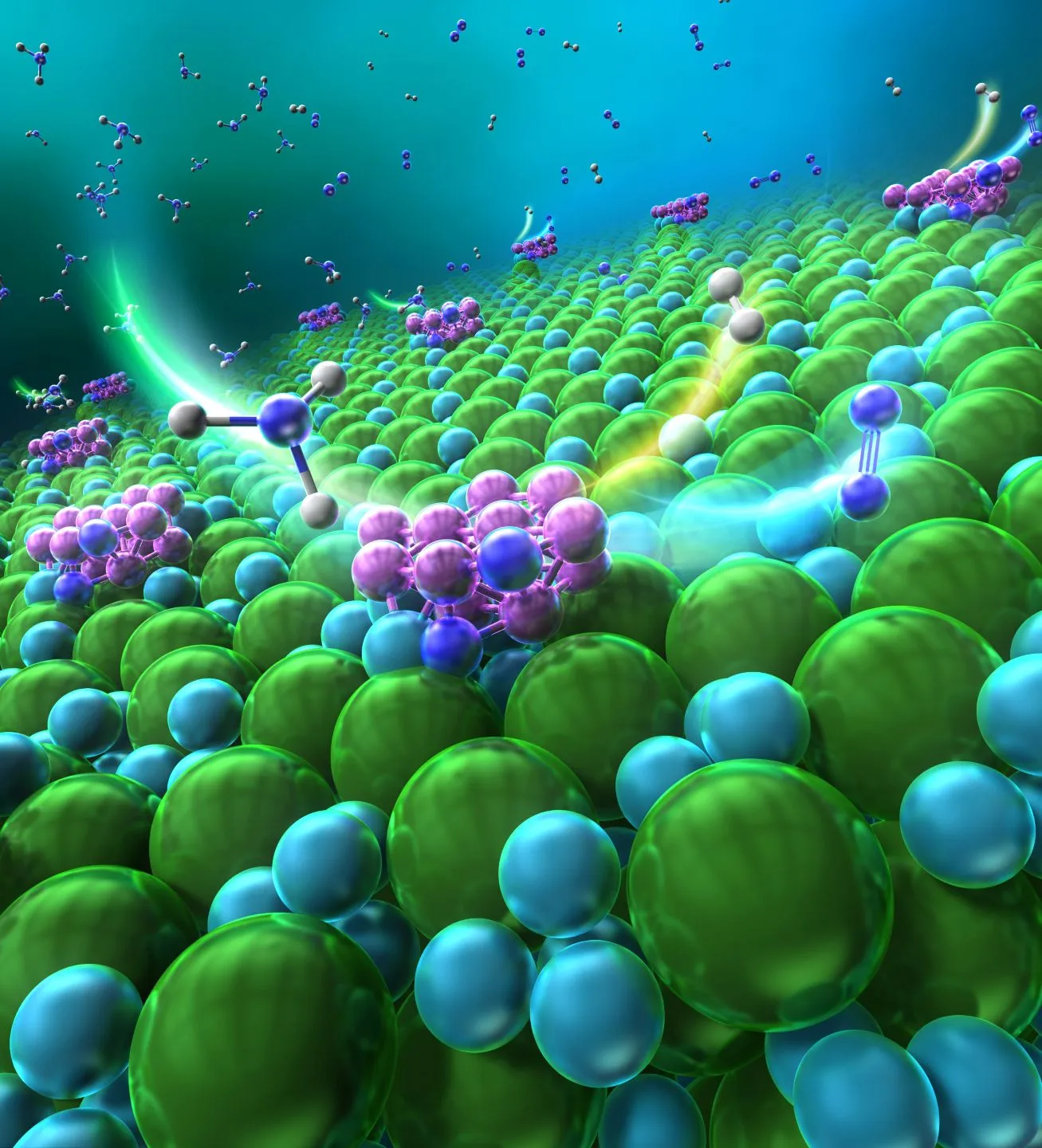
Cover artwork by Masaaki Kitano. Courtesy of the American Chemical Society.
Although many studies have attempted to promote this reaction using metal catalysts such as nickel and cobalt, temperatures above 650 ℃ were required to achieve sufficient hydrogen production.
Ruthenium, an expensive metal, can enable the reaction at lower temperatures, but its high cost limits practical use. To address this issue, Professor Masaaki Kitano of Institute of Science Tokyo (Science Tokyo) explored whether hydrogen could be efficiently extracted using more affordable metals. His team focused on a unique material called barium silicide (BaSi₂). Because BaSi₂ contains barium (Ba), which can easily donate electrons, it was expected to lower the energy barrier for nitrogen recombination and enable efficient hydrogen production at lower temperatures.
Why this matters
Conventional catalyst research has mainly focused on how to accelerate reactions occurring on metal surfaces. As a result, many studies have aimed to improve catalytic performance by controlling the structure of metal surfaces.
In contrast, this study took a different approach. Instead of focusing on conventional approaches, the researchers targeted the most difficult step in the reaction: the recombination of nitrogen atoms. They aimed to create a new type of active site where nitrogen atoms can combine more easily. This step is the main reason why the reaction does not proceed efficiently at low temperatures.
To investigate this, the research team examined where nitrogen recombination occurs and carefully studied the combination of metals and BaSi₂. They discovered that at the interface between the metal and BaSi₂, a special state is formed in which metal, nitrogen, and barium are bonded together. This state is known as a “ternary transition metal nitride intermediate.”
This unique structure significantly lowers the energy required for nitrogen atoms to combine, as demonstrated through both experiments and theoretical calculations.
As a result, even when using nickel, the catalyst achieved nearly 100% ammonia decomposition at 580 °C—performance comparable to that of ruthenium-based catalysts.
What’s next
This achievement represents an important step toward a hydrogen-based energy society. By enabling hydrogen production using abundant and inexpensive elements, it makes energy storage and transportation more practical.
Moreover, the idea that reactions occur at the “interface” between materials provides a new perspective for catalyst design. Traditionally, metal surfaces were considered the main active sites. However, this study shows that intermediate states formed at material interfaces can play a crucial role. This innovative concept opens new possibilities for designing catalysts that operate efficiently at lower temperatures.
Comment from the researcher
While technologies for producing ammonia have supported society, technologies for extracting hydrogen from ammonia will become increasingly important. BaSi₂ has rarely been studied as a catalyst before, but by focusing on its unique electronic structure, we discovered its potential. We believe that thinking beyond conventional ideas will lead to new directions in catalyst design.
(Masaaki Kitano, Professor, MDX Research Center for Element Strategy, Institute of Science Tokyo)

Dive deeper



Contact
Research Support Service Desk