A new strategy for synthesizing polyfunctionalized biaryls without transition-metal catalysts
An innovative substrate design strategy enables efficient synthesis of polyfunctionalized biaryls without expensive transition-metal catalysts or multistep prefunctionalization
Researchers at the Institute of Science Tokyo have developed a simple and efficient method for synthesizing polyfunctionalized biaryls without transition-metal catalysts or complex multistep prefunctionalization. Through an innovative substrate design strategy, the researchers achieved a benzidine-type sigmatropic rearrangement of nitroarenes that efficiently produces the desired biaryls in high yields. This approach offers precise control over the reaction pathway, enabling the synthesis of diverse organic compounds, thereby benefiting many industries.
A New Scalable Strategy for the Synthesis of Polyfunctionalized Biaryls
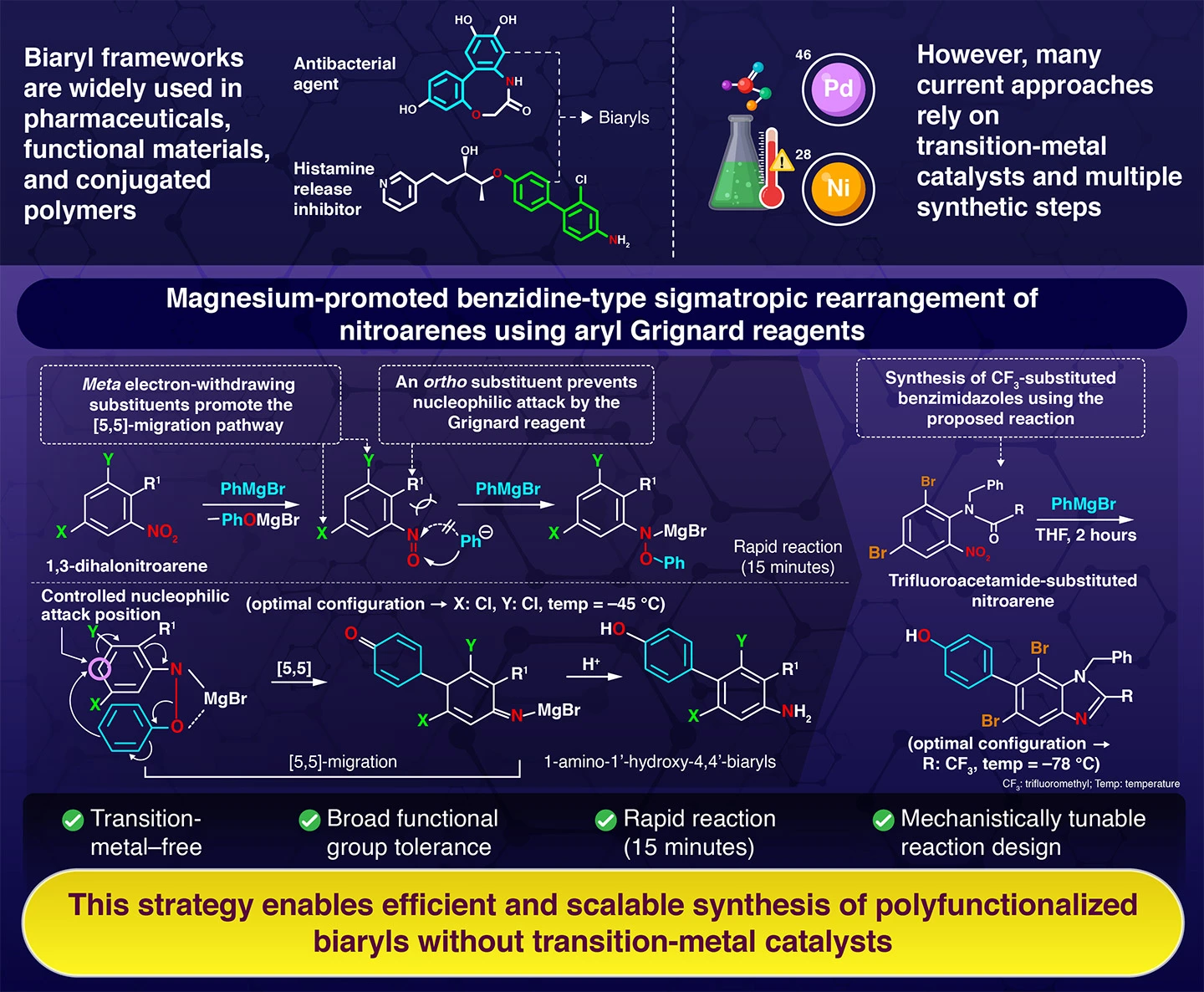
Biaryl molecular frameworks are fundamental structural units found in many biologically active compounds, including pharmaceuticals, functional materials, and conjugated polymers. Key examples include antibacterial agents, histamine release inhibitors, and HCV inhibitors. Their importance stems from their ability to modulate molecular geometry, electronic distribution, and intermolecular interactions, thereby strongly influencing biological activity. As a result, the development of efficient and general methods for constructing biaryls is a central topic in organic chemistry.
Many widely used methods for synthesizing compounds with biaryl motifs rely on precious and sensitive transition-metal catalysts, such as palladium and nickel, as well as intricate functional groups and multiple reaction steps. In addition, the need for high temperatures, external oxidants, or strong bases limits general applicability and raises sustainability concerns. These challenges have prompted researchers to explore more sustainable, transition-metal-free synthesis approaches.
In a breakthrough, a research team led by Associate Professor Takeshi Hata, Professor Hideya Yuasa, Assistant Professor Takashi Kanamori, and Assistant Professor Tadaomi Furuta from the School of Life Science and Technology, Institute of Science Tokyo (Science Tokyo), Japan, along with Professor Satoru Karasawa and Assistant Professor Shota Matsumoto from Showa Pharmaceutical University, Japan, developed a simple new method for synthesizing polyfunctionalized biaryls by combining appropriately substituted nitroarenes with aryl Grignard reagents. Their study was published online in Chemistry – A European Journal on February 15, 2026.
"In this study, we demonstrated that rational substrate design can selectively promote a benzidine-type sigmatropic rearrangement of nitroarenes, enabling efficient synthesis of polyfunctionalized biaryls without the need for expensive transition-metal catalysts," explains Hata.
Benzidine-type sigmatropic rearrangements of nitroarenes typically occur only as minor side reactions, producing small amounts of the desired biaryl compounds. To transform this pathway into the dominant reaction, the researchers employed a new substrate design strategy. Specifically, they installed two electron-withdrawing halogen substituents at the meta positions of the nitroarene and introduced an appropriate substituent at the ortho position. This modification precisely controlled the electronic state and steric environment of the reaction intermediates, selectively promoting the benzidine-type sigmatropic rearrangement.
By converting a previously minor side reaction into the dominant pathway through substrate design, this study demonstrates a new strategy for controlling reaction pathways in organic synthesis.
Thus, by combining the modified nitroarene with aryl Grignard reagents at low temperatures, the researchers obtained the desired biaryl compounds in high yields without the use of transition-metal catalysts. Under the optimal conditions, five equivalents of aryl Grignard reagents were used at -45 °C, affording the desired product within 15 minutes.
The researchers also examined the effects of different substituents at the meta and ortho positions of the nitroarene. Their results showed that ortho substitution is a critical factor for the reaction, while the system supports a broad range of functional groups at both positions. Additionally, careful selection of substituted aryl Grignard reagents and groups at the ortho position of the nitroarene enabled controlled synthesis of diverse polyfunctionalized biaryls with complex structures that are difficult to obtain via conventional routes.
The researchers also found that trifluoroacetamide-substituted nitroarenes, instead of forming biaryls, undergo intramolecular cyclization after the rearrangement to produce trifluoromethyl-substituted benzimidazoles, which are highly valuable in medicinal chemistry.
"Our study establishes a mechanistically tunable and sustainable strategy for constructing valuable biaryl and benzimidazole frameworks," remarks Hata. "This approach provides precise control over the reaction pathway and may facilitate the synthesis of complex molecules and functional materials."
This innovative approach may contribute to the development of environmentally friendly synthetic methods for pharmaceuticals and other valuable organic materials, paving the way toward more sustainable industrial processes.
Reference
- Authors:
- Shumpei Saito1, Manato Ishida1, Yuki Busujima1, Miki Ebihara1, Kodai Kohama1, Naomi Tanaka1, Eitaro Toya1, Minami Nakamura1, Takashi Kanamori1, Tadaomi Furuta1, Shota Matsumoto2, Satoru Karasawa2, Hideya Yuasa1, and Takeshi Hata1*
*Corresponding author - Title:
- Magnesium-Promoted Benzidine-Type Rearrangement for Regioselective Construction of Polyfunctionalized Biaryls
- Journal:
- Chemistry – A European Journal
- Affiliations:
- 1Department of Life Science and Technology, School of Life Science and Technology, Institute of Science Tokyo, Japan
2Faculty of Pharmaceutical Sciences, Showa Pharmaceutical University, Japan
Related articles
Further information
Associate Professor Takeshi Hata
School of Life Science and Technology, Institute of Science Tokyo
- thata@life.isct.ac.jp
Contact
Public Relations Division, Institute of Science Tokyo
- media@adm.isct.ac.jp
- Tel
- +81-3-5734-2975